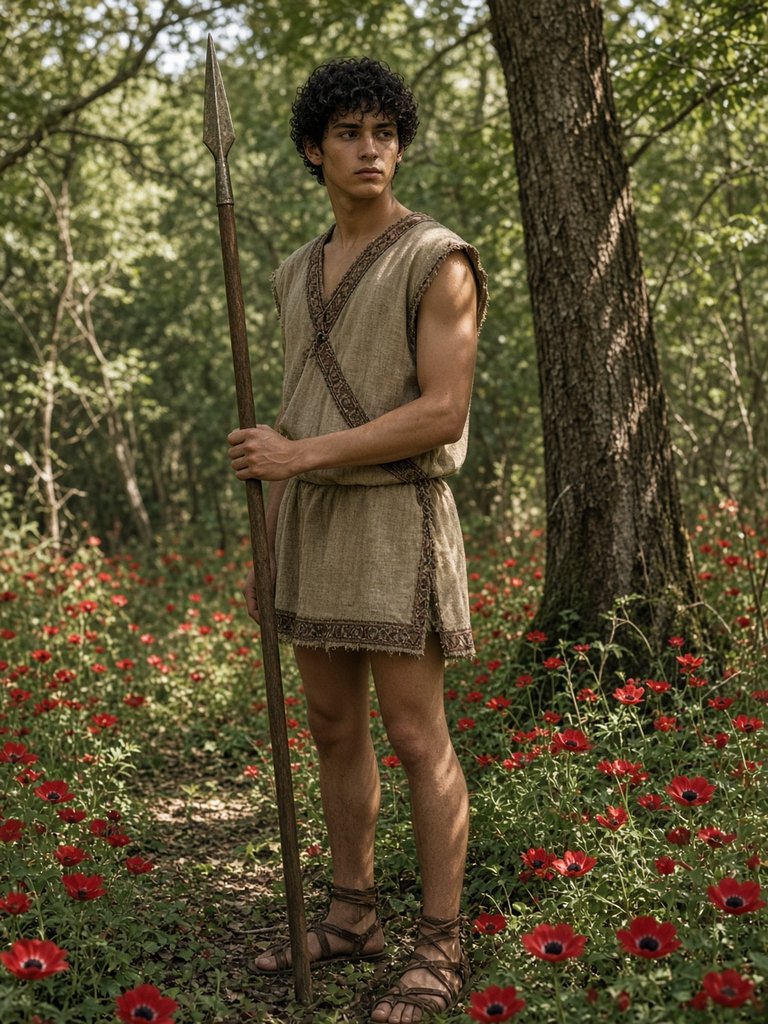
Adonis was a youth of such beauty that Aphrodite herself loved him. He was born from a myrrh tree, into which his mother Myrrha (or Smyrna) had been changed after she conceived him by her own father, a king of Cyprus or Assyria (Apollodorus 3.14.4; Ovid, Metamorphoses 10.298–518, paraphrased).
Aphrodite hid the infant in a chest and gave him to Persephone to keep, but Persephone would not give him back. Zeus divided the year: Adonis spent a third with Persephone, a third with Aphrodite, and a third as he chose (Apollodorus 3.14.4, citing Panyasis, paraphrased).
While hunting he was killed by a wild boar, and from his blood Aphrodite made the red anemone spring (Ovid, Metamorphoses 10.708–739, paraphrased). Women mourned him every summer at the Adonia, planting quick-withering gardens of Adonis in pots on the rooftops (Plato, Phaedrus 276b; Aristophanes, Lysistrata 389–398; Theocritus 15, paraphrased). His name comes from the Semitic word for lord.
Epithets
- Ἄδωνις · Adōnis
- from the Semitic adon, lord
Symbols and virtues
Beauty that flowers and dies with the season. Symbols: the anemone, the hunting spear, the gardens of Adonis.
Myths
- Born of the myrrh tree. Apollodorus 3.14.4; Ovid, Metamorphoses 10.298–518.
- Shared by two goddesses. Apollodorus 3.14.4.
- Death by the boar. Ovid, Metamorphoses 10.708–739.
Cult and places
- Athens and Byblos. The summer Adonia and the rites at Byblos (Plato, Phaedrus 276b; Lucian, On the Syrian Goddess 6–9).
Sources
Sappho, fragment 140; Plato, Phaedrus 276b; Theocritus 15; Apollodorus 3.14.4; Ovid, Metamorphoses 10.298–739; Lucian, On the Syrian Goddess 6–9.
Quotations in public-domain translations (Evelyn-White 1914, Butler 1898/1900, Taylor 1792); other authors paraphrased.