Why did the West forget this tradition while seeking the same goals in the East? See P.G., The Forgotten Ithaca: Hellenic Polytheism and the Eastward Turn of Western Spirituality since 1950 (2026).
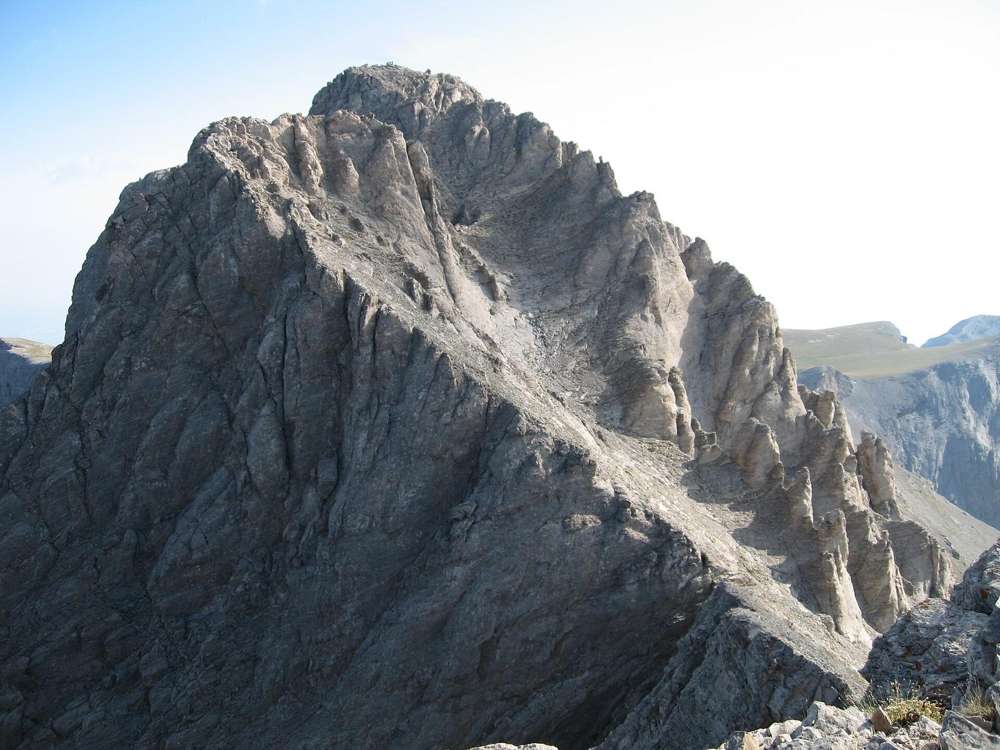
The Temple of the Hellenic Pantheon exists to restore the worship of the gods of Hellas, and with it the understanding that gave Greek and Roman civilization its form. We keep the sacred year, its rites, hymns and offerings. We rebuild, in stone, image and study, the temples, cities and works of art in which that worship lived. And we stand with the communities in Greece, Italy and around the world who have already begun this return.
The Ladder to Divinity (ἀναγωγή, anagōgē)
The ladder to divinity is the soul’s ordered ascent from the life of the body to union with the divine. It is the soul’s natural desire: having fallen from its divine source into birth, it longs to return home (Plotinus, Enneads IV.8, VI.9.9). The Neoplatonists called the ascent anagōgē (ἀναγωγή, “leading upward”). Plato pictures it in the Symposium as a climb “as if by steps” (ἐπαναβασμοῖς, epanabasmois), from beautiful bodies to beautiful souls, to beautiful knowledge, and at last to Beauty itself (211b–c). Its rungs are aretē, which purifies the soul; nous, which the purified soul awakens; and henōsis, union with the One. Theurgy, the work of the rites, is the means by which the gods help the soul climb.
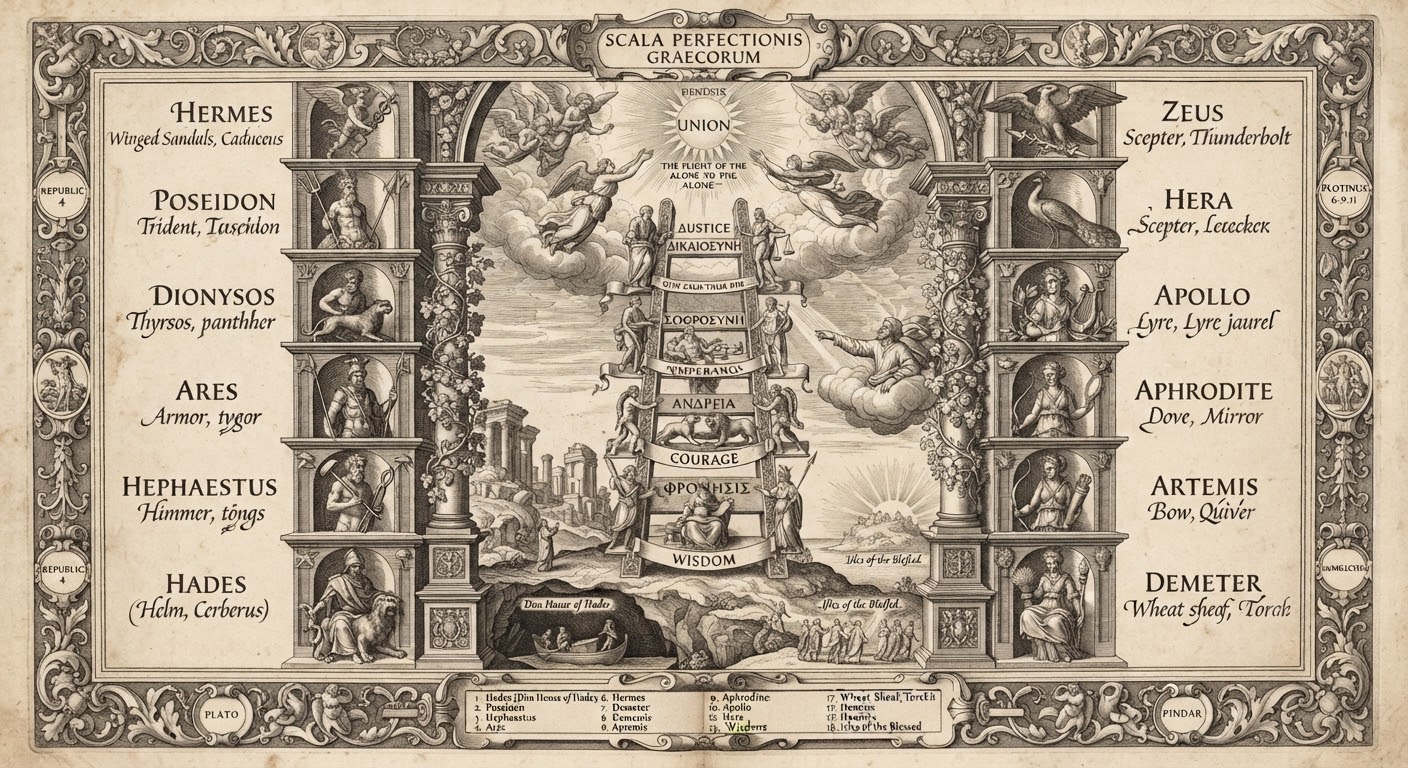
Theurgy is the work by which the soul, guided by the gods and heroes, rises through a life of aretē to awaken its nous and reach henōsis, union with the divine.
Nous. Nous (νοῦς, “mind” or “intellect”) is the highest power of the soul, the faculty that grasps truth directly rather than by reasoning step by step. Plato places it at the top of the Divided Line, where the soul, through noēsis, rises to first principles themselves (Republic VI, 511b–d), and in the Timaeus he makes it the ordering power of the cosmos, which can dwell in nothing apart from soul (30b). For the Neoplatonists, Nous is the second hypostasis, the divine Intellect that flows from the One and holds within itself the Forms.
Aretē. Aretē is excellence as virtue and virtue as excellence. For Plato, the aretē of anything is what lets it do its proper work well, as sight is the excellence of the eye, and the soul’s aretē is justice, by which it lives well (Republic I, 353b–e). Its parts are wisdom, courage, moderation and justice (Republic IV, 427e). Through aretē the soul is purified and made like the gods (Theaetetus 176b).
Henōsis. Henōsis (ἕνωσις, “union”) is the summit of the ascent: the soul’s union with the One, beyond thought and beyond all attributes. Plotinus ends the Enneads with it, “the flight of the alone to the alone” (VI.9.11), and his pupil Porphyry records that he reached it four times while they were together (Life of Plotinus 23). It is the Hellenic counterpart of the Eastern goals; see Nirvana and Henosis.
In the following section we show the method that links these steps together: a ladder to divinity, from aretē through nous to henōsis, climbed with the help of the gods.