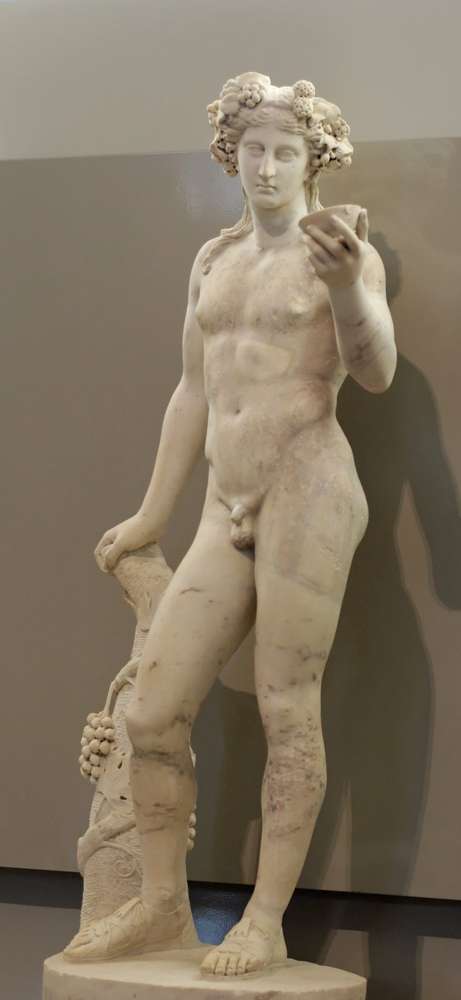
Dionysos, son of Zeus and the Theban princess Semele, is the god of the vine and its wine, of ecstatic release and of the theatre. Twice born, he came to Greece as a god returning to claim his honours, and tragedy and comedy were born at his festivals in Athens.
Epithets
- Βακχεῖος · Bakcheios
- of the Bacchic frenzy
- Βρόμιος · Bromios
- the roaring
- Ἐλευθερεύς · Eleuthereus
- of Eleutherai, whose image stood in the theatre at Athens (Pausanias 1.20.3; 1.38.8)
- Ληναῖος · Lenaios
- of the wine-press
- Δενδρίτης · Dendrites
- of the trees
- Λύσιος · Lysios
- the releaser
Myths
- Twice born. Semele perished in the fire of Zeus; Zeus sewed the unborn god into his thigh and bore him (Euripides, Bacchae 88–104).
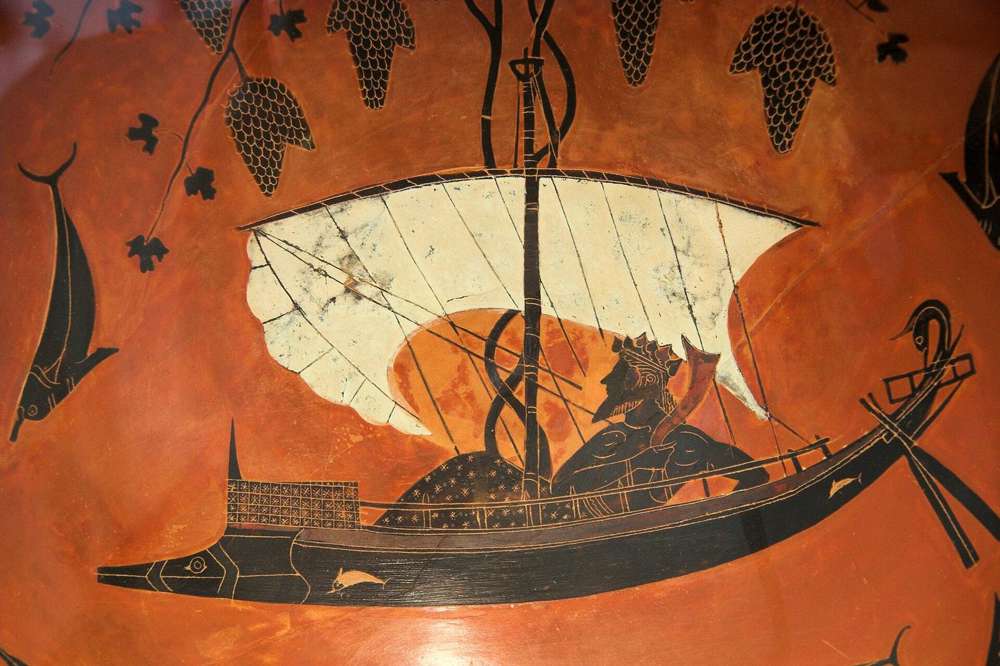
- The Tyrrhenian pirates. Seized by pirates, he made vines grow over the ship and turned the sailors into dolphins (Homeric Hymn 7).
- Pentheus. The king of Thebes who refused the god was torn apart by the maenads (Euripides, Bacchae).
- Ariadne. Dionysos took Ariadne, daughter of Minos, as his wife, and Zeus made her immortal (Hesiod, Theogony 947–949).
Cult sites
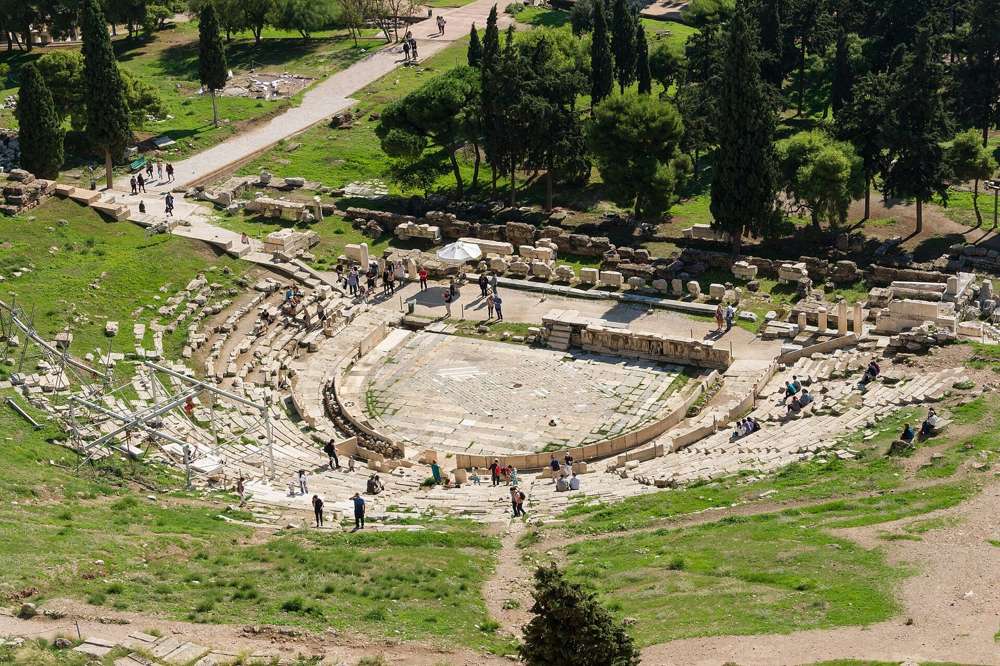
- The Theatre of Dionysos, Athens. On the south slope of the Acropolis, beside his sanctuary (Pausanias 1.20.3).
- In the Marshes. His sanctuary in the Limnai at Athens, opened only once a year, at the Anthesteria ([Demosthenes] 59.76).
- Delphi. Dionysos was held to rule at Delphi in the winter months while Apollo was away (Plutarch, On the E at Delphi 9, 388e–389c).
Festivals
- Rural Dionysia. In Poseideon in the demes of Attica, with the phallic procession (Aristophanes, Acharnians 241–279).
- Lenaia. In Gamelion, with dramatic contests.
- Anthesteria. 11–13 Anthesterion: Pithoigia (opening the new wine), Choes (the drinking contest) and Chytroi (Thucydides 2.15.4).
- City Dionysia. In Elaphebolion, the great festival of tragedy and comedy.
Offerings
Wine, ivy, grapes and figs; the first of the new wine was poured to him at the Pithoigia. Song, dance and drama are his oldest offerings.
Further epithets
- Βάκχος · Bakchos
- the frenzied, the god of the Bacchic cry
- Λυαῖος · Lyaios
- the loosener, who frees from care
- Διθύραμβος · Dithyrambos
- the twice-born, title of his choral song
- Λιμναῖος · Limnaios
- of the Marshes, with his oldest Athenian sanctuary, opened only once a year (Thucydides 2.15.4)
- Ζαγρεύς · Zagreus
- the great hunter, the Orphic Dionysos
- Μελάναιγις · Melanaigis
- of the black goatskin
- Ταυρόκερως · Taurokeros
- bull-horned
Birth and the primary sources
Dionysos is the son of Zeus and Semele, daughter of Kadmos of Thebes (Theogony 940–942; Iliad 14.325). Hera, disguised as Semele's old nurse, persuaded her to ask Zeus to appear in his true form; he came in lightning, and she was consumed. Zeus took the unborn child from her ashes and sewed him into his thigh, from which he was born in due time (Euripides, Bacchae 1–9, 88–100; Apollodorus 3.4.3). Hermes carried the infant to the nymphs of Nysa, who raised him in a cave. The Orphic story of Zagreus torn by the Titans belongs to the Mysteries page and the Orpheus page.
The Homeric Hymn 7 tells how Tyrrhenian pirates seized the god on a headland, taking him for a prince. The bonds would not hold him. Wine flowed over the ship, a vine spread along the sail with clusters of grapes, ivy wound round the mast, and the god became a lion on the deck; the sailors leapt into the sea and became dolphins, all but the helmsman who had recognised him (7.1–54). Exekias painted the scene on the cup shown above. In the Iliad Lykourgos of Thrace drove the god's nurses with an ox-goad, and the young Dionysos fled in terror into the sea, where Thetis received him; Zeus blinded Lykourgos for it (Iliad 6.130–140).
Euripides's Bacchae shows the god returning to Thebes to establish his rites. His mother's sisters denied his birth, so he drove the women mad to Kithairon, where they suckled fawns and wolf-cubs and struck the rock so that wine and milk flowed (Bacchae 677–774). King Pentheus imprisoned him; the palace shook and fell. Disguised as a woman, Pentheus went to spy on the maenads and was torn apart by them, led by his mother Agave (1043–1152). Ovid tells the story of King Midas, granted the golden touch by Dionysos (Metamorphoses 11.85–145), and Catullus his coming to Ariadne on Naxos with his rout of satyrs and maenads (Poem 64.251–264). Hesiod makes Ariadne his wife, made immortal by Zeus (Theogony 947–949). Apollodorus tells how he went down to Hades and brought Semele up to Olympus as the goddess Thyone (3.5.3).
Domains and symbols
Dionysos is the god of wine and the vine, of ecstasy and release, of the theatre, of the mask, and of the life that rises again in the sap of plants and the blood of animals. He frees the mind from care and the self from its bounds. He carries the thyrsos, a fennel stalk topped with a pine cone and wound with ivy, and the wine cup, the kantharos. Ivy and the vine are his plants, with the fig and the pine. His animals are the panther and the leopard, the bull and the goat, the lion and the serpent. His followers are the maenads and satyrs, Silenos and Pan.
Sanctuaries and cults
- The Theatre of Dionysos. On the south slope of the Acropolis, beside his temple of Eleuthereus, where the tragedies of Aeschylus, Sophocles and Euripides were first performed.
- The Marshes. The sanctuary of Dionysos in Limnai, opened on 12 Anthesterion, where the Basilinna was married to the god.
- Delphi. He ruled the oracle in the three winter months while Apollo was away, and the Thyiades danced for him on Parnassos (Plutarch, On the E at Delphi 9; see the Mysteries page).
- Naxos. The island of Ariadne, with the great unfinished gateway of his temple on the islet of Palatia.
- Thebes. His birthplace, where Semele's chamber was shown (Pausanias 9.12.3).
Athens honoured him through the winter and spring. The Rural Dionysia was held in the villages in Poseideon, with the phallic procession Aristophanes shows in the Acharnians (241–279). The Lenaia came in Gamelion, with comedy and tragedy at his sanctuary. The Anthesteria on 11–13 Anthesterion opened the new wine at the Pithoigia, held the drinking contest of the Choes, and ended with the Chytroi for the dead. The City Dionysia in Elaphebolion brought his image from the Academy to the theatre and saw the dramatic contests that made Athens famous.
Statues and art
The Dionysos Richelieu in the Louvre and the Exekias cup in Munich are shown above. Alkamenes made the gold-and-ivory statue for his temple beside the theatre (Pausanias 1.20.3). Praxiteles carved the infant Dionysos in the arms of Hermes at Olympia. The Makron cup in Munich, about 480 BC, circles its bowl with maenads dancing among satyrs. The bronze Derveni krater from Macedonia shows his marriage to Ariadne, and Roman sarcophagi his triumph from India. Caravaggio's Bacchus of about 1598, in the Uffizi, offers the viewer a cup of wine.
Beneath the Divine Mind
Dionysos is the Divine Mind as ecstasy and renewal: its overflowing life that breaks bounds, dies and rises again, fractured off, personified and deified as the twice-born god. Where Apollo is Mind's measure, Dionysos is its release, and Delphi held both. He stands beneath the One, as The One and the Many explains. He still acts in human affairs in every festival, every theatre performance, every glass raised among friends, and in the joy that frees a person from the narrow self.
Honouring Dionysos today
- Offerings. Wine first, poured unmixed for him; grapes, figs, honey, ivy and pine cones; a mask on the altar.
- Drama and dance. Go to the theatre, perform or read a tragedy, or dance at night in his honour.
- The months. Open the new wine on 11 Anthesterion, drink the Choes on the 12th, and set out grain for the dead on the 13th. Keep the Lenaia in Gamelion and the City Dionysia in Elaphebolion with a play.
- Measure. Honour him with joy and not with excess; the god punishes those who reject him and those who abuse his gift.
- Hymn. Recite the Homeric Hymn above or Homeric Hymn 7.
Hymn
I begin to sing of ivy-crowned Dionysus, the loud-crying god, splendid son of Zeus and glorious Semele.Homeric Hymn 26, To Dionysos. Homeric Hymns, tr. H. G. Evelyn-White (1914), public domain.
Images
Jebulon, CC0, via Wikimedia Commons

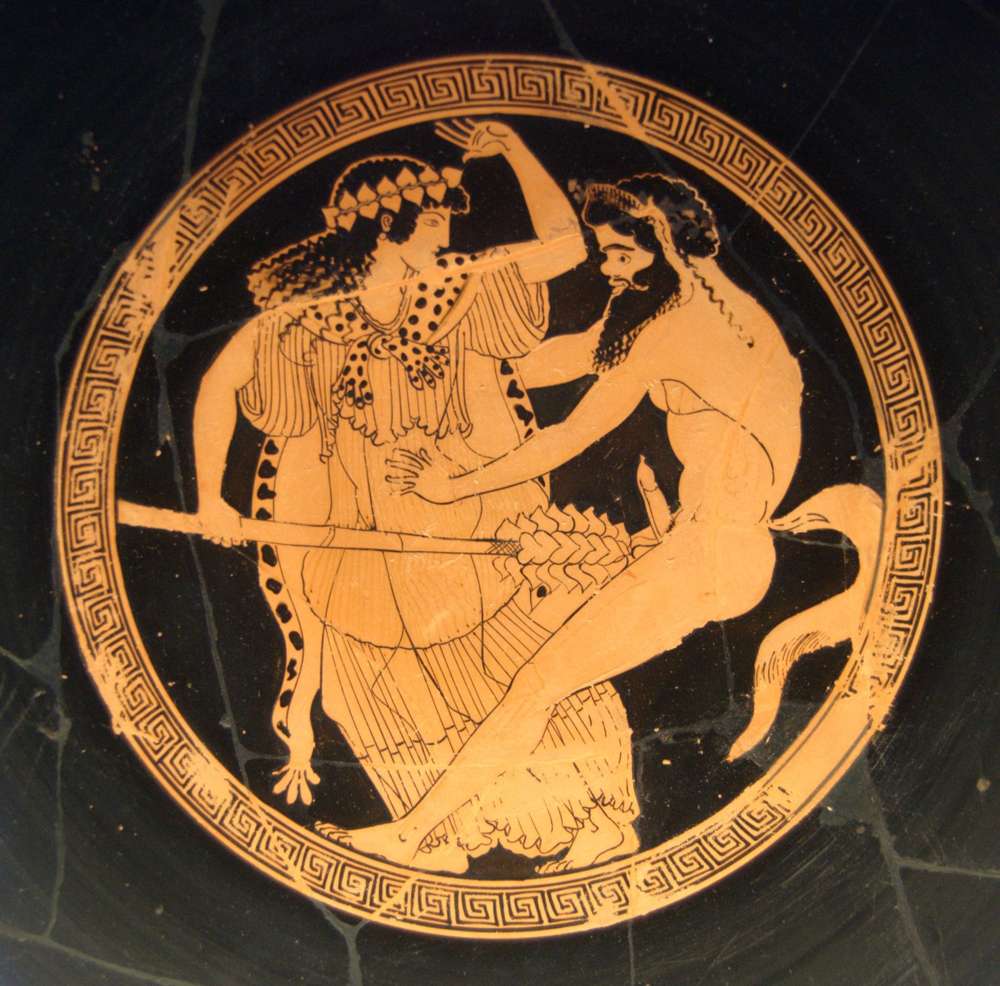
Hieron, signed (potter); Macron (painter), Public domain, via Wikimedia Commons

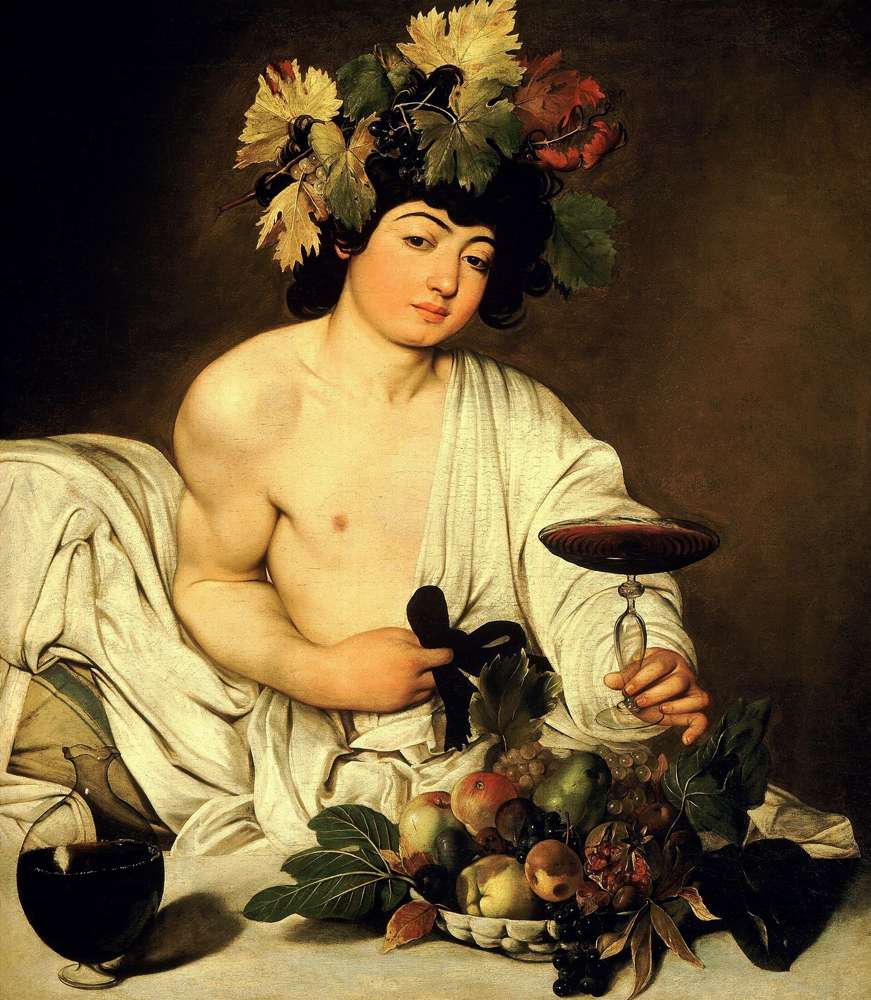
Caravaggio, Public domain, via Wikimedia Commons

Sources
Homeric Hymns 1, 7 and 26; Homer, Iliad 6 and 14; Hesiod, Theogony; Euripides, Bacchae; Aristophanes, Acharnians; Thucydides 2.15; Catullus 64; Ovid, Metamorphoses 11; Apollodorus, Library 3.4–5; Plutarch, On the E at Delphi; Pausanias 1.20, 1.38 and 9.12.
Quotations in public-domain translations (Evelyn-White 1914, Butler 1898/1900, Taylor 1792); other authors paraphrased.