Hermes, son of Zeus and the nymph Maia, is the messenger of the gods, the guide of travellers and of souls, the patron of herdsmen, merchants and athletes. Clever from the day of his birth, he invented the lyre and stole Apollo's cattle. Pillars bearing his head, the herms, stood at doors and crossroads throughout Athens.
Epithets
- Ἀργεϊφόντης · Argeiphontes
- slayer of Argos
- Διάκτορος · Diaktoros
- the guide
- Ψυχοπομπός · Psychopompos
- guide of souls
- Ἀγοραῖος · Agoraios
- of the marketplace
- Κυλλήνιος · Kyllenios
- of Mount Kyllene
- Ἐναγώνιος · Enagonios
- of contests
- Ἐριούνιος · Eriounios
- the luck-bringer
- Χθόνιος · Chthonios
- of the underworld, honoured at the Anthesteria
Myths
- Birth and the lyre. Born at dawn in a cave on Kyllene, by noon he had made a lyre from a tortoise shell (Homeric Hymn to Hermes 17–61).
- The cattle of Apollo. That evening he stole fifty cattle of Apollo, driving them backwards; reconciled, he gave Apollo the lyre (Hymn to Hermes 68–512).
- Messenger of Zeus. Hermes brought Zeus's command to Kalypso to release Odysseus (Odyssey 5.28–148), and gave Odysseus the herb moly against Kirki (Odyssey 10.275–306).
- Guide of souls. He leads the shades of the suitors to the meadow of asphodel (Odyssey 24.1–14).
Cult sites
- Mount Kyllene. His birthplace in Arcadia, with his temple on the summit (Pausanias 8.17.1–2).
- Pheneos. The Arcadian city that honoured him above all gods, with the games called Hermaia (Pausanias 8.14.10).
- The herms of Athens. Their mutilation in 415 BC on the eve of the Sicilian expedition shook the city (Thucydides 6.27).
Festivals
- Hermaia. Festivals of the gymnasium and the palaestra, held by the young.
- Chytroi. The third day of the Anthesteria, when pots of grain were cooked for Hermes Chthonios.
- The fourth day. The Hymn to Hermes places his birth on the fourth of the month (line 19), a day sacred to him.
Offerings
Libations at the herm by the door, small cakes, incense, and a share of a lucky find, the hermaion. Travellers added a stone to the cairns by the roads.
Further epithets
- Δόλιος · Dolios
- the crafty
- Κριοφόρος · Kriophoros
- ram-bearer, who carried a ram around the walls of Tanagra to end a plague (Pausanias 9.22.1)
- Προπύλαιος · Propylaios
- of the gateway, at the entrance to the Acropolis (Pausanias 1.22.8)
Birth and the primary sources
Hermes is the son of Zeus and Maia, daughter of Atlas, born in a cave on Mount Kyllene in Arcadia (Theogony 938–939; the Titan line is on the Theogony page). The long Homeric Hymn to Hermes tells his first day. Born at dawn, by noon he had found a tortoise at the cave mouth, scooped it out and stretched seven strings of sheep-gut across its shell to make the first lyre, and sang of Zeus and Maia (Hymn 4.17–61). By evening he had run to Pieria and stolen fifty cows of Apollo, driving them backwards and wearing sandals of twigs so that no track could be followed (68–86). At the Alpheios he rubbed sticks together and invented the making of fire, roasted two cows and divided the meat into twelve portions for the gods (108–137). Then he slipped back through the keyhole of the cave like mist and lay in his cradle (145–153).
Apollo traced him and dragged him before Zeus, where the infant swore he had not brought the cows home nor crossed the threshold; Zeus laughed aloud at the clever lie and ordered the two to be reconciled (Hymn 4.254–396). Hermes played the lyre for Apollo, who was so enchanted that he gave him the cattle in exchange for it, together with the golden herdsman's staff and the gift of the bee-maidens' prophecy (418–566). From that day the two gods were friends.
In Homer he is the swift messenger and guide. He binds on his golden sandals that carry him over sea and land and takes the wand with which he lulls men to sleep and wakes them (Iliad 24.339–345). He leads Priam through the Achaean camp at night to ransom the body of Hektor (24.333–467), and in the Odyssey he gives Odysseus the herb moly to resist Circe (Odyssey 10.275–308), carries Zeus's command to Kalypso (5.28–148), and leads the souls of the suitors down to the asphodel meadow, squeaking like bats (24.1–14). Apollodorus tells how he slew hundred-eyed Argos, set by Hera to guard Io (Library 2.1.3), and how he carried the infant Dionysos to the nymphs of Nysa (3.4.3). Aristophanes makes him the doorkeeper of heaven in the Peace, and Lucian's Dialogues of the Gods show him overworked by every errand on Olympus.
Domains and symbols
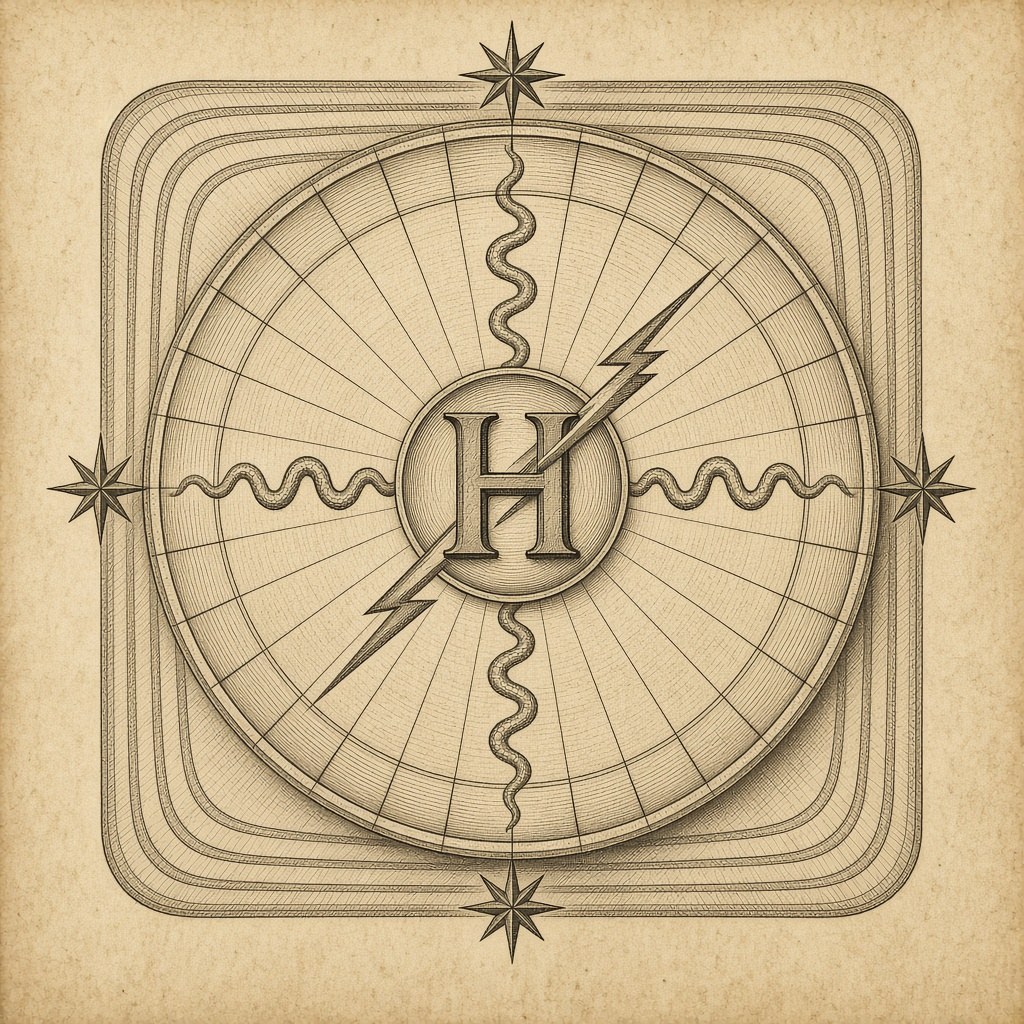
Hermes is the god of boundaries and those who cross them: travellers, heralds, merchants, shepherds, athletes, thieves and the dead. He rules roads and doorways, trade and exchange, eloquence and interpretation, luck and lucky finds, the hermaion. He carries the herald's staff, the kerykeion with its two serpents, and wears the travelling hat, the petasos, and winged sandals. The tortoise and the lyre are his, with the ram, the cockerel, and the crocus and strawberry tree. The stone heaps by the roadside, the hermaia, and the square pillars with his head, the herms, stood at doors and crossroads throughout Athens; their mutilation in 415 BC was a crime against the city (Thucydides 6.27).
Sanctuaries and cults
- Mount Kyllene. His birthplace in Arcadia, with a temple on the summit (Pausanias 8.17.1–2).
- Pheneos. The Arcadian city that honoured him above all gods, with games called the Hermaia (Pausanias 8.14.10).
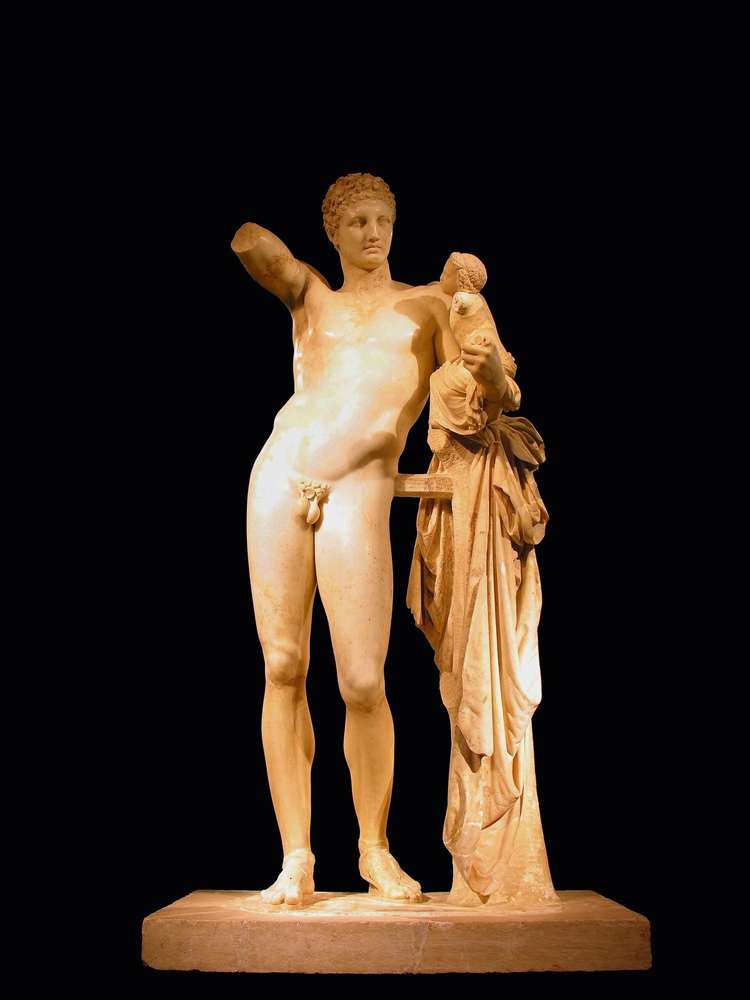
- Olympia. The Heraion at Olympia held the marble Hermes carrying the infant Dionysos, which Pausanias names as the work of Praxiteles (5.17.3).
- Tanagra. His cult of the Ram-bearer, in which the most beautiful youth carried a lamb around the city walls each year.
- Athens. Herms lined the Agora and its Stoa of the Herms; Hermes Agoraios stood at its centre.
The fourth day of every month was his birthday. At Athens the Hermaia were a festival of the gymnasia for boys. On the third day of the Anthesteria, the Chytroi on 13 Anthesterion, pots of boiled grains were offered to Hermes Chthonios for the dead.
Statues and art
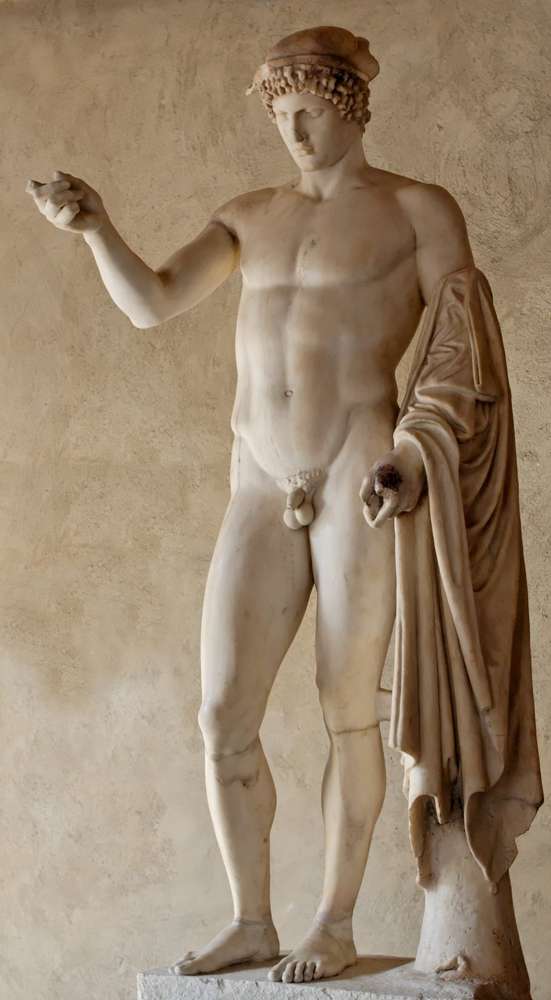
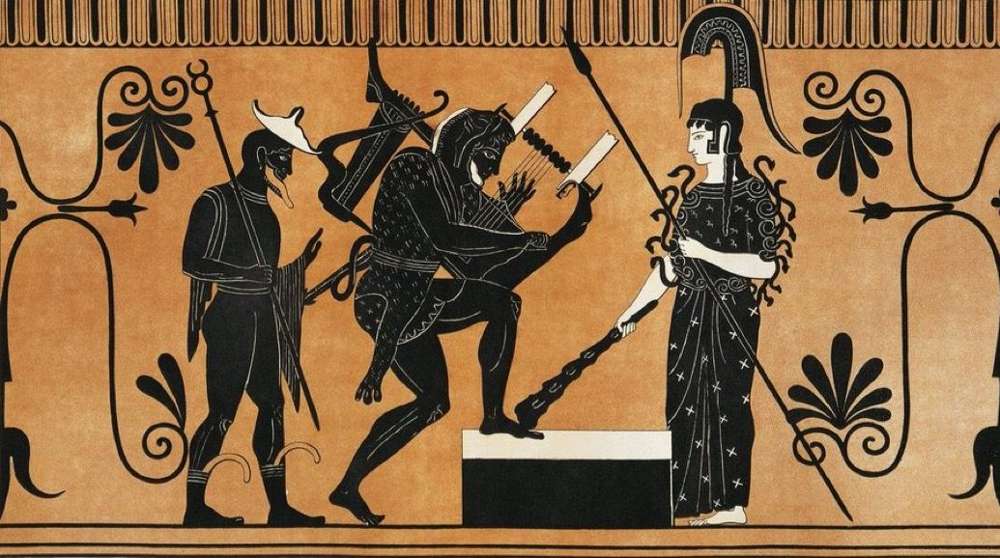
The Hermes of Praxiteles, found in 1877 in the Heraion at Olympia where Pausanias saw it, shows the god holding the young Dionysos on his arm, about 340 BC. The Hermes Ingenui in the Vatican preserves the bearded archaic type with petasos and kerykeion. Black-figure painters showed Hermes Kriophoros carrying his ram, and white-ground lekythoi, painted for the dead, show him leading souls to Charon's boat. Alkamenes made a herm for the Acropolis entrance, copied in the Hermes Propylaios from Pergamon.
Beneath the Divine Mind
Hermes is the Divine Mind as communication and interpretation: its Word, the logos that carries meaning between levels of being, fractured off, personified and deified as the messenger of the gods. He alone passes freely between Olympus, earth and the realm below. He stands beneath the One, as The One and the Many explains. He still acts in human affairs in every message delivered, every fair exchange, every road travelled safely and every good translation.
Honouring Hermes today
- At the threshold. A herm or stone by the door, or a small cairn at a crossroads; add a stone when passing.
- Offerings. Honey, milk, cakes, frankincense, and the first coin of a sale or a lucky find shared with him.
- Before travel and speech. Pray to Hermes before a journey, an examination, a negotiation or a speech.
- The fourth day. Keep the fourth of each lunar month as his birthday, and Wednesday, his planetary day.
- For the dead. On 13 Anthesterion offer a pot of boiled grains to Hermes Chthonios.
- Hymn. Recite the Homeric Hymn above or the opening of Hymn 4.
Hymn
I sing of Cyllenian Hermes, the Slayer of Argus, lord of Cyllene and Arcadia rich in flocks, luck-bringing messenger of the deathless gods.Homeric Hymn 18, To Hermes. Homeric Hymns, tr. H. G. Evelyn-White (1914), public domain.
Images
Dennis G. Jarvis, CC BY-SA 2.0, via Wikimedia Commons
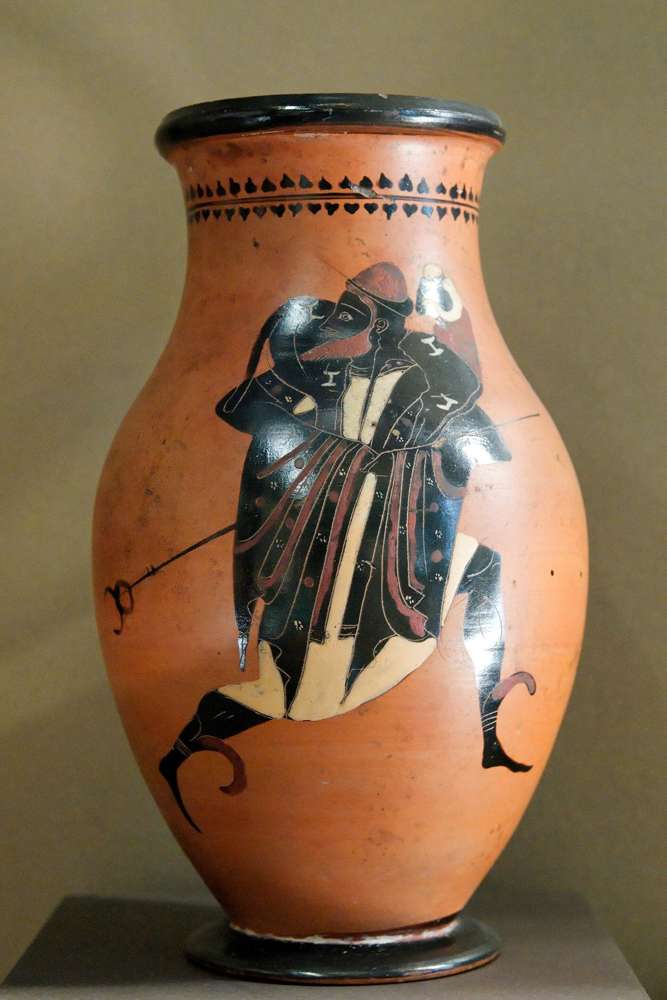
Painter of Louvre F 161, Public domain, via Wikimedia Commons
Sources
Homeric Hymn to Hermes (4) and Hymn 18; Hesiod, Theogony; Homer, Iliad 2, 20 and 24, and Odyssey 5, 10 and 24; Aeschylus, Libation Bearers; Aristophanes, Peace; Thucydides 6.27; Apollodorus, Library 2.1 and 3.4; Lucian, Dialogues of the Gods; Pausanias 1.15, 1.22, 5.17, 8.14, 8.17 and 9.22.
Quotations in public-domain translations (Evelyn-White 1914, Butler 1898/1900, Taylor 1792); other authors paraphrased.