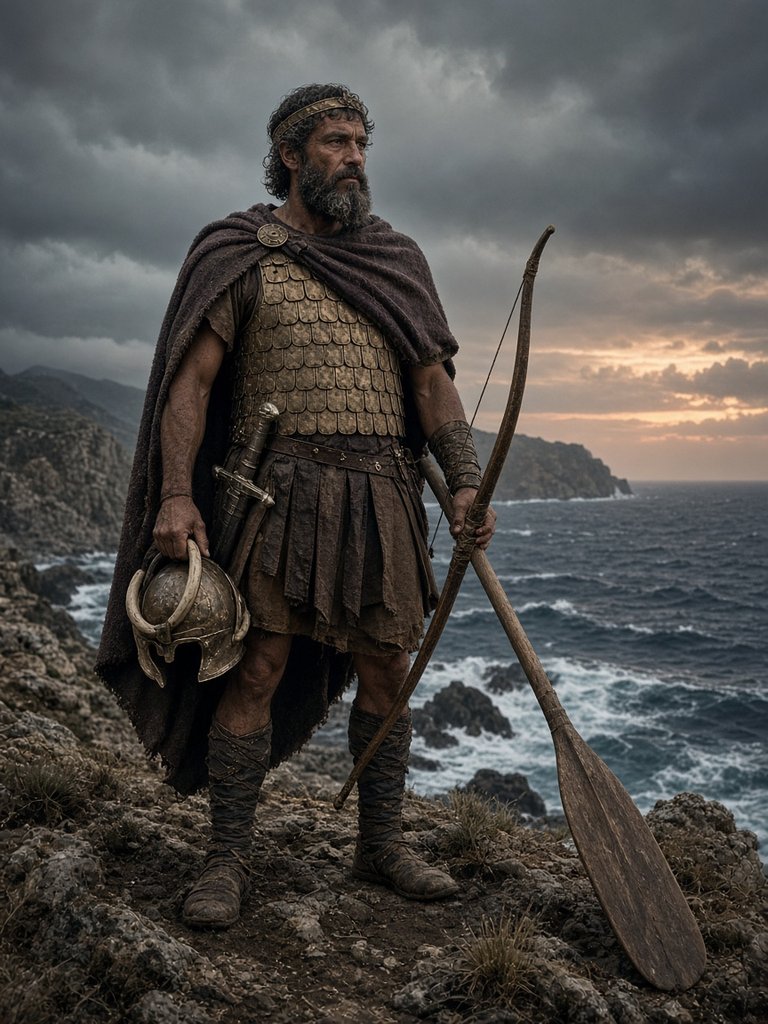
Odysseus, son of Laertes, is king of rocky Ithaca and the hero of the Odyssey: “Tell me, O Muse, of that ingenious hero who travelled far and wide after he had sacked the famous town of Troy” (Odyssey 1.1–2, tr. Butler). He names himself to the Phaeacians: “I am Ulysses son of Laertes, renowned among mankind for all manner of subtlety, so that my fame ascends to heaven” (Odyssey 9.19–20, tr. Butler). Athena loves him above all men for his cunning and stands beside him throughout.
At Troy he is the speaker and the planner. Antenor remembers that “when he raised his voice, and the words came driving from his deep chest like winter snow before the wind, then there was none to touch him” (Iliad 3.221–223, tr. Butler), and it is he who devises the wooden horse (Odyssey 8.492–520). His ten years’ return take him past the Cyclops Polyphemos, Aiolos and the Laistrygonians, a year with Kirke, the journey to the dead, the Sirens, Skylla and Charybdis, the cattle of Helios, and seven years with Kalypso. Hesiod names his sons by the goddesses: by Kirke, Agrios, Latinos and Telegonos, and by Kalypso, Nausithoos and Nausinoos (Theogony 1011–1018).
Brought home asleep by the Phaeacians, he enters his own house as a beggar, strings the great bow that none of the suitors can bend, and kills them; Penelope knows him at last by the secret of their bed, built round the trunk of a living olive (Odyssey 21–23). Teiresias foretells that he must carry an oar inland until a man mistakes it for a winnowing fan, sacrifice there to Poseidon, and die in a gentle old age far from the sea (Odyssey 11.119–137, paraphrased).
Epithets
- πολύτροπος · polutropos
- of many turns (Odyssey 1.1)
- πολύμητις · polumētis
- of many counsels
- πτολίπορθος · ptoliporthos
- sacker of cities
Symbols and virtues
Endurance and the mind that finds a way; the longing for home. Symbols: the bow of Eurytos, the oar, the felt sailor’s cap (pilos), the olive-tree bed, the dog Argos.
Myths
- The wooden horse. Odyssey 8.492–520.
- The Cyclops. Odyssey 9.
- Kirke and the dead. Odyssey 10–11.
- The Sirens. Odyssey 12.
- The bow and the suitors. Odyssey 21–22.
- The bed of olive. Odyssey 23.
Cult and places
- Sparta. Odysseus set up three images of Athena Keleuthia, “of the Road” (Pausanias 3.12.4).
In the poets
“Tell me, O Muse, of that ingenious hero who travelled far and wide after he had sacked the famous town of Troy.”Homer, Odyssey 1.1–2, tr. Samuel Butler (1900), public domain.
Sources
Homer, Iliad 3.216–224; Odyssey (all books, esp. 1.1–5, 9.19–20, 11.119–137, 21–23); Hesiod, Theogony 1011–1018; Pausanias 3.12.4.
Quotations in public-domain translations (Evelyn-White 1914, Butler 1898/1900, Taylor 1792); other authors paraphrased.