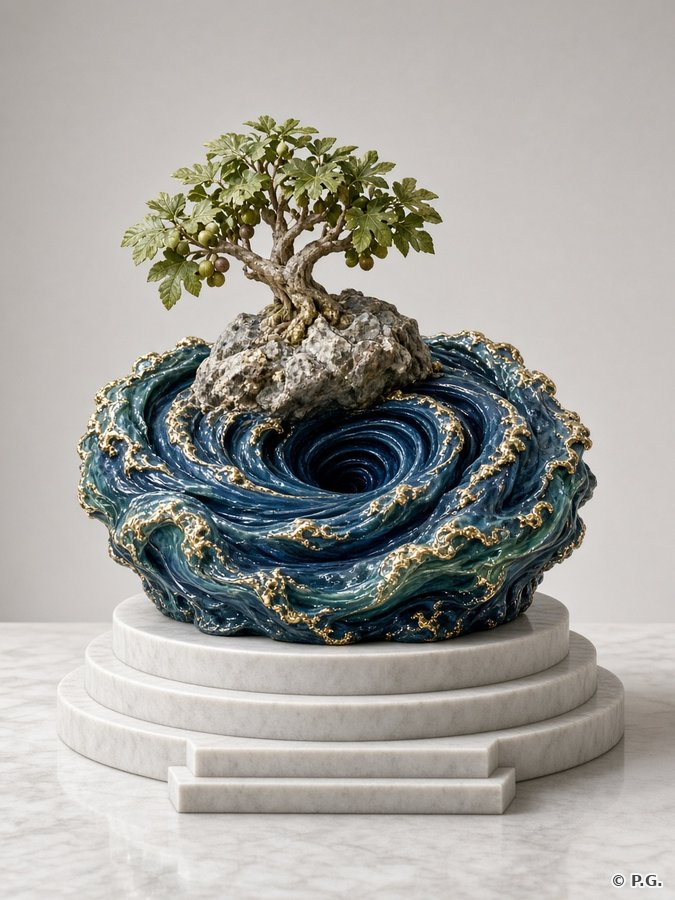
Opposite Skylla, under a lower rock with a great fig tree on it, lies Charybdis. Kirki warns Odysseus: “Three times in the day does she vomit forth her waters, and three times she sucks them down again; see that you be not there when she is sucking, for if you are, Neptune himself could not save you” (Odyssey 12.104–107, tr. Butler). Homer calls her “dread Charybdis” (δῖα Χάρυβδις, 12.104).
As the ship enters the strait, Odysseus sees her: “As she vomited it up, it was like the water in a cauldron when it is boiling over upon a great fire, and the spray reached the top of the rocks on either side. When she began to suck again, we could see the water all inside whirling round and round… We could see the bottom of the whirlpool all black with sand and mud” (12.237–243, tr. Butler). After the ship is destroyed for the cattle of the Sun, Odysseus drifts back to her on the wreckage and saves himself by clinging to the fig tree “like a bat” until she casts up his mast and keel (12.426–446). Apollonius tells how the Nereids and Thetis brought the Argo safely between the dangers of the strait (Argonautica 4.922–963).
Epithets
- Δῖα Χάρυβδις · Dia Charybdis
- “divine” or dread Charybdis (Odyssey 12.104)
Domains and symbols
The force that swallows everything: the abyss of the sea and the danger of losing all for fear of losing a part. Admire: prudence, timing. Sacred symbols: the whirlpool, the fig tree on the rock.
Myths
- Kirki’s warning. Better to lose six men to Skylla than all to Charybdis (Odyssey 12.101–110).
- The first passage. The whirlpool seen like a boiling cauldron (12.234–244).
- The fig tree. Odysseus clings to the tree over her until she casts up his raft (12.426–446).
- The Argo. Thetis and the Nereids guide the ship (Apollonius 4.922–963).
- Aeneas warned. Helenus warns Aeneas to sail round Sicily rather than through the strait (Virgil, Aeneid 3.420–432).
Offerings
Charybdis received no cult. Odysseus’ way is to keep clear of her, and when that fails, to hold on and wait.
Beneath the Divine Mind
Charybdis is the Divine Mind seen as the boundless deep: the power that takes back what it gives. Facing her, the soul learns patience. Like every god she stands beneath the One (The One and the Many).
Honouring Charybdis today
- Patience. When caught in something you cannot fight, hold on and wait, as Odysseus did on the fig tree.
- Prudence. Choose the lesser risk.
- Story. Read Odyssey book 12.
Sources
Homer, Odyssey 12.101–110, 12.234–244, 12.426–446, 23.327; Apollonius, Argonautica 4.783–832, 4.922–963; Virgil, Aeneid 3.420–432. Quotations from Homer are in the prose translation of Samuel Butler (Odyssey 1900), public domain, which gives the gods their Latin names (Jove, Neptune).
Quotations in public-domain translations (Evelyn-White 1914, Butler 1898/1900, Taylor 1792); other authors paraphrased.