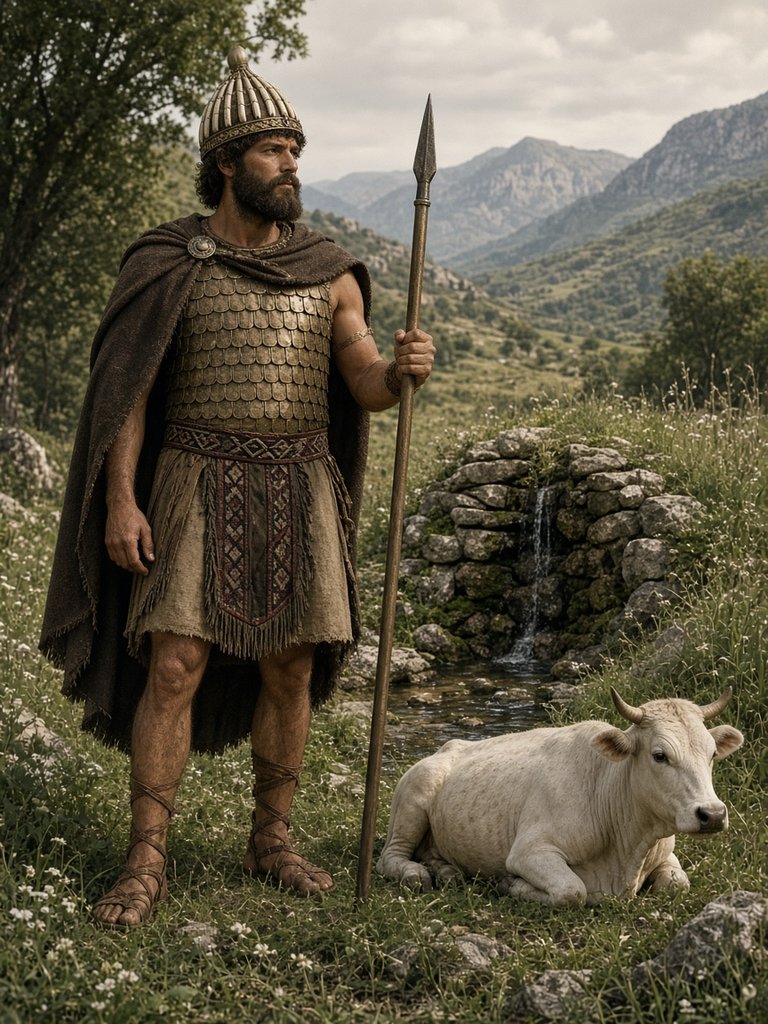
Kadmos, son of Agenor king of Phoenicia (Tyre or Sidon), went searching for his sister Europa when Zeus carried her off. The Delphic oracle told him to give up the search, follow a cow and found a city where it lay down; there, in Boeotia, he killed the serpent of Ares that guarded the spring, and sowed its teeth, from which armed men sprang up and fought until five were left, the Spartoi, ancestors of the Theban nobles (Apollodorus 3.4.1–2; Euripides, Phoenician Women 638–675, paraphrased). His citadel was the Kadmeia.
The gods gave him Harmonia, daughter of Ares and Aphrodite, and came to the wedding, where the Muses sang (Pindar, Pythian 3.88–95, paraphrased). Hesiod names “Harmonia whom high-spirited Cadmus made his wife” (Theogony 937, tr. Evelyn-White), and that “Harmonia, the daughter of golden Aphrodite, bare to Cadmus Ino and Semele and fair-cheeked Agave and Autonoe whom long haired Aristaeus wedded, and Polydorus also in rich-crowned Thebe” (Theogony 975–978). Through Semele he was grandfather of Dionysos; his daughter Ino became the sea-goddess Leukothea: “Ino, daughter of Cadmus, also called Leucothea, saw him. She had formerly been a mere mortal, but had been since raised to the rank of a marine goddess” (Odyssey 5.333–335, tr. Butler).
Herodotus says the Phoenicians who came with Kadmos brought the letters of the alphabet to Greece (5.58, paraphrased). In old age Kadmos and Harmonia left Thebes for Illyria and were changed into serpents, then carried to the Isles of the Blessed (Euripides, Bacchae 1330–1339; Pindar, Olympian 2.78, paraphrased).
Epithets
- Ἀγηνορίδης · Agēnoridēs
- son of Agenor
- κτίστης Θηβῶν · ktistēs Thēbōn
- founder of Thebes
Symbols and virtues
The founder: courage, order won from the wild, and letters. Symbols: the cow that led him, the serpent of Ares and its teeth, the Phoenician letters.
Myths
- Searching for Europa. Apollodorus 3.1.1, 3.4.1.
- The cow and the serpent. Euripides, Phoenician Women 638–675; Ovid, Metamorphoses 3.1–130.
- The Spartoi. Apollodorus 3.4.1.
- The wedding with Harmonia. Theogony 937, 975–978; Pindar, Pythian 3.88–95.
- Letters. Herodotus 5.58.
- Changed to serpents. Euripides, Bacchae 1330–1339.
Cult and places
- Thebes. The Kadmeia, his citadel (Pausanias 9.5.1–3, 9.12.1–3).
In the poets
“Harmonia, the daughter of golden Aphrodite, bare to Cadmus Ino and Semele and fair-cheeked Agave and Autonoe whom long haired Aristaeus wedded, and Polydorus also in rich-crowned Thebe.”Hesiod, Theogony 975–978, tr. H. G. Evelyn-White (1914), public domain.
Sources
Hesiod, Theogony 937, 975–978; Homer, Odyssey 5.333–335; Pindar, Pythian 3.88–95, Olympian 2.78; Herodotus 5.57–61; Euripides, Phoenician Women 638–675, Bacchae 1330–1339; Apollodorus, Library 3.1.1, 3.4.1–2; Pausanias 9.5.1–3, 9.12.1–3.
Quotations in public-domain translations (Evelyn-White 1914, Butler 1898/1900, Taylor 1792); other authors paraphrased.