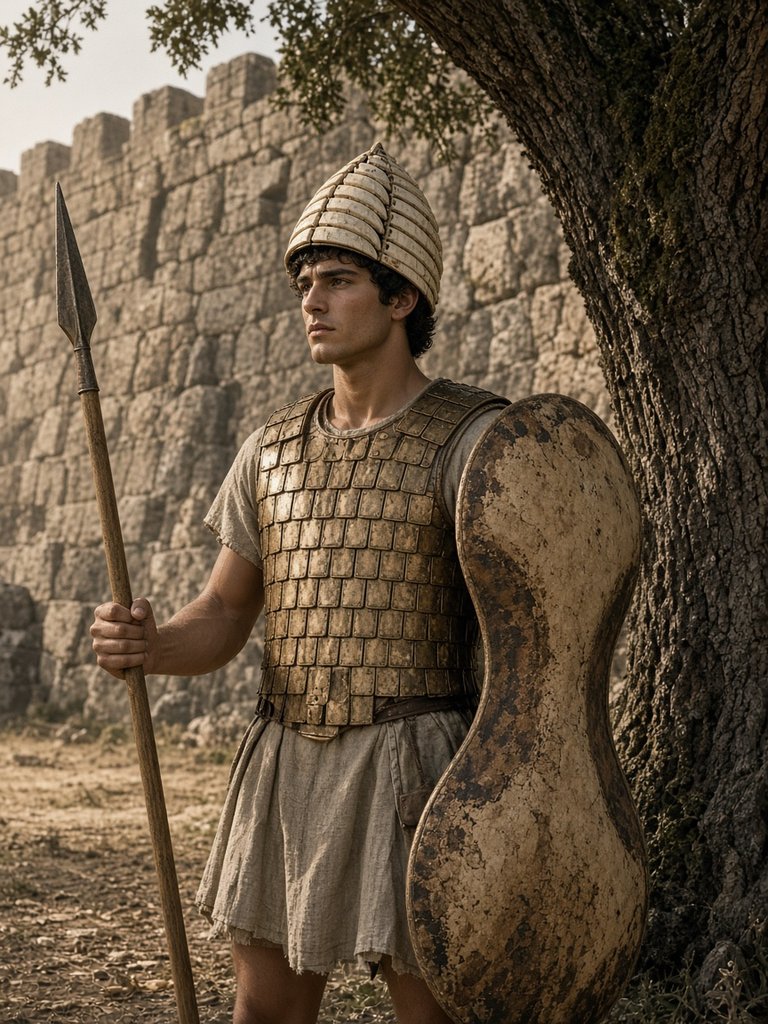
Agenor is a son of Antenor and Theano, one of the bravest of the younger Trojans. He leads one of the five companies in the attack on the Achaean wall (Iliad 12.93) and kills Elephenor, leader of the Abantes (Iliad 4.467–470, paraphrased).
When the Trojans are fleeing before Achilles into the city, Apollo puts courage into Agenor and he waits alone, weighing whether to run. Homer compares him to a panther that will not flee from the hunter: “even so did noble Agenor son of Antenor refuse to fly till he had made trial of Achilles” (Iliad 21.577–579, tr. Butler).
His spear strikes Achilles’ greave but does not pierce it. Before Achilles can kill him, Apollo hides him in mist and takes his shape, leading Achilles away from the gates so that the Trojans can get inside the walls (Iliad 21.590–22.20, paraphrased).
Epithets
- Ἀντηνορίδης · Antēnoridēs
- son of Antenor
- ἀγαυός · agauos
- noble
Symbols and virtues
Courage in a lost moment, saved by a god. Symbols: the spear, the mist of Apollo.
Myths
- Elephenor. Iliad 4.467–470.
- Facing Achilles. Iliad 21.544–598.
- Apollo in his shape. Iliad 21.599–22.20.
In the poets
“Even so did noble Agenor son of Antenor refuse to fly till he had made trial of Achilles.”Homer, Iliad 21.577–579, tr. Samuel Butler (1898), public domain.
Sources
Homer, Iliad 4.467–470, 11.59, 12.93, 13.490, 21.544–22.20.
Quotations in public-domain translations (Evelyn-White 1914, Butler 1898/1900, Taylor 1792); other authors paraphrased.