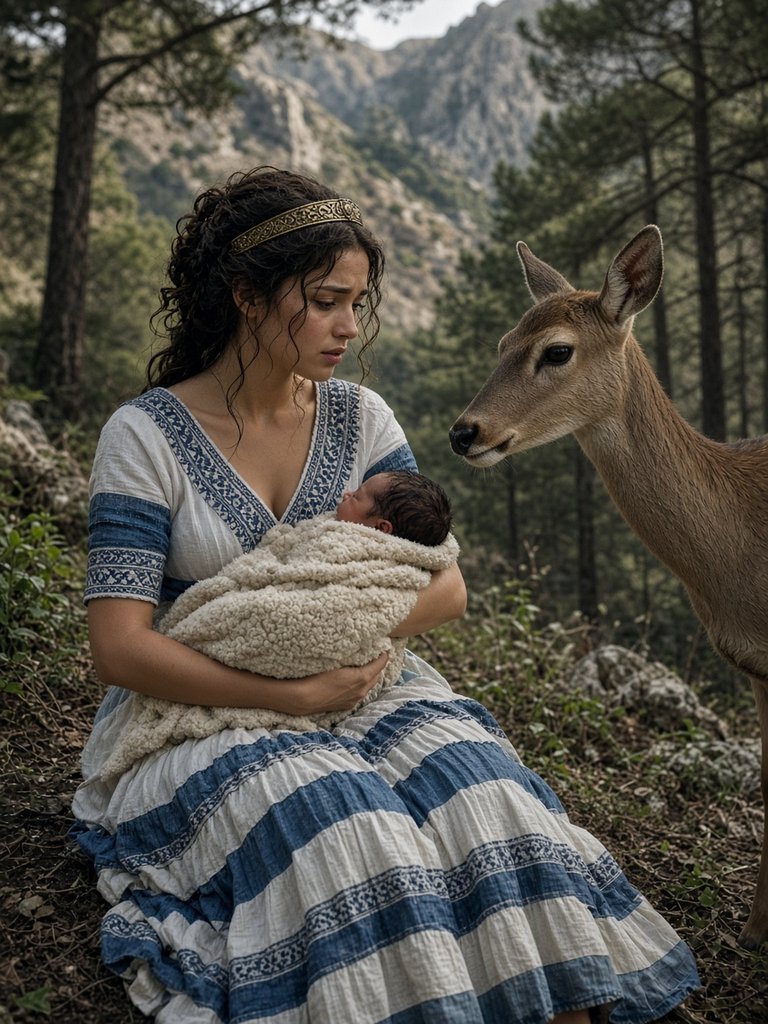
Auge was the daughter of Aleos, king of Tegea in Arkadia, and a priestess of Athena. Herakles, passing through Tegea, seduced her, and she bore a son in secret and hid him in the sacred precinct of the goddess (Apollodorus 2.7.4, 3.9.1, paraphrased).
When the land was struck by famine and an oracle spoke of impiety in the sanctuary, Aleos searched it and found the child. He exposed the baby on Mount Parthenion, where a doe suckled him, and he was called Telephos (Apollodorus 3.9.1, paraphrased).
Aleos gave Auge to Nauplios to be drowned or sold abroad, and he passed her to Teuthras, king of Mysia, who married her; in time Telephos came to Mysia and found his mother there (Apollodorus 2.7.4, 3.9.1, paraphrased). An older version in the Hesiodic Catalogue had Teuthras raise her as his daughter (fr. 165, paraphrased).
Epithets
- Ἀλεάς · Aleas
- daughter of Aleos
Symbols and virtues
A priestess’s fall and a mother restored to her son. Symbols: the doe, the sanctuary of Athena Alea.
Myths
- Seduced by Herakles. Apollodorus 2.7.4.
- The child in the sanctuary. Apollodorus 3.9.1.
- Given to Nauplios. Apollodorus 2.7.4.
- Queen in Mysia. Apollodorus 3.9.1.
Cult and places
- Tegea. In the sanctuary of Eileithyia was an image called Auge on her knees (Pausanias 8.48.7).
Sources
Hesiodic Catalogue fr. 165; Apollodorus 2.7.4, 3.9.1; Diodorus 4.33.7–12; Pausanias 8.4.9, 8.47.4, 8.48.7.
Quotations in public-domain translations (Evelyn-White 1914, Butler 1898/1900, Taylor 1792); other authors paraphrased.