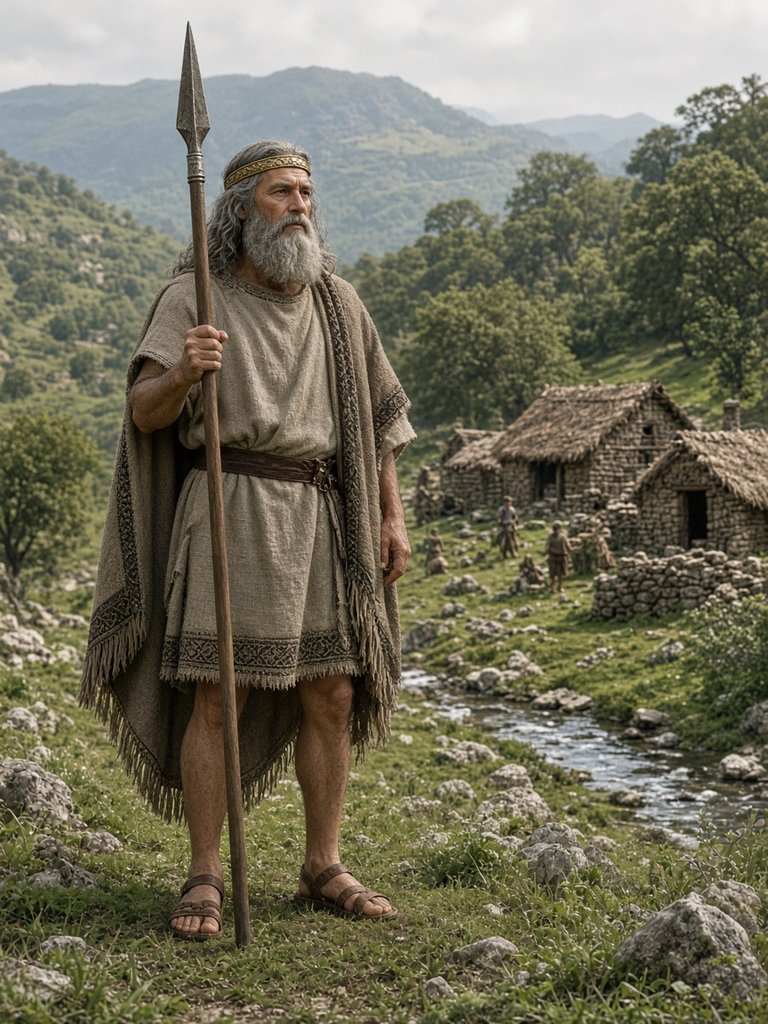
Dardanos was the son of Zeus and Elektra, daughter of Atlas. Apollodorus says that he left Samothrace after his brother Iasion was struck by a thunderbolt, and crossed to the Asian mainland, where King Teukros gave him his daughter and part of his land (Apollodorus 3.12.1, paraphrased).
In the Iliad Aineias recites his lineage: “In the beginning Dardanus was the son of Jove, and founded Dardania, for Ilius was not yet stablished on the plain for men to dwell in, and her people still abode on the spurs of many-fountained Ida” (Iliad 20.215–218, tr. Butler). Poseidon says that Zeus loved Dardanos best of all the sons born to him of mortal women (Iliad 20.304–305, paraphrased).
From him descended the royal houses of Troy: his son Erichthonios, richest of men; Tros; Ilos, Assarakos and Ganymedes; then Laomedon and Priam on one side, and on the other Kapys, Anchises and Aineias (Iliad 20.219–240, paraphrased). The Trojans are often called Dardanians after him.
Epithets
- Διογενής · Diogenēs
- born of Zeus
Symbols and virtues
Foundation and lineage. Symbols: the spear, the springs of Mount Ida.
Myths
- Son of Zeus and Elektra. Apollodorus 3.12.1.
- Founder of Dardania. Iliad 20.215–218.
- Best loved of Zeus’s mortal sons. Iliad 20.304–305.
- Ancestor of the Trojan kings. Iliad 20.219–240.
In the poets
“In the beginning Dardanus was the son of Jove, and founded Dardania, for Ilius was not yet stablished on the plain for men to dwell in, and her people still abode on the spurs of many-fountained Ida.”Homer, Iliad 20.215–218, tr. Samuel Butler (1898), public domain.
Sources
Homer, Iliad 20.215–240, 20.304–305; Apollodorus 3.12.1–2; Diodorus 5.48.2–3; Virgil, Aeneid 3.163–171.
Quotations in public-domain translations (Evelyn-White 1914, Butler 1898/1900, Taylor 1792); other authors paraphrased.