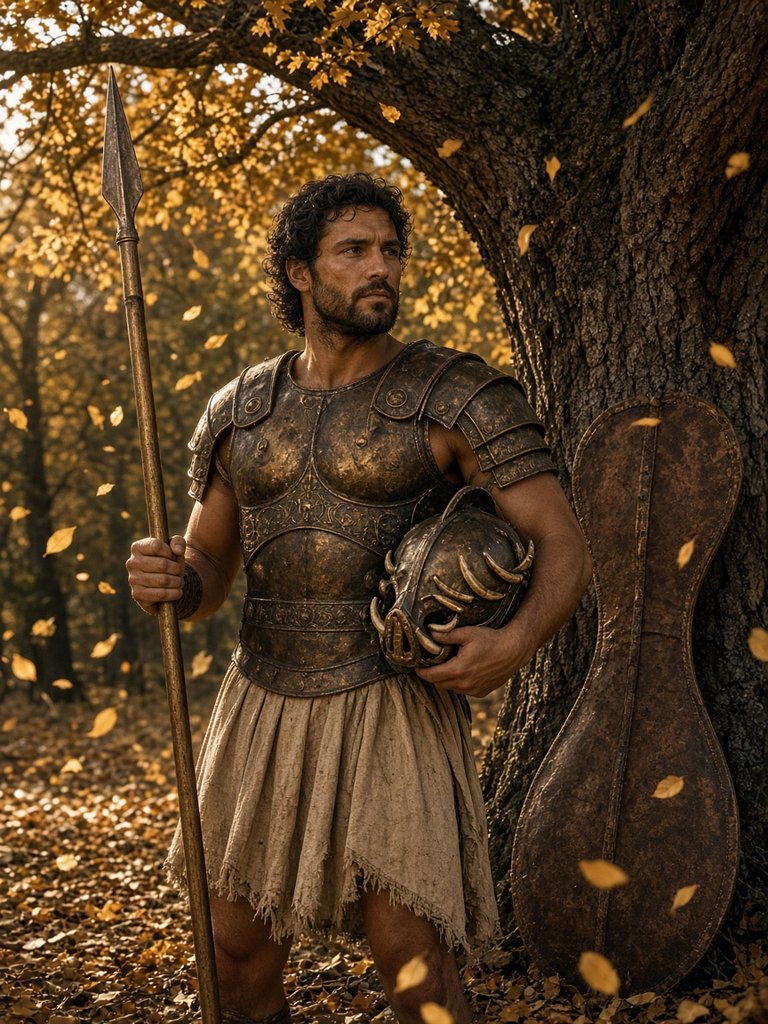
Glaukos, son of Hippolochos and grandson of Bellerophon, commands the Lycians with Sarpedon. Meeting Diomedes between the armies, he answers the question of his lineage with the most famous image in the Iliad: “Men come and go as leaves year by year upon the trees. Those of autumn the wind sheds upon the ground, but when spring returns the forest buds forth with fresh vines. Even so is it with the generations of mankind, the new spring up as the old are passing away” (Iliad 6.146–149, tr. Butler).
He then tells the story of his grandfather Bellerophon, who killed the Chimaira (Iliad 6.152–211). Diomedes finds that their grandfathers were guest-friends, and the two agree not to fight; they exchange armour, and Zeus takes away Glaukos’ wits, so that he gives gold armour worth a hundred oxen for bronze worth nine (Iliad 6.212–236, paraphrased).
Wounded by an arrow of Teukros at the wall (Iliad 12.387–391), he is healed by Apollo in answer to his prayer and rallies the Lycians over the body of Sarpedon (Iliad 16.508–531). In the fight over the body of Patroklos he rebukes Hektor for abandoning his allies (Iliad 17.140–168, paraphrased).
Epithets
- Ἱππολόχοιο υἱός · Hippolochoio huios
- son of Hippolochos
- Λύκιος · Lukios
- the Lycian
Symbols and virtues
The passing of the generations; friendship that crosses enemy lines. Symbols: falling leaves, the golden armour.
Myths
- The generations of leaves. Iliad 6.144–211.
- The exchange with Diomedes. Iliad 6.212–236.
- Healed by Apollo. Iliad 16.508–531.
In the poets
“Men come and go as leaves year by year upon the trees. Those of autumn the wind sheds upon the ground, but when spring returns the forest buds forth with fresh vines.”Homer, Iliad 6.146–148, tr. Samuel Butler (1898), public domain.
Sources
Homer, Iliad 2.876–877, 6.119–236, 12.309–391, 16.492–531, 17.140–182.
Quotations in public-domain translations (Evelyn-White 1914, Butler 1898/1900, Taylor 1792); other authors paraphrased.