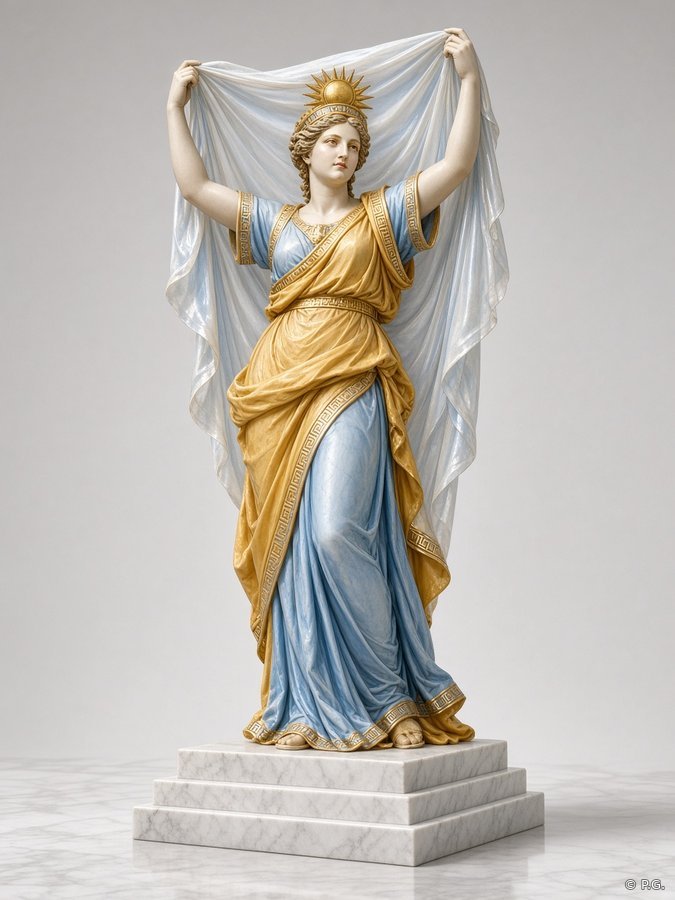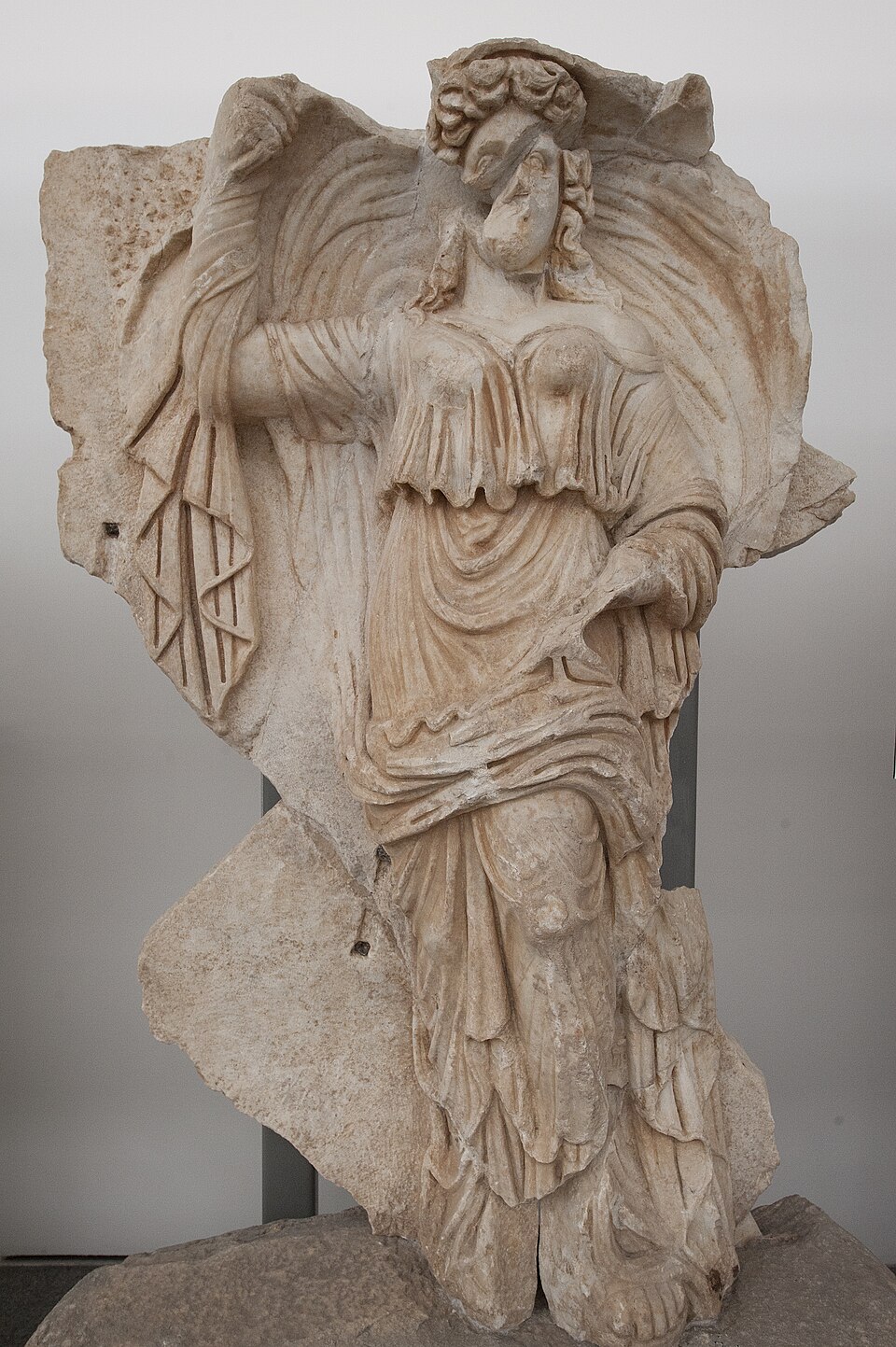
Dosseman, CC BY-SA 4.0, via Wikimedia Commons

Hemera is the Day itself. She is one of the first beings, born of darkness: “of Night were born Aether and Day, whom she conceived and bare from union in love with Erebus” (Theogony 124–125). She and her mother Nyx share one house at the edge of the world, and never meet within it: “Night and Day draw near and greet one another as they pass the great threshold of bronze: and while the one is about to go down into the house, the other comes out at the door. And the house never holds them both within” (Theogony 748–752). Day “holds all-seeing light for them on earth” (Theogony 755).
Pausanias saw her on the roof of the Royal Stoa in the Athenian Agora, in a group of baked clay showing Hemera carrying off Kephalos (Pausanias 1.3.1). She is the goddess whose name the Temple’s daily guide bears: Hemera, a companion for each day.
Epithets
- Ἡμέρα · Hemera
- Day
Domains and symbols
Daylight and the turning of the day; the threshold between night and morning. Admire: making good use of each day. Sacred symbols: the bronze threshold, the light of morning.
Myths
- Born of Night and Erebos. Sister of Aither (Theogony 124–125).
- The house of Night. She and Night pass each other at the bronze threshold, never within at once (Theogony 744–757).
- Kephalos. Hemera carrying away Kephalos, a roof group of the Royal Stoa in Athens (Pausanias 1.3.1).
- At Aphrodisias. Shown as Day among the reliefs of the Sebasteion, 1st century AD.
Offerings
No cult of Hemera is recorded. Today: a morning greeting at the door, a cup of water, and the day’s god in Hemera.
Beneath the Divine Mind
Hemera is the Divine Mind as the gift of each day: light given again and again, never held by the same house as the night. To honour her is to receive the day as given. Like every god she stands beneath the One (The One and the Many).
Honouring Hemera today
- Morning. Greet the day at the threshold of your house.
- The day’s god. Open Hemera to see whom the day honours.
- Reading. Read Theogony 744–757 aloud.
Hymn
Night and Day draw near and greet one another as they pass the great threshold of bronze: and while the one is about to go down into the house, the other comes out at the door.Hesiod, Theogony 748–750, tr. H. G. Evelyn-White (1914), public domain. There is no Homeric or Orphic hymn to Hemera.
Sources
Hesiod, Theogony 124–125, 744–757; Pausanias 1.3.1; Sebasteion reliefs, Aphrodisias.
Quotations in public-domain translations (Evelyn-White 1914, Butler 1898/1900, Taylor 1792); other authors paraphrased.