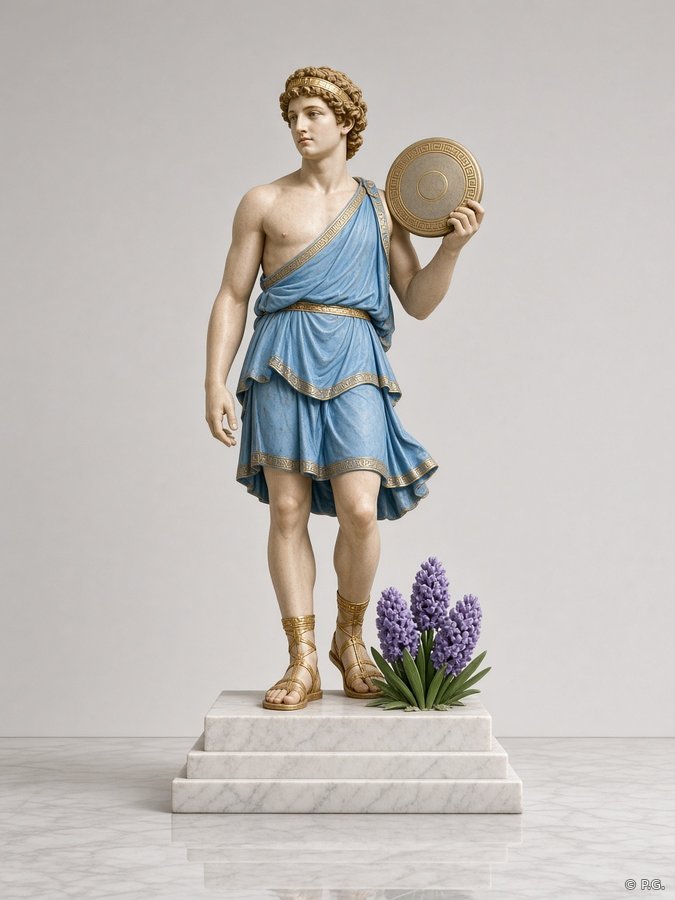
Hyakinthos was a prince of Amyklai near Sparta, the son of Amyklas (Pausanias 3.1.3; Apollodorus, Library 3.10.3), or in another account of the Muse Kleio and Pieros (Apollodorus 1.3.3). Apollo loved him and killed him by accident with a thrown discus (Apollodorus 1.3.3, 3.10.3); later writers say the West Wind, Zephyros, jealous, turned the discus aside (Lucian, Dialogues of the Gods 16 [14]). Ovid tells how Apollo made a flower spring from his blood and wrote his grief on its petals (Metamorphoses 10.162–219).
At Amyklai his tomb was the altar-shaped base of the great bronze image of Apollo. Pausanias saw it and records that at the Hyakinthia, before the sacrifice to Apollo, the people made offerings to Hyakinthos as to a hero through a bronze door in the side of the altar; on it were carved Hyakinthos and his sister Polyboia being carried to heaven by Aphrodite, Athena and Artemis (Pausanias 3.19.3–5). The Hyakinthia was among the greatest Spartan festivals: the Spartans would not march while it lasted (Herodotus 9.7, 9.11), and the men of Amyklai went home from campaign to sing the paean (Xenophon, Hellenica 4.5.11). Polykrates, quoted by Athenaeus, says it lasted three days, the first of mourning, without wreaths or paean, the next of processions, choruses and feasting (Athenaeus 4.139d–f).
Epithets
- Ἀμυκλαῖος · Amyklaios
- of Amyklai
- Ὑάκινθος · Hyakinthos
- the hyacinth flower
Domains and symbols
Death in youth and the return of life: mourning turned to celebration. Admire: beauty, friendship, remembrance of the dead. Sacred symbols: the hyacinth flower, the discus, Apollo’s throne at Amyklai.
Myths
- Son of Amyklas. Pausanias 3.1.3; Apollodorus 3.10.3.
- Son of Kleio. By Pieros, in another account (Apollodorus 1.3.3).
- The discus. Killed by Apollo’s throw (Apollodorus 1.3.3, 3.10.3).
- Zephyros. The jealous wind turned the discus (Lucian, Dialogues of the Gods 16 [14]).
- The flower. His blood becomes the flower that bears Apollo’s lament (Ovid, Metamorphoses 10.162–219).
- Carried to heaven. With Polyboia, on the altar at Amyklai (Pausanias 3.19.4).
Cult sites
- Amyklai. His tomb in the base of Apollo’s throne, with a bronze door for offerings (Pausanias 3.19.3–5).
Festivals
- Hyakinthia. Three days at Amyklai in early summer: a day of mourning, then processions, choruses and feasting (Athenaeus 4.139d–f; Herodotus 9.7; Xenophon, Hellenica 4.5.11; Euripides, Helen 1465–1475).
Offerings
Before Apollo’s sacrifice, offerings to Hyakinthos as a hero, through the bronze door of his altar-tomb (Pausanias 3.19.3). On the first day of the Hyakinthia, plain fare without wreaths (Athenaeus 4.139d–e). Today: hyacinths, and a meal that begins in remembrance and ends in joy.
Beneath the Divine Mind
Hyakinthos is the Divine Mind as beauty that passes and returns: the soul’s bloom is cut down and rises again as the flower, and Apollo’s grief becomes a festival. Like every god he stands beneath the One (The One and the Many).
Honouring Hyakinthos today
- Remember. Honour a friend who died young.
- Flowers. Plant or set out hyacinths in spring.
- Joy after grief. Keep a day of mourning followed by a day of feasting.
Sources
Pausanias 3.1.3, 3.19.3–5; Apollodorus, Library 1.3.3, 3.10.3; Herodotus 9.7, 9.11; Xenophon, Hellenica 4.5.11; Euripides, Helen 1465–1475; Athenaeus 4.139d–f; Ovid, Metamorphoses 10.162–219; Lucian, Dialogues of the Gods 16 [14].
Quotations in public-domain translations (Evelyn-White 1914, Butler 1898/1900, Taylor 1792); other authors paraphrased.