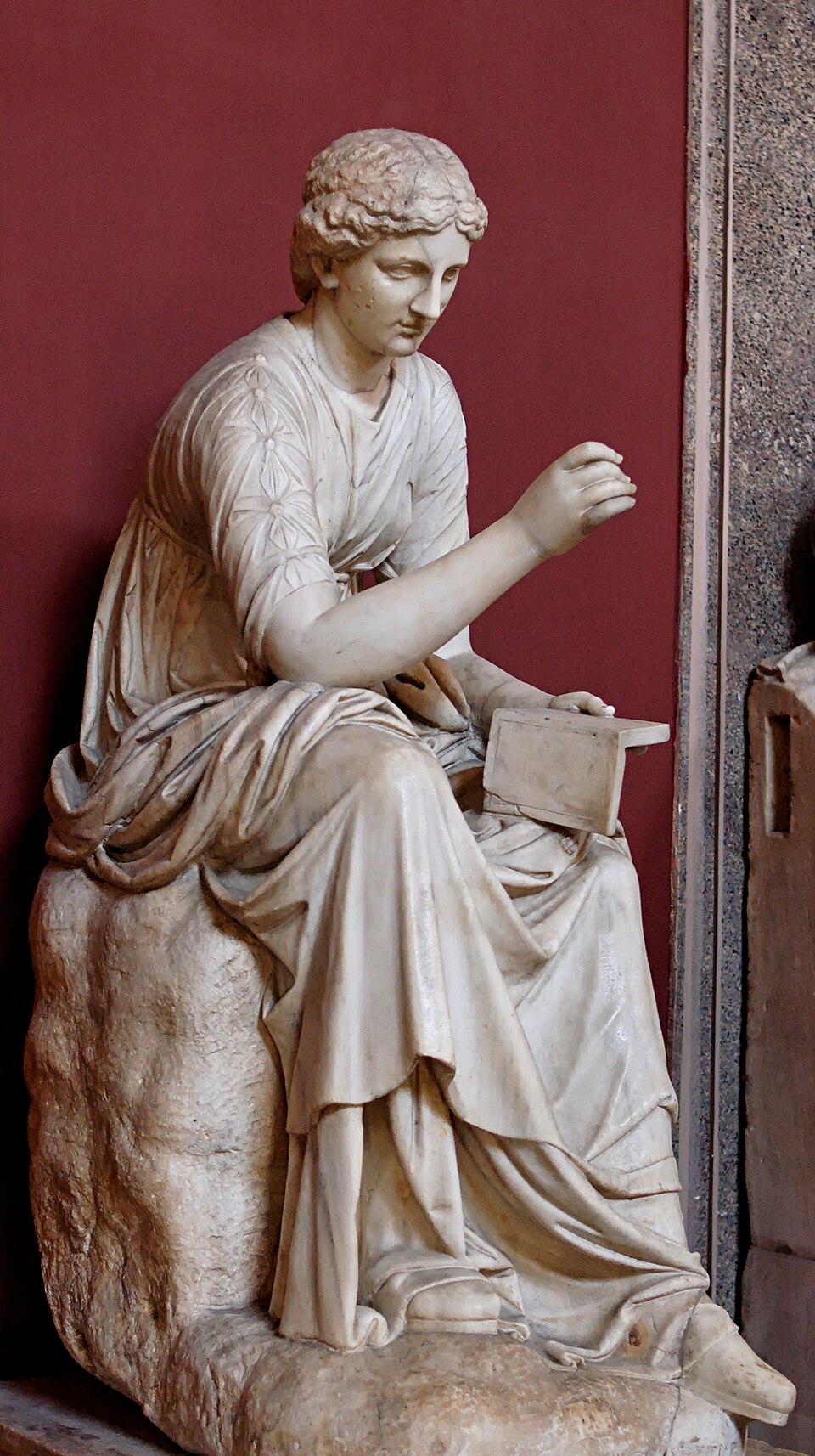
Jastrow, Public domain, via Wikimedia Commons

Kalliope is one of the nine Muses, daughters of Zeus and Mnemosyne (Memory), born in Pieria “a little way from the topmost peak of snowy Olympus” after Zeus lay with Mnemosyne nine nights (Theogony 53–62). Hesiod names the nine together: “Cleio and Euterpe, Thaleia, Melpomene and Terpsichore, and Erato and Polyhymnia and Urania and Calliope” (Theogony 77–79).
Hesiod sets her apart: “Calliope, who is the chiefest of them all, for she attends on worshipful princes: whomsoever of heaven-nourished princes the daughters of great Zeus honour, and behold him at his birth, they pour sweet dew upon his tongue, and from his lips flow gracious words” (Theogony 79–84). She is the mother of the singer Orpheus by the Thracian king Oiagros (Apollonius, Argonautica 1.23–25; Apollodorus, Library 1.3.2). Plato calls her the eldest of the Muses, who with Ourania honours those who spend their lives in philosophy (Phaedrus 259d). In later tradition she is the Muse of epic poetry.
Epithets
- Καλλιόπη · Kalliope
- beautiful-voiced (Theogony 79)
- Προφερεστάτη · Propherestate
- “chiefest of them all” (Theogony 79)
Domains and symbols
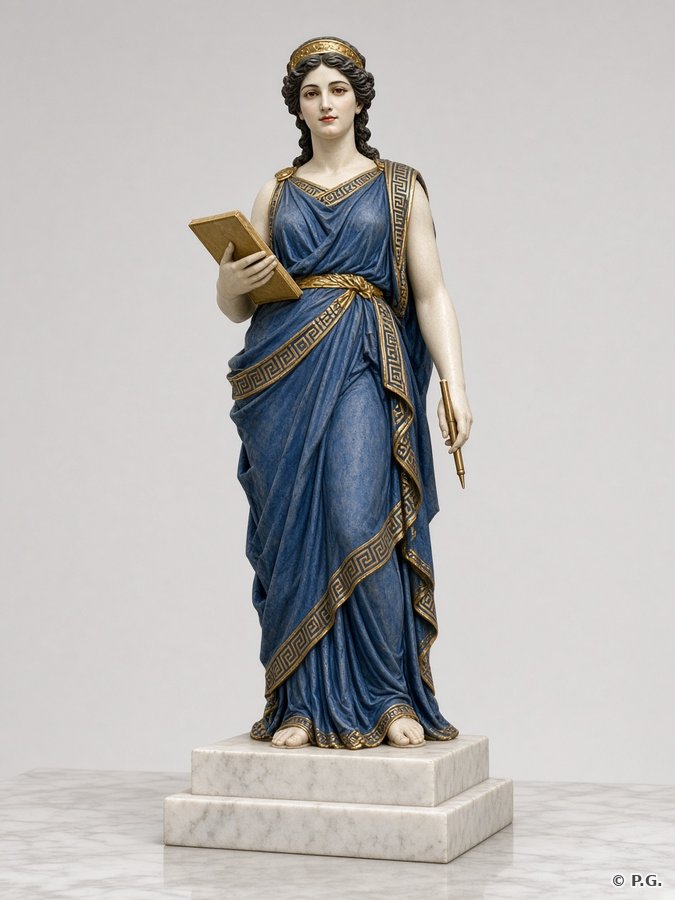
Epic song and the persuasive speech of just rulers: Hesiod’s Kalliope gives kings the gentle words that settle quarrels (Theogony 80–93). Admire: eloquence, justice in speech, the long story well told. Sacred symbols: the writing tablet and stylus, the scroll; on the Louvre Muses sarcophagus she holds a tablet.
Myths
- Born of Memory. Daughter of Zeus and Mnemosyne, born in Pieria (Theogony 53–62).
- Hesiod’s calling. The Muses taught Hesiod “glorious song while he was shepherding his lambs under holy Helicon” and gave him a laurel staff (Theogony 22–34).
- Mother of Orpheus. By Oiagros (Apollonius, Argonautica 1.23–25; Apollodorus 1.3.2).
- With the princes. She stands beside kings who judge rightly (Theogony 79–93).
- Eldest of the nine. With Ourania she honours philosophers (Plato, Phaedrus 259d).
- Song at the feast of the gods. “Apollo struck his lyre, and the Muses lifted up their sweet voices, calling and answering one another” (Iliad 1.603–604, tr. Butler).
- Lament for Achilles. “The nine muses also came and lifted up their sweet voices in lament—calling and answering one another” (Odyssey 24.60–61, tr. Butler).
Cult sites
- Mount Helikon. The grove of the Muses on Helikon above Thespiai held statues of all nine and the Hippokrene spring (Pausanias 9.29–31; Theogony 1–8).
- Athens. An altar of the Muses Ilissiades stood by the Ilissos (Pausanias 1.19.5).
- Troizen. An altar shared by the Muses and Sleep (Pausanias 2.31.3).
- Sparta. The Spartan king sacrificed to the Muses before battle (Plutarch, Lycurgus 21).
Festivals
- Mouseia. The Thespians held a festival and contests for the Muses on Helikon (Pausanias 9.31.3).
Offerings
Hesiod dedicated the tripod he won for a song at Chalkis to the Muses of Helikon, where they had first set him on the path of song (Works and Days 650–659). Today: a lamp, water or honey, and above all the work itself, a poem said, a song sung, a page read aloud.
Beneath the Divine Mind
Kalliope is the Divine Mind as the beautiful voice: Mind that speaks so that justice is heard and the quarrel ends. Hesiod puts her beside the just king, and Plato beside the philosopher. Like every god she stands beneath the One (The One and the Many).
Honouring Kalliope today
- Speak well. Before a hard conversation, ask Kalliope for gentle and true words.
- Epic. Read aloud a passage of Homer or Hesiod.
- Hymn. Recite the Homeric Hymn to the Muses below.
Hymn
I will begin with the Muses and Apollo and Zeus. For it is through the Muses and Apollo that there are singers upon the earth and players upon the lyre; but kings are from Zeus. Happy is he whom the Muses love: sweet flows speech from his lips. Hail, children of Zeus! Give honour to my song! And now I will remember you and another song also.Homeric Hymn 25, To the Muses and Apollo. Tr. H. G. Evelyn-White (1914), public domain.
Sources
Hesiod, Theogony 1–115, esp. 22–34, 53–62, 75–103; Works and Days 656–659; Homeric Hymn 25; Homer, Iliad 1.603–604, Odyssey 24.60–62; Pausanias 1.19.5, 2.31.3, 9.29–31; Plutarch, Lycurgus 21; Apollonius, Argonautica 1.23–25; Apollodorus, Library 1.3.2; Plato, Phaedrus 259b–d; Diodorus Siculus 4.7.
Quotations in public-domain translations (Evelyn-White 1914, Butler 1898/1900, Taylor 1792); other authors paraphrased.