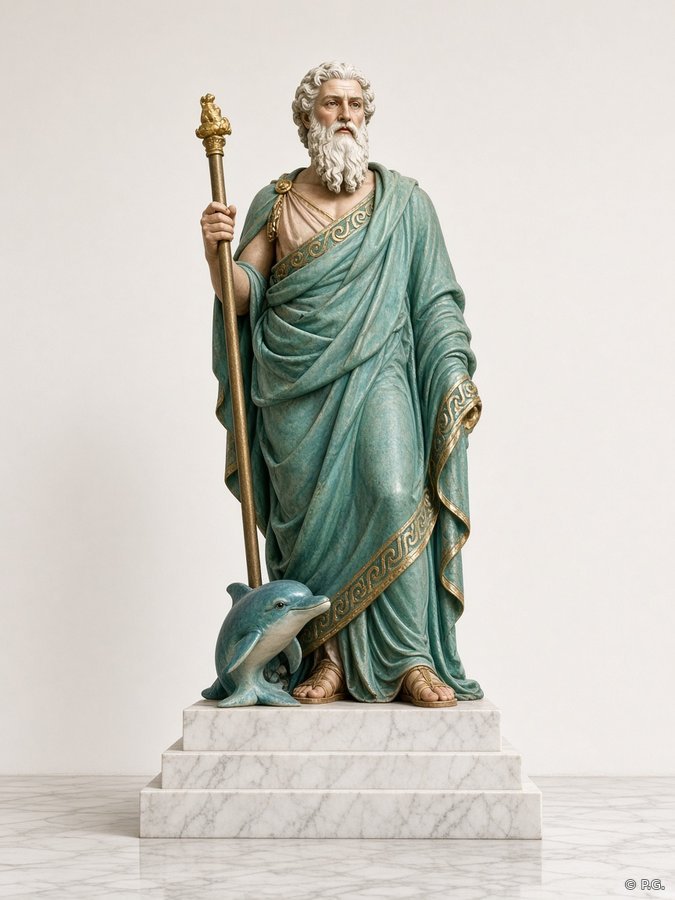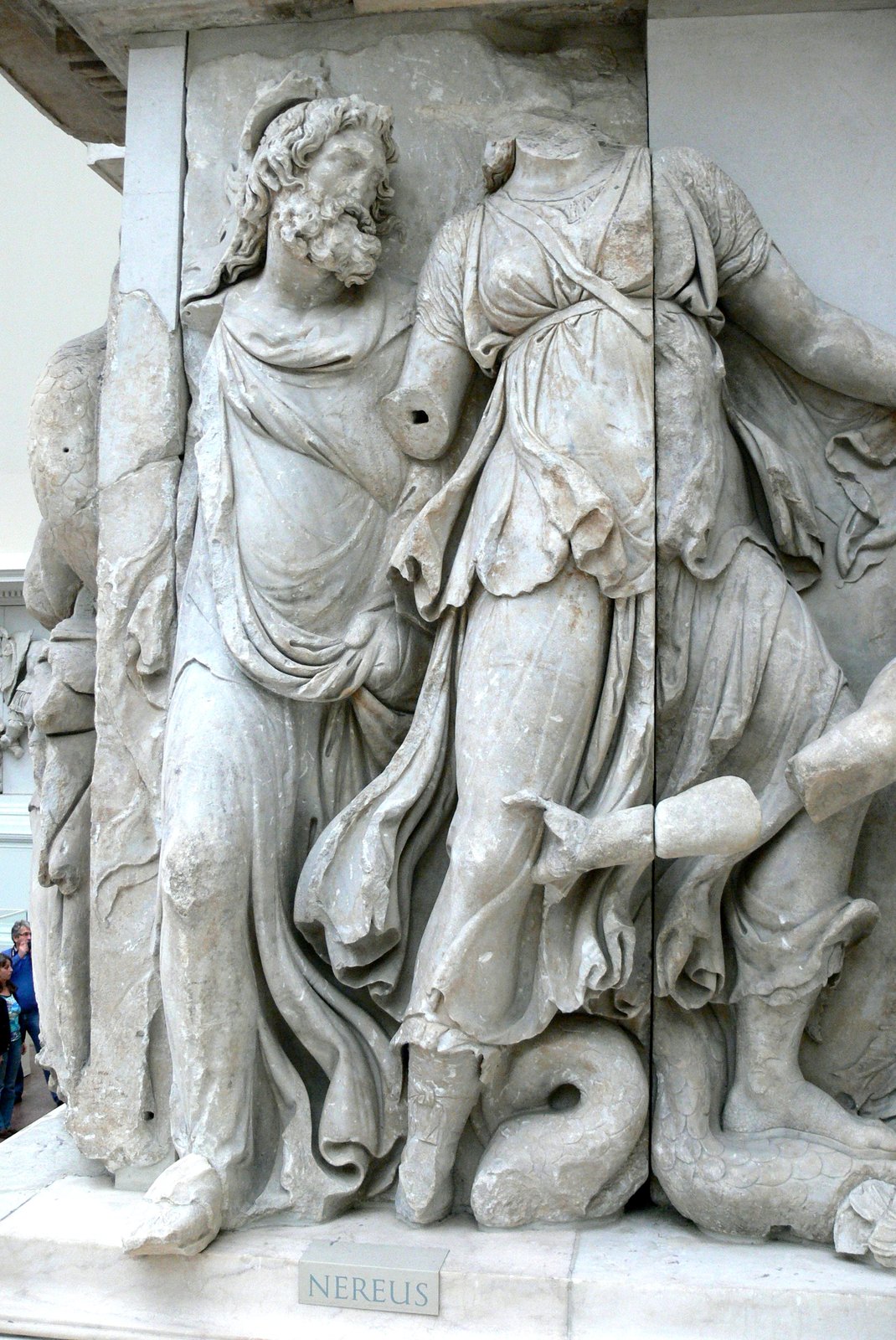
“And Sea begat Nereus, the eldest of his children, who is true and lies not: and men call him the Old Man because he is trusty and gentle and does not forget the laws of righteousness, but thinks just and kindly thoughts” (Theogony 233–236). With Doris, daughter of Okeanos, he fathered the fifty Nereids, among them Thetis and Amphitrite (Theogony 240–264). Homer calls him simply “the old man of the sea”, father of Thetis (Iliad 18.141).
Epithets
- Ἅλιος γέρων · Halios Geron
- the Old Man of the Sea (Iliad 18.141)
- Ἀψευδής · Apseudes
- who does not lie (Theogony 233)
Domains and symbols
The calm deep sea; truth and prophecy; justice and kindness. Admire: honesty, gentleness. Sacred symbols: the trident or staff, fish and dolphins.
Myths
- His daughters. The fifty Nereids, “passing lovely amongst goddesses” (Theogony 240–264).
- Herakles. Herakles seized him as he slept and held him through all his changes until he told the way to the apples of the Hesperides (Apollodorus, Library 2.5.11).
Cult sites
- Gytheion. The people of Gytheion in Laconia said an old man lived in the sea, and they called him Nereus (Pausanias 3.21.9).
Offerings
Myrrh, as his Orphic hymn asks; libations poured into the sea. Today: pray to him before a voyage and for truthful speech.
Beneath the Divine Mind
Nereus is the Divine Mind as truth that does not lie, personified and deified as the old man of the sea. Like every god he stands beneath the One (The One and the Many).
Honouring Nereus today
- Offerings. A libation poured into the sea.
- Practice. Speak only what is true for a day in his honour.
- Hymn. Recite the Orphic hymn below.
Hymn
O Thou, who doff the roots of Okeanos keep in seats cærulean, dæmon of the deep, with fifty nymphs (attending in thy train, fair virgin artists) glorying thro’ the main.Orphic Hymn 23, To Nereus, 1–3. Tr. Thomas Taylor (1792), public domain; divine names as given on Hemera.
Images
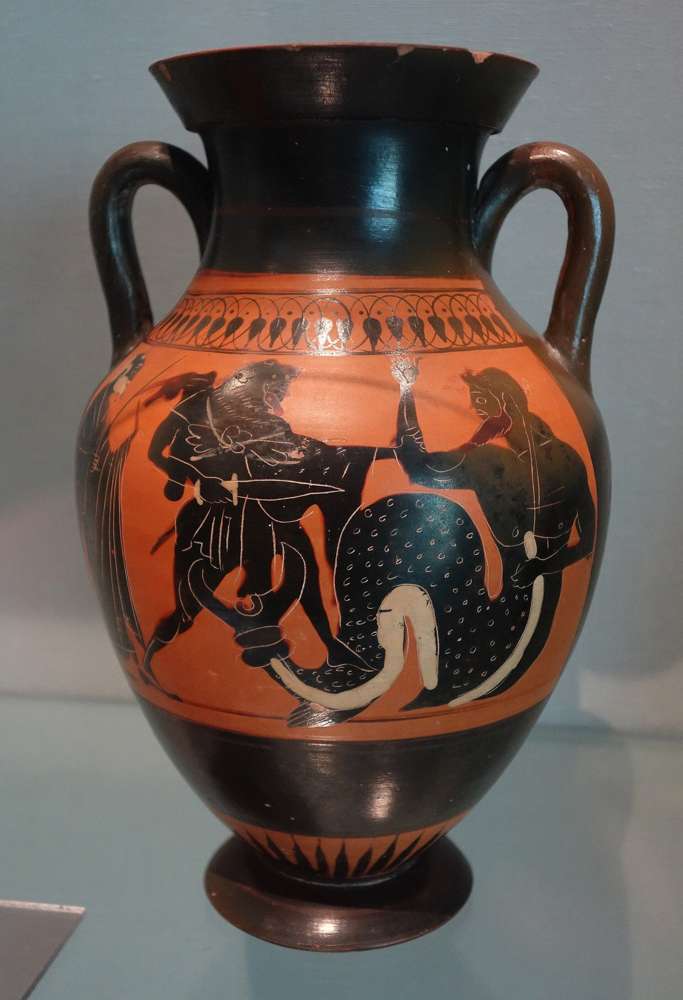
Crawdad Blues, Public domain, via Wikimedia Commons

Sources
Hesiod, Theogony 233–264; Homer, Iliad 18.141; Apollodorus, Library 2.5.11; Pausanias 3.21.9; Orphic Hymn 23.
Quotations in public-domain translations (Evelyn-White 1914, Butler 1898/1900, Taylor 1792); other authors paraphrased.