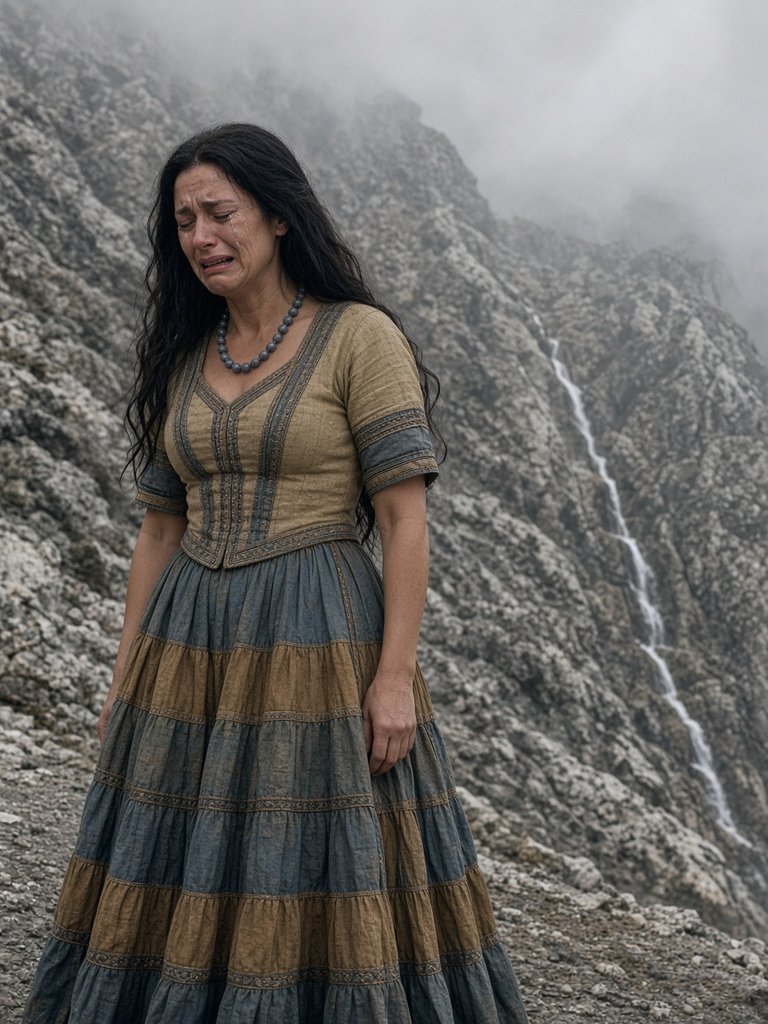
Niobe, daughter of Tantalos and wife of Amphion of Thebes, boasted that she was more blessed than Leto, who had only two children. Achilles tells her story to Priam: “Apollo killed the sons with arrows from his silver bow, to punish Niobe, and Diana slew the daughters, because Niobe had vaunted herself against Leto; she said Leto had borne two children only, whereas she had herself borne many—whereon the two killed the many” (Iliad 24.605–609, tr. Butler).
For nine days the dead lay unburied, for Zeus had turned the people to stone; on the tenth the gods themselves buried them (Iliad 24.610–612, paraphrased). Achilles tells the tale to persuade Priam to eat: “Even lovely Niobe had to think about eating, though her twelve children—six daughters and six lusty sons—had been all slain in her house” (Iliad 24.602–604, tr. Butler).
Niobe herself was turned to stone on Mount Sipylos in Lydia, where “she lives in stone and still nurses the sorrows sent upon her by the hand of heaven” (Iliad 24.614–617, tr. Butler). Pausanias says he climbed Sipylos and saw the rock, which from near is only a crag but from far looks like a weeping woman (1.21.3, paraphrased). Apollodorus says one daughter, Chloris, survived (3.5.6).
Epithets
- ἠΰκομος · ēukomos
- lovely-haired (Iliad 24.602)
Symbols and virtues
Pride that challenges the gods, and grief that turns to stone. Symbols: the weeping rock of Sipylos, the arrows of Apollo and Artemis.
Myths
- The boast against Leto. Iliad 24.602–609.
- The children killed. Iliad 24.605–612.
- Turned to stone. Iliad 24.614–617; Pausanias 1.21.3.
Cult and places
- Mount Sipylos. The weeping rock shown to travellers (Pausanias 1.21.3, 8.2.7).
In the poets
“Even lovely Niobe had to think about eating, though her twelve children—six daughters and six lusty sons—had been all slain in her house.”Homer, Iliad 24.602–604, tr. Samuel Butler (1898), public domain.
Sources
Homer, Iliad 24.599–620; Apollodorus 3.5.6; Ovid, Metamorphoses 6.146–312; Pausanias 1.21.3, 8.2.7.
Quotations in public-domain translations (Evelyn-White 1914, Butler 1898/1900, Taylor 1792); other authors paraphrased.