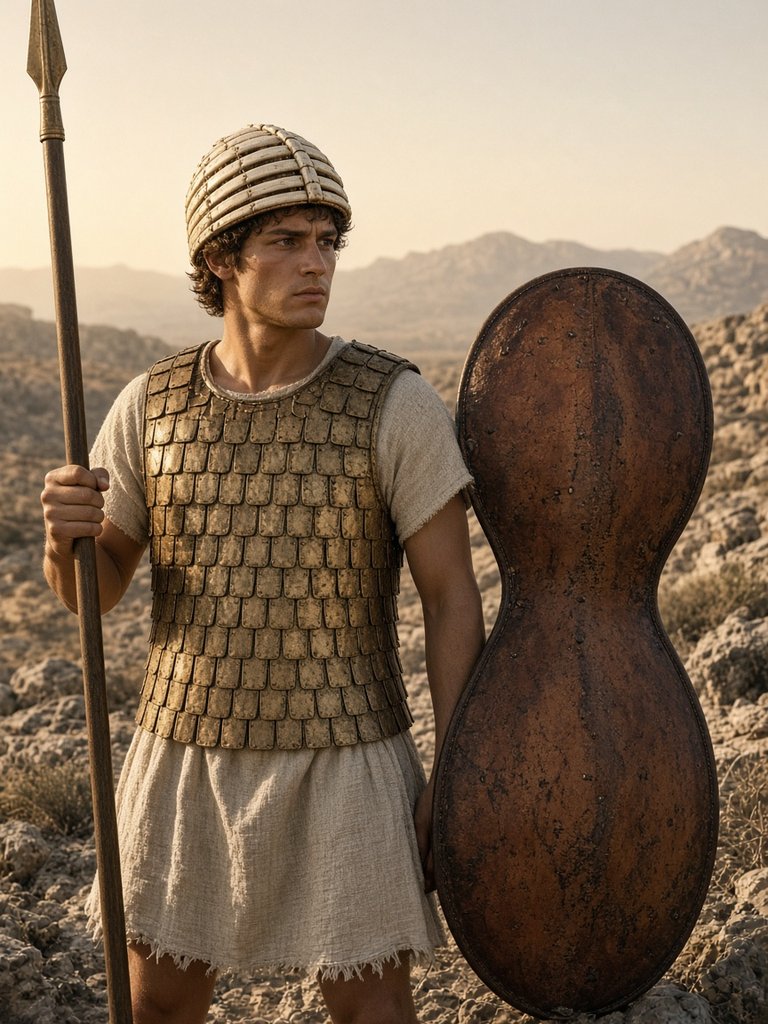
Parthenopaios was the son of Atalanta, by Melanion or, as some said, by Ares or Meleagros (Apollodorus 3.9.2, paraphrased). He grew up in Arkadia and came to Argos, where he joined Adrastos as one of the Seven who marched against Thebes on behalf of Polyneikes (Apollodorus 3.6.3, paraphrased).
In Aeschylus’ Seven against Thebes the scout describes him as a boy barely bearded, beautiful but savage in spirit, who swore by his spear to sack the city, and who bore on his shield the Sphinx holding a Theban (Seven against Thebes 526–549, paraphrased). In Euripides’ Suppliant Women Adrastos praises him as an Arkadian who lived in Argos without giving offence and fought for it as his own (Suppliant Women 888–900, paraphrased).
He was killed at the gates of Thebes, by Periklymenos son of Poseidon according to Euripides and Apollodorus, or by Asphodikos in the epic Thebaid (Euripides, Phoenician Women 1153–1162; Apollodorus 3.6.8; Pausanias 9.18.6, paraphrased). His son Promachos was among the Epigonoi who avenged their fathers.
Epithets
- Παρθενοπαῖος · Parthenopaios
- the maiden’s son
Symbols and virtues
Youthful beauty and fierce courage, dead before his time. Symbols: the Sphinx on the shield, the spear.
Myths
- Son of Atalanta. Apollodorus 3.9.2.
- One of the Seven. Apollodorus 3.6.3.
- His shield and oath. Aeschylus, Seven against Thebes 526–549.
- Death at Thebes. Euripides, Phoenician Women 1153–1162; Pausanias 9.18.6.
Sources
Aeschylus, Seven against Thebes 526–567; Euripides, Suppliant Women 888–900, Phoenician Women 1104–1109, 1153–1162; Apollodorus 3.6.3, 3.6.8, 3.9.2; Pausanias 9.18.6.
Quotations in public-domain translations (Evelyn-White 1914, Butler 1898/1900, Taylor 1792); other authors paraphrased.