Prokne was a daughter of Pandion, king of Athens, and sister of Philomela. Pandion gave her in marriage to Tereus, a Thracian king who had helped Athens in a war, and she bore him a son, Itys (Apollodorus 3.14.8, paraphrased). Thucydides places Tereus at Daulis in Phokis (2.29.3).
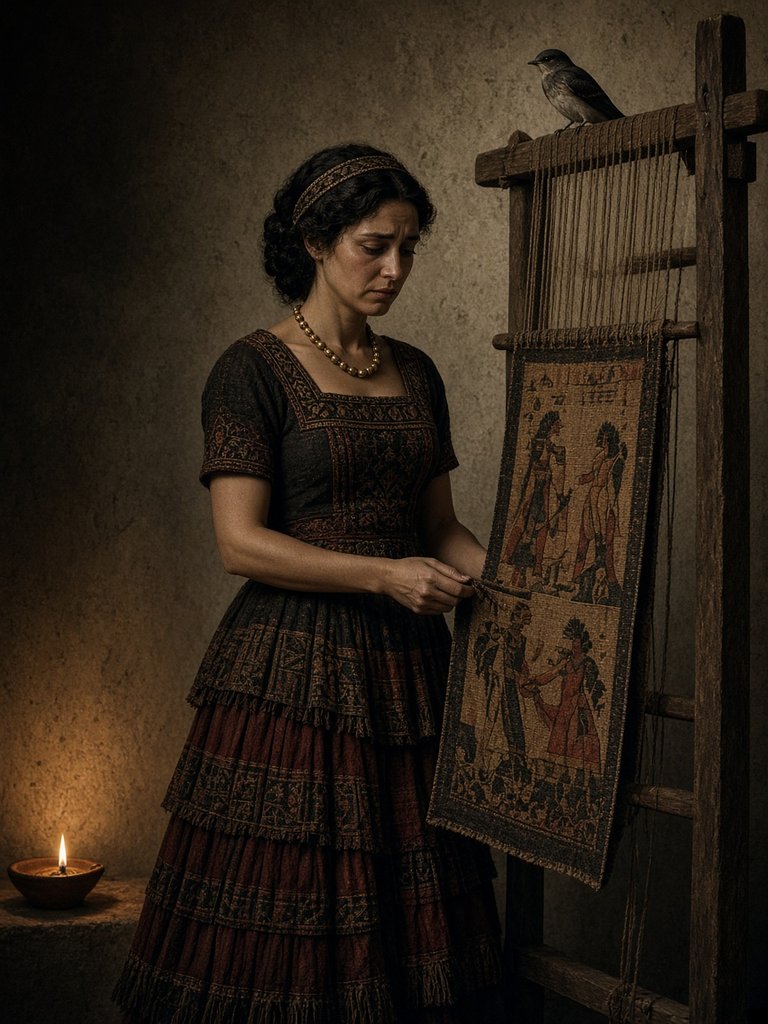
Longing for her sister, she asked Tereus to fetch her. On the way he raped Philomela, cut out her tongue and hid her, telling Prokne she was dead. Philomela wove the story into a robe and sent it to her sister (Apollodorus 3.14.8; Ovid, Metamorphoses 6.424–586, paraphrased).
Prokne found her sister and, in revenge, killed her own son Itys and served his flesh to Tereus. When he pursued the sisters with an axe, the gods changed all three into birds. In the Greek accounts Prokne became the nightingale, ever mourning Itys, and Philomela the swallow; Roman poets reverse them (Apollodorus 3.14.8; Ovid, Metamorphoses 6.587–674; Pausanias 1.41.8–9, paraphrased).
Epithets
- Πανδιονίς · Pandionis
- daughter of Pandion
Symbols and virtues
Sisterhood, terrible vengeance and endless mourning. Symbols: the woven robe, the nightingale.
Myths
- Married to Tereus. Apollodorus 3.14.8; Thucydides 2.29.3.
- The woven message. Ovid, Metamorphoses 6.571–586.
- The death of Itys. Apollodorus 3.14.8; Ovid, Metamorphoses 6.619–666.
- Changed into the nightingale. Apollodorus 3.14.8; Pausanias 1.41.9.
Sources
Sophocles, Tereus (fragments); Thucydides 2.29.3; Apollodorus 3.14.8; Pausanias 1.5.4, 1.41.8–9, 10.4.8–9; Ovid, Metamorphoses 6.424–674.
Quotations in public-domain translations (Evelyn-White 1914, Butler 1898/1900, Taylor 1792); other authors paraphrased.