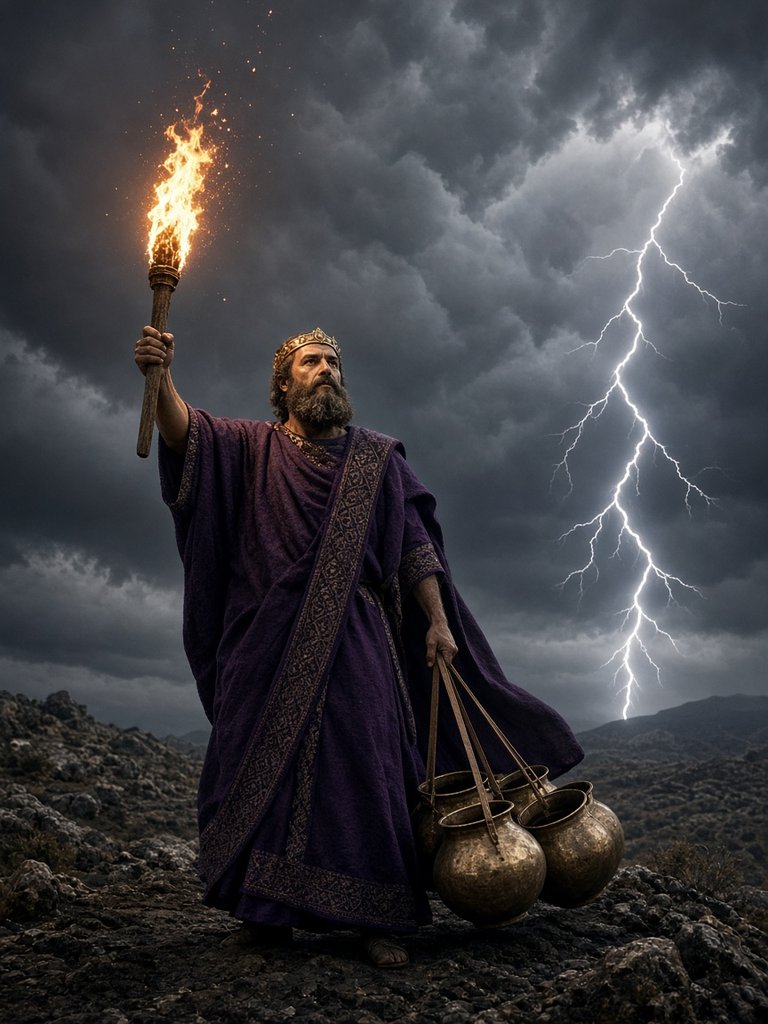
Salmoneus was a son of Aiolos and father of Tyro. In the underworld Odysseus says of her: “She was daughter of Salmoneus and wife of Cretheus the son of Aeolus” (Odyssey 11.235–236, tr. Butler). He left Thessaly and founded the city of Salmone in Elis (Apollodorus 1.9.7, paraphrased).
Arrogant, he claimed to be Zeus himself, took away the god’s sacrifices and ordered them offered to him. He dragged dried hides and bronze cauldrons behind his chariot, saying that he made thunder, and hurled blazing torches into the sky as lightning (Apollodorus 1.9.7, paraphrased).
Zeus struck him with a thunderbolt and wiped out his city and its people (Apollodorus 1.9.7; Diodorus 4.68, paraphrased). Virgil places him among the great sinners in Tartarus, still paying for imitating the fire of Jupiter and the sound of the heavens (Aeneid 6.585–594, paraphrased).
Epithets
- Αἰολίδης · Aiolidēs
- son of Aiolos
Symbols and virtues
Pride that imitates the gods. Symbols: the false thunder of cauldrons, the torch, the real thunderbolt.
Myths
- Father of Tyro. Odyssey 11.235–236.
- Founder of Salmone. Apollodorus 1.9.7.
- The false thunder. Apollodorus 1.9.7.
- Struck by Zeus. Diodorus 4.68; Virgil, Aeneid 6.585–594.
In the poets
“She was daughter of Salmoneus and wife of Cretheus the son of Aeolus.”Homer, Odyssey 11.235–236, tr. Samuel Butler (1900), public domain.
Sources
Homer, Odyssey 11.235–237; Diodorus 4.68, 6.6; Apollodorus 1.7.3, 1.9.7–8; Strabo 8.3.32; Virgil, Aeneid 6.585–594.
Quotations in public-domain translations (Evelyn-White 1914, Butler 1898/1900, Taylor 1792); other authors paraphrased.