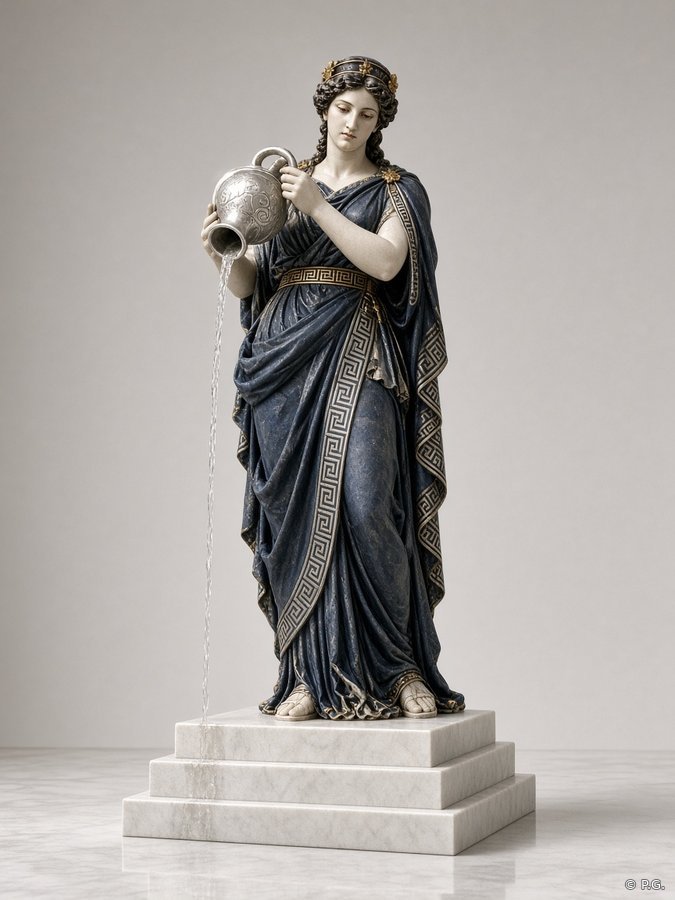
Styx is the eldest daughter of Okeanos and Tethys (Theogony 361, 776–777). When Zeus called the gods to fight the Titans, she came first to Olympus with her children, Zelos, Nike, Kratos and Bia, and Zeus made her the great oath of the gods (Theogony 383–403). Whoever of the gods swears falsely by her water lies a year without breath and is banished from the councils of heaven for nine years more (Theogony 793–806).
Epithets
- Στυγερή · Stygere
- loathed (Theogony 775)
Domains and symbols
The binding oath; the boundary between worlds. Admire: keeping one’s word. Sacred symbol: the cold water falling from the high rock.
Myths
- First to Zeus. She brought her children to Zeus before the war (Theogony 397–403).
- The oath. Iris brings her water in a golden jug when the gods must swear (Theogony 780–806; Iliad 15.37–38).
Cult sites
- Nonakris, Arcadia. The water of Styx falling from a cliff (Herodotus 6.74; Pausanias 8.17.6–8.18.6).
Offerings
She was not worshipped with offerings; men swore by her. Today: make no oath you will not keep.
Beneath the Divine Mind
Styx is the Divine Mind as the binding word, personified and deified as the river of the oath. Like every god she stands beneath the One (The One and the Many).
Honouring Styx today
- Practice. Keep your word.
Hymn
And there dwells the goddess loathed by the deathless gods, terrible Styx, eldest daughter of back-flowing Ocean.Hesiod, Theogony 775–777, tr. H. G. Evelyn-White (1914), public domain. There is no Homeric or Orphic hymn to Styx.
Images
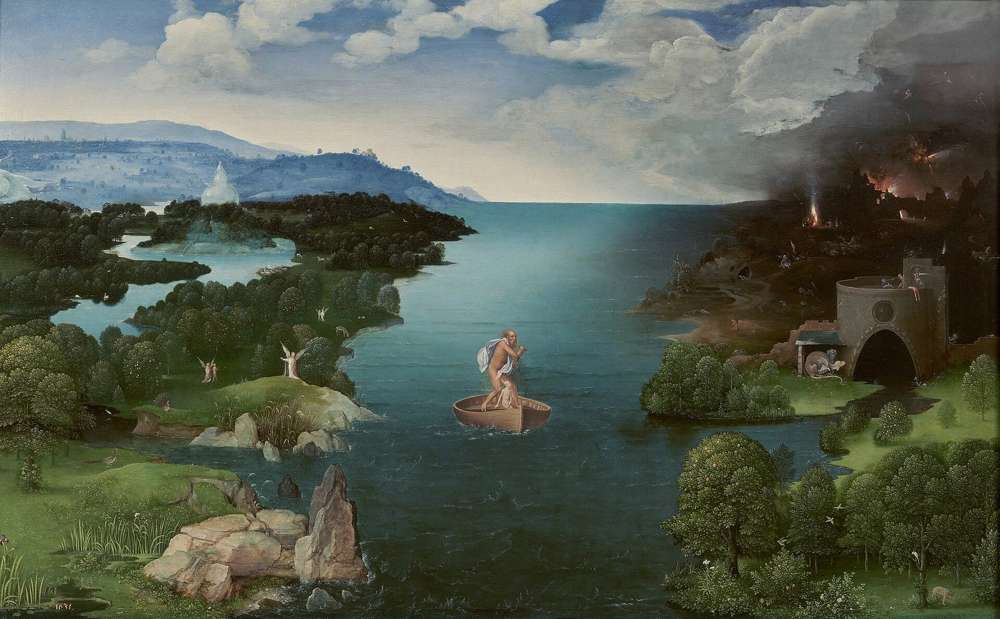
Joachim Patinir, Public domain, via Wikimedia Commons

Sources
Hesiod, Theogony 361, 383–403, 775–806; Homer, Iliad 15.37–38; Herodotus 6.74; Pausanias 8.17.6–8.18.6.
Quotations in public-domain translations (Evelyn-White 1914, Butler 1898/1900, Taylor 1792); other authors paraphrased.