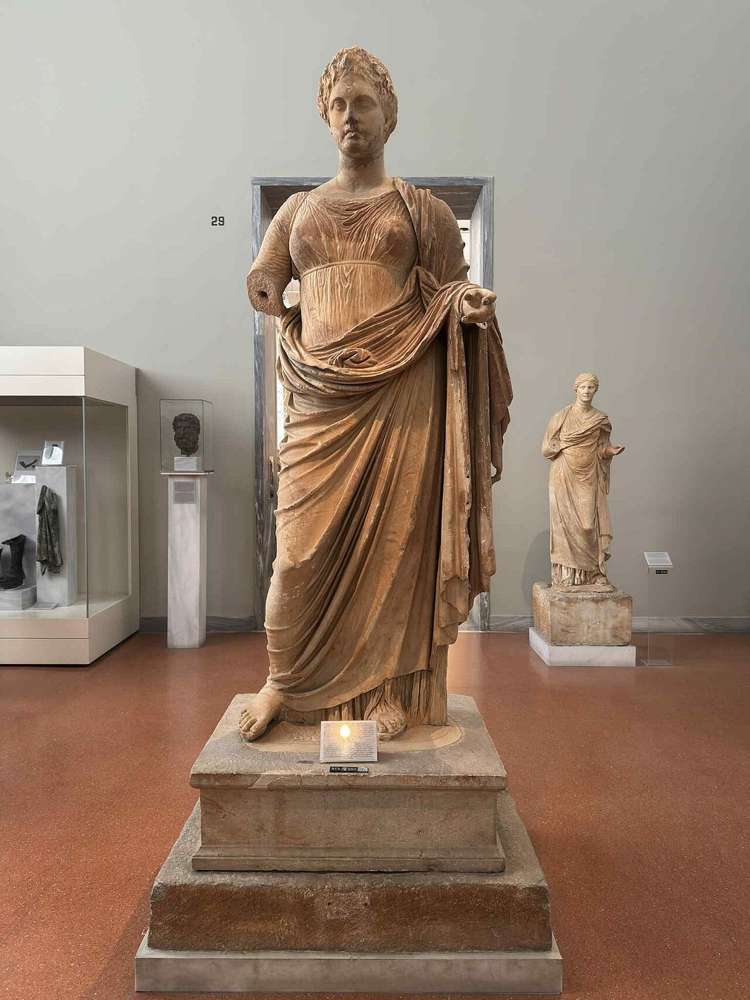
Furius, CC0, via Wikimedia Commons

Themis, Titaness and daughter of Ouranos and Gaia (Theogony 135), was the second wife of Zeus and bore him the Horai, Eunomia, Dike and Eirene, who watch over the works of men, and the Moirai (Theogony 901–906). She held the oracle at Delphi after Earth and before Apollo (Aeschylus, Eumenides 1–3). She calls the gods to assembly and “looses and gathers the assemblies of men” (Iliad 20.4–6; Odyssey 2.68–69).
Epithets
- Εὔβουλος · Euboulos
- of good counsel (Pindar, Isthmian 8.31)
- Σώτειρα · Soteira
- saviour (Pindar, Olympian 8.21–22)
- Ἰχναία · Ichnaia
- of Ichnai (Homeric Hymn to Apollo 94)
Domains and symbols
Divine law, right custom and order; the assembly; oracles. Admire: justice, fairness, keeping the custom of the gods. Sacred symbols: the scales, the sword or sceptre, the oracle bowl.
Myths
- The Horai and the Moirai. Her daughters with Zeus are Good Order, Justice and Peace, and the Fates (Theogony 901–906).
- Delphi. “First Earth, then Themis, then Phoibe” held the oracle before Phoibos Apollo (Aeschylus, Eumenides 1–8).
- The assembly. Zeus bade Themis summon all the gods to council (Iliad 20.4–6).
Cult sites
- Rhamnous. A small temple of Themis beside the temple of Nemesis.
- Thebes. A temple of Themis (Pausanias 9.25.4).
Offerings
Frankincense, as her Orphic hymn asks. Today: pray to her before a decision or a judgement.
Beneath the Divine Mind
Themis is the Divine Mind as law: the right order of things, personified and deified as the counsellor of Zeus. Like every god she stands beneath the One (The One and the Many).
Honouring Themis today
- Altar. A pair of scales.
- Offerings. Frankincense.
- Hymn. Recite the Orphic hymn below.
Hymn
Illustrious Themis, of celestial birth, thee I invoke, young blossom of the earth; beauteous-eyed virgin; first from thee alone, prophetic oracles to men were known.Orphic Hymn 79, To Themis, 1–4. Tr. Thomas Taylor (1792), public domain; divine names as given on Hemera.
Sources
Hesiod, Theogony 135, 901–906; Homer, Iliad 15.87–95, 20.4–6, Odyssey 2.68–69; Aeschylus, Eumenides 1–8; Orphic Hymn 79; Pausanias 9.25.4.
Quotations in public-domain translations (Evelyn-White 1914, Butler 1898/1900, Taylor 1792); other authors paraphrased.