THE PATH TO HENŌSIS
The ancient Hellenic ladder of ascent, and how it was taken over.
P.G.
The ancients had a clear and tested theological structure of ascent that was co-opted and perverted by the Christians trying to wrest power from the Pagans. The Hellenes knew where the soul comes from, what has gone wrong with it, how it climbs back, who helps it climb, and what it finds at the top. They called the top henōsis, union with the divine. Over some nine centuries, from Plato to Proclus, they built and tested a ladder to reach it. The Christians kept the ladder. They changed the reason for climbing it, the meaning of each rung, and the One at the top, and then they shut the schools that had built it. This paper sets out the Hellenic path stage by stage, and at each stage shows what the Christians did with it.
This paper is the companion to The Forgotten Ithaca, which looked at Hellenic polytheism alongside the paths of the East. Here the comparison is with Christianity. It builds on The Roman Crimes Against the Hellenes, which tells how Rome and the Church used law, force and the charge of “idolatry” to suppress the public worship of the gods. That paper is about the temples and the people. This one is about the inner path, the theology of ascent, and what became of it.
1. How to read this paper
Theology is rough ground. Words slide, and a word in one tradition can look like a word in another while meaning something else. So this paper follows four rules.
First, every Greek term is defined when it first appears. A glossary at the end collects them.
Second, the goal and the means are kept apart. The goal of the Hellenic path is henōsis (ἕνωσις), “union” or “becoming one” with the divine. Its Christian counterpart is theōsis (θέωσις), “deification” or “becoming god.” The chief ritual means of the Hellenic path is theurgy (θεουργία, theourgia), “divine work,” the rites given by the gods. Its Christian counterpart is the sacraments (in the Greek Church, the mystēria, “mysteries”). Theurgy is a means, not a goal. It is never the same thing as theōsis. Where this paper compares the two paths, it compares goal with goal and means with means.
Third, quotations are exact. Each one comes from a named public-domain translation and carries its standard reference: Stephanus numbers for Plato (for example Phaedrus 246a), book, treatise and chapter for Plotinus (for example Enneads 6.9.11), and book and chapter for Iamblichus. Where no translation was checked, the paper paraphrases and says so in the notes.
Fourth, each stage has two parts. First comes the ancient Hellenic view. Then comes a short passage marked The Christian adaptation, showing what the Church kept, what it changed, and why.
2. The thesis in brief
The claim of this paper has three parts.
(a) The structure was Hellenic and it was complete. By the fifth century AD the Platonic schools taught a full account of the soul’s ascent. It had a map of reality, a theory of the soul, an account of what had gone wrong, a graded ladder of virtues, a set of rites, a discipline of contemplation, and a named goal. Each part had been argued over and refined by teachers who practised what they taught.
(b) The Christians took it over. Christian writers, above all the author who wrote under the name of Dionysius the Areopagite, took this structure, often in its exact terms and order, and set it inside the Church. The ladder became the hierarchy of the Church, the rites became the sacraments, and union with the One became union with the God of the Bible.
(c) In taking it over, they changed its meaning. The soul’s problem was no longer forgetfulness but guilt. The gods who had helped the soul climb were now called demons who pulled it down. The virtues of the citizen and philosopher gave way to obedience and the fight against temptation. And the Church, now joined to the imperial state, closed the schools and the temples that had kept the older path. This was done by people seeking power over those who held the older faith. The power to grant ascent now passed only through the Church.
The rest of the paper argues these points from the sources, one stage at a time.
3. The structure of reality
The ancient view
The Platonists saw reality as a series of levels. Plotinus (AD 205–270), the founder of what modern scholars call Neoplatonism, named three principles, which he called hypostases (ὑποστάσεις, “underlying realities”).
The One (τὸ ἕν, to hen), also called the Good (τἀγαθόν, tagathon). This is the first source of all things. It is perfectly simple. It is beyond being and beyond thought, so nothing we say of it is strictly true. It is not a person who chooses or judges.
Intellect (νοῦς, nous). This is the divine mind. It thinks the eternal Forms, the perfect patterns of all things. For the later Platonists, the gods live at this level and above it.
Soul (ψυχή, psychē). This is the principle of life and movement. The World Soul gives life to the whole cosmos. Individual souls, ours among them, belong to this level.
Below Soul lie nature and the visible cosmos (κόσμος, “ordered world”), and at the very edge lies matter (ὕλη, hylē), which has almost no being of its own.
All things come from the One in an outflow called procession (πρόοδος, proodos). All things also long to go back to their source. This going back is called return or reversion (ἐπιστροφή, epistrophē). Proclus (AD 412–485), head of the Platonic school at Athens, made this into a rule: every effect remains in its cause, proceeds from it, and reverts to it (Elements of Theology, prop. 35, paraphrased).
This is the key to the whole path. The way down is also the way up. The soul came down through the levels. It goes back up through the same levels, in reverse order. The ladder is not invented. It is built into the shape of reality.
Two features of this map matter for what follows. First, the cosmos is not evil. It is the outflow of the Good and is full of gods. Second, there is no break between the divine and the world. The levels shade into one another, so the divine can be reached from where we stand.
The Christian adaptation
The Church could not keep this map as it stood. The God of the Bible is a creator who made the world “from nothing” by an act of will, not a source from which things flow. So Christian writers kept the language of levels, light and outflow, but cut the chain at one point. They placed an absolute gap between the uncreated God and all created things. The gods who filled the middle levels had to be removed. Their places were given to ranks of angels, and the gods themselves were reclassed as demons (see sections 8 and 12). The map of procession and return survived; the population of the map was replaced.
4. The soul
The ancient view
Divine origin. For Plato the soul is not made by the body and does not die with it. In the Phaedrus Socrates says: “All soul is immortal, for she is the source of all motion” (245c, tr. Jowett). The soul’s home is above, among the gods.
The chariot. Plato pictures the soul as a team: “a pair of winged horses and a charioteer.” In the gods, both horses are good. In us, “one of them is noble and of noble breed, and the other is ignoble and of ignoble breed; and the driving of them of necessity gives a great deal of trouble” (246a–b, tr. Jowett). The charioteer is reason. The good horse is the spirited part. The unruly horse is appetite.
The wings. The soul rises on wings. “The divine is beauty, wisdom, goodness, and the like; and by these the wing of the soul is nourished, and grows apace; but when fed upon evil and foulness and the opposite of good, wastes and falls away” (246d–e, tr. Jowett). This sentence holds the whole ethic of the path. Goodness is food for the soul’s wings. Vice starves them.
The descent. A soul that cannot keep up with the gods falls. It “sinks beneath the double load of forgetfulness and vice, and her wings fall from her and she drops to the ground” (248c, tr. Jowett). It then takes a body. Note the two causes named: forgetfulness and vice. Not guilt, and not an inherited crime.
Rebirth. The fallen soul passes through many lives. “Ten thousand years must elapse before the soul of each one can return to the place from whence she came, for she cannot grow her wings in less,” though the philosopher may return sooner (248e–249a, tr. Jowett). The Greek word for this passage through lives is metensōmatōsis (μετενσωμάτωσις, “re-embodiment”). Rebirth is not a punishment without end. It is a long school.
The vehicle. The later Platonists held that the soul wears a subtle body called the ochēma (ὄχημα, “vehicle” or “chariot”), named after Plato’s chariot. It is finer than flesh and joins the soul to the body. It can be clouded or cleansed. Iamblichus and Proclus taught that the rites purify this vehicle, which is one reason the rites matter (on this see Shaw, Theurgy and the Soul, and Dodds’s appendix on the astral body in his edition of Proclus’s Elements of Theology).
Two views of the descent. Here the Platonists disagreed, and the disagreement shapes the whole path.
Plotinus: the undescended soul. Plotinus held that part of us never left. “Not the whole soul enters into the body. By her higher part, she ever remains united to the intelligible world; as, by her lower part, she remains united to the sense-world” (Enneads 4.8.8, tr. Guthrie). If this is so, the ascent is mainly a matter of waking up. We turn inward and find the part of us that is still above.
Iamblichus: the full descent. Iamblichus of Chalcis (c. AD 245–325) rejected this. He held that the whole soul descends. Nothing in us stays above. If so, we cannot climb by our own thinking alone, because our thinking has come down too. We need help from above, from the gods, given through the rites they established. Later Platonists, including Proclus, sided with Iamblichus on this point (Shaw, Theurgy and the Soul). This is why theurgy (section 9) became central in the later schools.
Both views share one thing. The soul is divine in origin and its descent can be reversed.
The Christian adaptation
The Church kept the soul’s immortality and the language of ascent. It dropped three things. It rejected the soul’s existence before birth, and with it rebirth. It rejected the soul’s divine origin: the soul was now a creature, made from nothing. And it reread the fall. In Plato a soul falls through forgetfulness and vice and can grow its wings again. In the Christian account, all humanity fell in Adam: “by one man sin entered into the world, and death by sin” (Romans 5:12, King James Version). The cure could no longer come from the soul’s own nature, helped by the gods. It had to come through the Church.
5. The descent into birth
Section 4 said that the soul comes down from above and takes a body. This section shows how the ancients pictured that coming down. Three sources give the picture: Plato’s Myth of Er, Macrobius’s account of the soul’s path through the heavens, and the gold tablets buried with initiates. They agree on one point above all. The soul forgets on its way into birth, and the path home begins with remembering.
The Myth of Er (Plato, Republic 10)
Plato ends the Republic with a story (614b–621d). Its hero is “Er the son of Armenius, a Pamphylian by birth.” He was killed in battle, but his body did not decay, and “on the twelfth day, as he was lying on the funeral pile, he returned to life” and told what he had seen (614b, tr. Jowett). The story has three key stages.
1. The spindle of Necessity. The souls travel to a column of light. From it “is extended the spindle of Necessity, on which all the revolutions turn” (616c, tr. Jowett). Necessity (Ἀνάγκη, Anankē) is the power that holds the cosmos in order. Her daughters are the three Fates (Μοῖραι, Moirai): Lachesis, who allots; Clotho, who spins; and Atropos, who makes the thread unchangeable.
2. The choice of lives. A prophet takes lots and samples of lives from the knees of Lachesis and speaks:
“Hear the word of Lachesis, the daughter of Necessity. Mortal souls, behold a new cycle of life and mortality. Your genius will not be allotted to you, but you will choose your genius; and let him who draws the first lot have the first choice, and the life which he chooses shall be his destiny. Virtue is free, and as a man honours or dishonours her he will have more or less of her; the responsibility is with the chooser—God is justified.” (617d–e, tr. Jowett)
“Genius” here translates daimōn (δαίμων), a guiding spirit. In Greek usage a daimōn is not an evil being. It is a divine guardian. Each soul chooses its own life, and with it its own guardian. The lesson is plain. The soul is responsible for its life. Not the gods, and not an ancestor.
Plato shows what wisdom looks like here. The soul of Odysseus draws the last lot. “The recollection of former toils had disenchanted him of ambition,” and he searched for “the life of a private man who had no cares,” and was glad to find it (620c–d, tr. Jowett). Experience from past lives, remembered, leads to a wise choice.
3. Forgetting. Then the souls pass beneath the throne of Necessity and march
“to the plain of Forgetfulness, which was a barren waste destitute of trees and verdure; and then towards evening they encamped by the river of Unmindfulness, whose water no vessel can hold; of this they were all obliged to drink a certain quantity, and those who were not saved by wisdom drank more than was necessary; and each one as he drank forgot all things.” (621a, tr. Jowett)
In Greek the plain is Lēthē (Λήθη, Forgetfulness) and the river is Amelēs (Ἀμέλης, Unmindfulness or Carelessness). Note the words “those who were not saved by wisdom drank more than was necessary.” Wisdom limits forgetting. That is why philosophy matters: it is the art of not forgetting too much. Then “in an instant they were driven upwards in all manner of ways to their birth, like stars shooting” (621b, tr. Jowett).
Socrates ends with the moral: the tale “will save us if we are obedient to the word spoken; and we shall pass safely over the river of Forgetfulness and our soul will not be defiled” (621c, tr. Jowett).
The gates of the heavens (Macrobius)
Macrobius was a Latin writer of the early fifth century AD. His Commentary on the Dream of Scipio explains a passage in Cicero, and in Book 1, chapter 12, he gives a detailed map of the soul’s descent drawn from earlier Platonists. No public-domain English translation could be checked, so this account is a paraphrase of 1.12 (the standard English translation is W. H. Stahl’s, listed in the references).
- Two gates. The soul comes down from the heavens by way of the Milky Way. Where the Milky Way crosses the zodiac there are two gates. Cancer is the gate of men: souls pass down through it into birth. Capricorn is the gate of gods: souls pass up through it on their return.
- The cup. Between Cancer and Leo lies the constellation of the Cup (Crater), which Macrobius links to Bacchus. Here the descending soul first tastes a drink that makes it heavy and forgetful. This is his version of Plato’s river of Forgetfulness. A soul that drinks less remembers more.
- A gift at each sphere. As the soul falls through the seven planetary spheres it takes on a faculty from each. From Saturn it receives reasoning and understanding; from Jupiter, the power to act; from Mars, spirited boldness; from the Sun, sense-perception and imagination; from Venus, desire; from Mercury, the power of speech and interpretation; and from the Moon, the power of growth and nourishment of the body.
- The return. The way up is the way down in reverse. The soul goes back through the same heavens and leaves by the gate of the gods. This fits the rule of procession and return set out in section 3.
Two points follow. First, the faculties are not evil. They are gifts of the planetary gods, needed for life in a body. Second, the soul’s real trouble on the way down is the cup, that is, forgetting.
The gold tablets
Small inscribed sheets of gold have been found in graves in southern Italy, Greece and Crete. Modern scholars often call them “Orphic” gold tablets, after Orpheus, the legendary singer whose teachings on the soul were followed by some initiates. They were buried with the dead as instructions for the journey after death. One of the best known was found near Petelia in southern Italy and is now in the British Museum. It is usually dated to the fourth century BC.
The translation below is Gilbert Murray’s, from the appendix he wrote for Jane Harrison’s Prolegomena to the Study of Greek Religion (1903), “Critical Appendix on the Orphic Tablets,” I, “The Petelia Tablet.” The round brackets are Murray’s.
“Thou shalt find to the left of the House of Hades a Well-spring,
And by the side thereof standing a white cypress.
To this Well-spring approach not near.
But thou shalt find another by the Lake of Memory,
Cold water flowing forth, and there are Guardians before it.
Say: ‘I am a child of Earth and of Starry Heaven;
But my race is of Heaven (alone). This ye know yourselves.
And lo, I am parched with thirst and I perish. Give me quickly
The cold water flowing forth from the Lake of Memory.’
And of themselves they will give thee to drink from the holy Well-spring,
And thereafter among the other Heroes thou shalt have lordship....”
The tablet turns Plato’s picture around for the journey home.
- On the way into birth, in the Myth of Er, the soul drinks from Forgetfulness.
- On the way out, the initiate must refuse the first spring and drink instead from the Lake of Memory (Μνημοσύνη, Mnēmosynē, also the name of the goddess Memory, mother of the Muses).
- The password is a statement of origin: “I am a child of Earth and of Starry Heaven; but my race is of Heaven.” The soul is saved by knowing what it is.
What the three sources teach together
Put side by side, the three sources give one clear teaching.
- The soul existed before this life and comes down from the heavens.
- It chooses its life and is responsible for the choice.
- On the way down it forgets. Forgetting, not guilt, is the root of its trouble.
- The way back is remembering: drinking from Memory, “saved by wisdom.”
- The way back retraces the way down.
This is the ground on which the rest of the ladder stands. Virtue, rite and contemplation are all forms of remembering.
The Christian adaptation
The Church rejected this whole picture. It taught that each soul is created by God for one body and one life. It has no life before birth, makes no choice of lives, and is not reborn. The teaching that souls existed before birth was linked above all with the Christian writer Origen of Alexandria (c. AD 185–254), and it was condemned. A list of fifteen anathemas against Origenist teachings is associated with the Council of Constantinople of 553. The first reads: “If anyone asserts the fabulous pre-existence of souls, and shall assert the monstrous restoration which follows from it: let him be anathema” (tr. H. R. Percival, Nicene and Post-Nicene Fathers, series 2, vol. 14). Scholars debate whether these anathemas were formally passed by the council itself or shortly before it, but the condemnation of pre-existence in that period is not in doubt.
The effect on the path was large. In the Hellenic view the soul’s past is the key to its cure: it has forgotten what it knew, and it can remember. Once pre-existence was declared a heresy, there was nothing to remember. The soul’s trouble had to be explained in a new way, as the inherited sin of Adam (section 6), and its cure had to come from outside it, through the Church. The river of Forgetfulness was replaced by the font of Baptism.
6. What went wrong, and how it is undone
The ancient view
The Hellenes had no word that matches the Christian word “sin” in its full sense, that is, an offence against a personal God that brings guilt and deserves punishment. Their account of the soul’s trouble used other words. Each describes a condition to be healed, not a debt to be paid.
Forgetfulness (λήθη, lēthē). The soul forgets what it saw among the gods. This is the “double load of forgetfulness and vice” of the Phaedrus (248c). Plato’s answer is recollection (ἀνάμνησις, anamnēsis): learning is remembering what the soul already knew.
Error (ἁμαρτία, hamartia). The word means “missing the mark,” as an archer misses. It is a failure of aim, often caused by ignorance. The same Greek word was later used by Christians for “sin.” The word stayed; its weight changed.
Impurity (μίασμα, miasma). This is pollution, a stain the soul takes on from contact with the body, with passions, or with certain acts. A stain is removed by washing, not by a sentence.
Daring or boldness (τόλμα, tolma). Plotinus speaks of the soul’s wish to belong to itself as the start of its trouble (Enneads 5.1.1, paraphrased). This is a turning away, a self-will, not a crime against a judge.
Since the trouble is forgetfulness, error and stain, the cure is remembering, correction and cleansing. The ancients had two key words for it.
Katharsis (κάθαρσις, “purification”). In the Phaedo Socrates asks: “what is purification but the separation of the soul from the body … the habit of the soul gathering and collecting herself into herself from all sides out of the body … the release of the soul from the chains of the body?” (67c–d, tr. Jowett). He also says that the virtues themselves are purification: “temperance, and justice, and courage, and wisdom herself are the purgation of them,” that is, of the passions (69b–c, tr. Jowett).
Lysis (λύσις, “release” or “loosing”). This is the untying of the soul from what binds it. The Phaedo passage above speaks of exactly this “release.”
Plato ties katharsis to the mysteries. “He who passes unsanctified and uninitiated into the world below will lie in a slough, but … he who arrives there after initiation and purification will dwell with the gods. For ‘many,’ as they say in the mysteries, ‘are the thyrsus-bearers, but few are the mystics’” (69c–d, tr. Jowett). Philosophy, rite and virtue are all forms of the same cleansing.
Notice who does the work. The soul, helped by the gods, does it. No one has to die in its place. No institution holds the keys. Release is the soul’s own recovery of its nature.
The Christian adaptation
The Church kept the vocabulary: hamartia, katharsis, illumination, release. It changed the problem underneath. In the Christian account the soul’s state is guilt before God, shared by all through Adam (Romans 5:12). The cure is salvation (σωτηρία, sōtēria), given by God through Christ’s death and received through the Church. Baptism takes over the ancient role of the cleansing rite. But it now washes away guilt, not forgetfulness. The difference is not small. A soul that has forgotten can be taught by any good teacher. A soul that is guilty can be pardoned only by the one who holds the right to pardon. Moving the problem from ignorance to guilt moved the power to cure it into the hands of the clergy.
7. The ladder of virtues
The ancient view
The Greek word for virtue is aretē (ἀρετή), “excellence.” It means doing well what a thing is made to do. The four chief virtues, named by Plato in the Republic, are wisdom (sophia), courage (andreia), self-control (sōphrosynē) and justice (dikaiosynē).
Plato gave the reason for virtue in the Theaetetus: “we ought to fly away from earth to heaven as quickly as we can; and to fly away is to become like God, as far as this is possible; and to become like him, is to become holy, just, and wise” (176a–b, tr. Jowett). The Greek phrase is homoiōsis theōi (ὁμοίωσις θεῷ), “likeness to god.” Virtue is not obedience to a rule. It is becoming like the divine.
Plotinus built on this in his treatise On Virtues (Enneads 1.2). He asked how virtue can make us like the gods, when the gods have no need of courage or self-control. His answer was that the same virtues exist at different levels. The civic virtues bring measure to the passions. The higher, purificatory virtues free the soul from the passions altogether and turn it toward Intellect (paraphrased).
Porphyry (c. AD 234–305), Plotinus’s student and editor, set the levels out as a graded ladder in his Sentences (Sententiae 32, paraphrased):
- Civic virtues (πολιτικαί, politikai). The four virtues as practised in daily life and in the city. They bring metriopatheia, measured passion.
- Purificatory virtues (καθαρτικαί, kathartikai). The same virtues turned inward. They free the soul from the body’s pull. They bring apatheia, freedom from passion.
- Contemplative virtues (θεωρητικαί, theōrētikai). The virtues of a soul that now looks to Intellect.
- Paradigmatic virtues (παραδειγματικαί, paradeigmatikai). The virtues as they exist in Intellect itself, the patterns of which all lower virtues are copies.
The later school added rungs. Marinus, Proclus’s student and successor, wrote a Life of Proclus arranged by the grades of virtue. He begins with natural and ethical virtues, then moves through civic, purificatory and contemplative virtues, and places the theurgic virtues (θεουργικαί, theourgikai) at the top (Life of Proclus 3, paraphrased). Marinus presents his teacher’s life as a climb up this ladder.
Three points about this ladder must be clear.
It is graded. Each rung builds on the one below. No one skips civic virtue and goes straight to contemplation.
It is the same virtues all the way up. Justice in the market and justice in Intellect are the same virtue at different heights.
It begins in public life. The first rung is the good citizen. The path to the gods runs through the city, the family and the festival, not away from them.
The Christian adaptation
The Church kept the four virtues, which it later called the “cardinal” virtues, and added faith, hope and love. It kept the idea of grades. But the moving force of the Christian ladder was different. The monastic writers built their ladders out of struggle against vices, which Evagrius of Pontus (AD 345–399) listed as eight “thoughts” (logismoi). Through John Cassian and Pope Gregory the Great these became the Western “seven deadly sins.” The civic rung, where the Hellenic ladder begins, lost its place. The model life was no longer the just citizen but the monk who left the city. And the climb was now framed as a war against tempting demons, not as growth into likeness with the gods. Section 12 shows this in John Climacus’s Ladder.
8. The gods at every rung
The ancient view
The Hellenic soul does not climb alone. The gods help at every stage. This is the point most often lost when the path is retold.
Following one’s god. In the Phaedrus the souls ride behind the gods: “Zeus, the mighty lord, holding the reins of a winged chariot, leads the way in heaven, ordering all and taking care of all; and there follows him the array of gods and demi-gods.” Any soul may join: “he may follow who will and can, for jealousy has no place in the celestial choir” (246e–247a, tr. Jowett). Each soul belongs to the train of one god. On earth, “he who follows in the train of any other god, while he is unspoiled and the impression lasts, honours and imitates him, as far as he is able” (252d, tr. Jowett). The first form of divine help is a model to follow.
Rung by rung. Each rung of the ladder in section 7 has its matching form of help.
- Civic virtue: the gods of the city. Festivals, oaths, sacrifices and the honour of the household gods shape character. Piety (εὐσέβεια, eusebeia, “right reverence”) is itself part of civic virtue.
- Purificatory virtue: the mysteries. The rites of purification and initiation, at Eleusis and elsewhere, were held to be gifts of the gods. Plato himself, as quoted above, ties purification to initiation (Phaedo 69c–d).
- Contemplative virtue: divine light. The gods dwell at the level of Intellect and above. A mind that turns toward them is lit by them. The Platonists spoke of illumination (ἔλλαμψις, ellampsis).
- Theurgic virtue: the rites and the symbols. At the top, the gods act through the tokens they placed in the world (section 9).
Prayer. Prayer (εὐχή, euchē) runs through every rung. Iamblichus discusses prayer in Book 5 of On the Mysteries, treating it as something that joins the soul to the gods by degrees (paraphrased; see Clarke, Dillon and Hershbell’s translation).
Divine love. In the Symposium, love (ἔρως, erōs) is a great spirit that carries the soul upward (section 10).
Chains of the gods. Proclus taught that each god heads a chain (σειρά, seira) that runs down through spirits, souls, animals, plants and stones. Every thing in nature belongs to some god’s chain and carries that god’s mark. So the world is full of handholds back to the gods (paraphrased; see Shaw and Uždavinys).
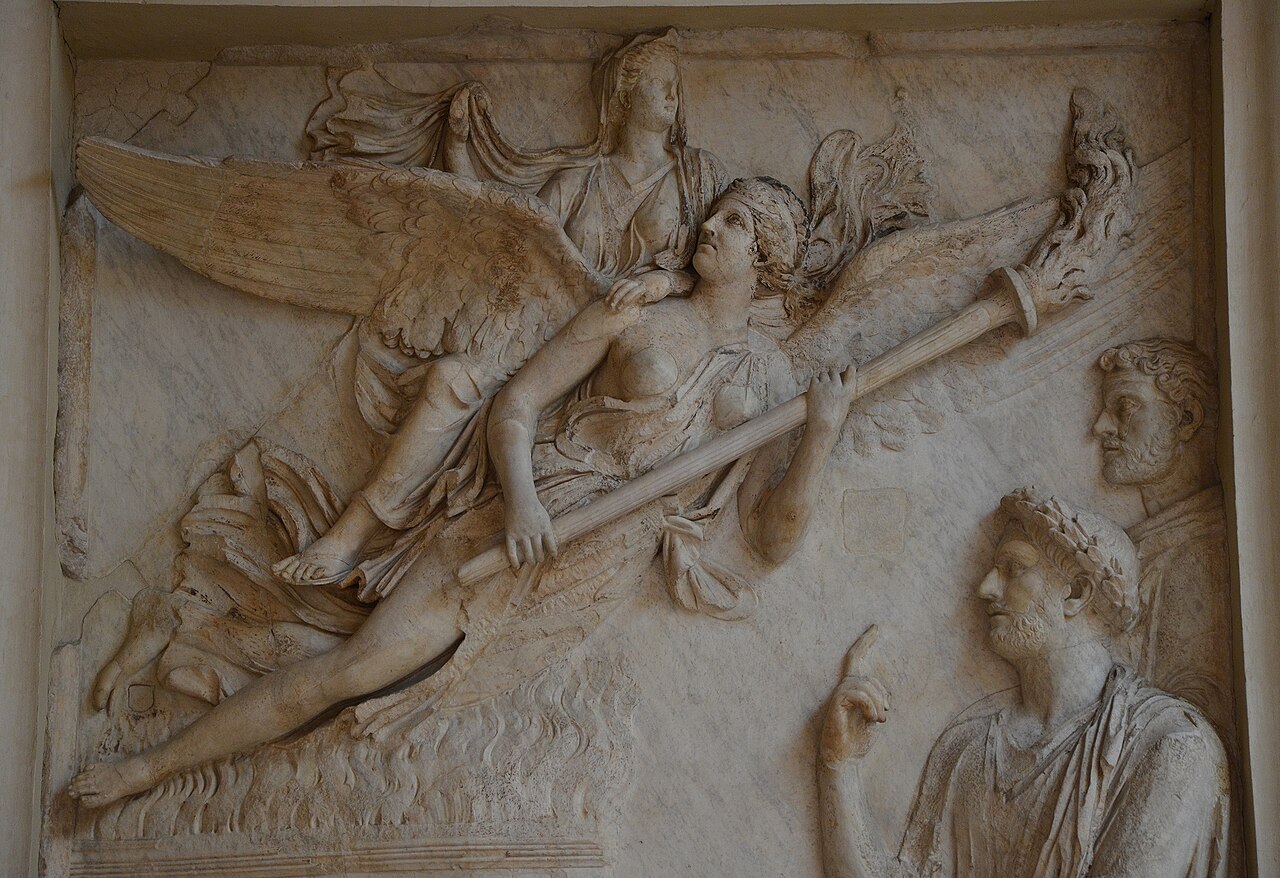
The relief above shows a Roman image of ascent: an empress carried up to the heavens. Rome turned the old idea of the soul’s rise into a state honour for its rulers. That is a different and more political thing than the philosophers’ path. But it shows how widely the ancient world held that the gods could raise a soul to themselves.
The Christian adaptation
This is the place where the change is sharpest. The Church kept the idea of helpers between the soul and God: ranks of angels, and later the saints. It took away the gods. Following Psalm 96:5 in the Greek Septuagint (95:5 in its numbering), which says that the gods of the nations are demons, Christian writers reclassed the gods as evil spirits. The Roman Crimes Against the Hellenes sets out how this “theology of demons” was turned into law and force. For the inner path, the result is plain. The helpers who had led the soul upward were now said to be the very beings who dragged it down. The Christian monk, climbing his ladder, fights the demons. The Hellenic philosopher, climbing his, follows his god.
9. Theurgy: the means
What theurgy is
Theurgy (θεουργία, theourgia) means “divine work” or “god-work.” It is the rites by which the gods act on the soul. The word is used of a set of practices: prayers, hymns, offerings, the use of sacred names, and the use of objects and signs that belong to particular gods. Its greatest defender was Iamblichus, in the work known as On the Mysteries (Latin De Mysteriis), written as a reply to questions from Porphyry.
Theurgy is a means. It is one of the ways up the ladder, the highest way in Iamblichus’s view. It is not the goal. The goal is henōsis (section 11). Its Christian counterpart, as a means, is the sacraments. It is not the counterpart of theōsis, which is a goal.
Why thinking is not enough
Iamblichus’s central argument is that the human mind cannot reach the gods by its own power. This follows from his view that the whole soul has descended (section 4).
“For a conception of the mind does not conjoin theurgists with the Gods; since, if this were the case, what would hinder those who philosophize theoretically, from having a theurgic union with the Gods? Now, however, in reality, this is not the case. For the perfect efficacy of ineffable works, which are divinely performed in a way surpassing all intelligence, and the power of inexplicable symbols, which are known only to the Gods, impart theurgic union.” (On the Mysteries 2.11, tr. Thomas Taylor)
He goes on: “when we do not energize intellectually, the synthemata themselves perform by themselves their proper work, and the ineffable power of the Gods itself knows, by itself, its own images” (2.11, tr. Taylor).
The symbols
The synthēmata (συνθήματα, “tokens” or “passwords”) and symbola (σύμβολα, “symbols”) are signs the gods placed in the world. They may be names, sounds, plants, stones or images. Each belongs to a god’s chain (section 8). In the rite they are not tools by which a human controls a god. Iamblichus is clear that the lower cannot move the higher: in the same chapter he says it is not natural for “perfect” natures to be excited “by imperfect natures, nor wholes by parts” (2.11, tr. Taylor). The gods themselves act through their own signs. The theurgist offers a place for the god’s action, and the god acts.
Theurgy and philosophy
Iamblichus did not reject philosophy. Thought and virtue prepare the soul. But at the top, the rite completes what thought cannot. This is why Marinus places the theurgic virtues above the contemplative ones (section 7). It is also why the later Athenian school, under Proclus, combined commentary on Plato with hymns, festivals and rites. Some of Proclus’s own Hymns survive.
Theurgy is not magic
Critics, ancient and modern, called theurgy magic. Its defenders rejected this. On their account, magic tries to force spirits to serve human ends, while theurgy submits the soul to the gods. The difference lies in who acts and who serves (see Shaw, Theurgy and the Soul; for a more critical view, Dodds, “Theurgy and its Relationship to Neoplatonism,” appendix II of The Greeks and the Irrational).
The Christian adaptation
The Church kept the logic of theurgy and changed its owner. Christian sacraments work, in Church teaching, by divine power through material signs: water, oil, bread and wine. This is the same logic Iamblichus gave for the synthēmata. The author writing as Dionysius the Areopagite even used the word theourgia for the divine works of Christ and spoke of the Church’s rites in the same vocabulary (see Louth and Rorem in the references). Two things changed. First, the gods’ signs were declared demonic, and the Church’s signs alone were valid. Second, only an ordained priest could perform the rites. The Hellenic theurgist served the gods through tokens found in all of nature. The Christian priest held a monopoly on the only signs now allowed.
10. Contemplation: the ladder of love
The ancient view
Contemplation (θεωρία, theōria) means “beholding” or “looking at.” It is the soul’s steady gaze on what is real. Its classic map is the speech of the priestess Diotima in Plato’s Symposium, often called the ladder of love.
“And the true order of going, or being led by another, to the things of love, is to begin from the beauties of earth and mount upwards for the sake of that other beauty, using these as steps only, and from one going on to two, and from two to all fair forms, and from fair forms to fair practices, and from fair practices to fair notions, until from fair notions he arrives at the notion of absolute beauty, and at last knows what the essence of beauty is.” (Symposium 211b–c, tr. Jowett)
Laid out plainly, the steps are:
- One beautiful body.
- All beautiful bodies.
- Beautiful practices, that is, ways of living.
- Beautiful notions, that is, kinds of knowledge.
- Beauty itself.
Three features stand out. The ladder starts with the world, not against it: earthly beauty is the first step. Each step is used and then passed, “as steps only.” And the force that moves the climber is erōs, love, which Diotima calls a great spirit between gods and mortals (Symposium 202d–e, paraphrased). Love of beauty is the engine of ascent.
Plotinus took up this ladder in his treatise On Beauty (Enneads 1.6) and carried it higher. For him the soul passes beyond beauty and even beyond Intellect to the One (section 11).
The Christian adaptation
Christian writers kept the ladder of contemplation and the term theōria. Gregory of Nyssa’s Life of Moses describes the soul climbing ever higher into the darkness of God. Pseudo-Dionysius’s Mystical Theology describes an ascent beyond all names into a divine darkness, close to Plotinus and Proclus in method. But the starting point moved. Diotima’s ladder begins with the beauty of a body. The Christian monastic ladder begins by turning away from bodies. Erōs, for Plato the great spirit of ascent, came under suspicion as a passion to be fought.
11. Henōsis: the goal
The ancient view
Henōsis (ἕνωσις) means “union” or “becoming one.” It is the goal of the whole path. The soul, having climbed through virtue, rite and contemplation, is joined to the divine. For Plotinus it is union with the One. For Iamblichus and Proclus it comes through union with the gods, who are themselves rooted in the One.
On Hekate’s place in the Chaldean scheme, see The Chaldean Oracles.
Plotinus describes it at the end of his treatise On the Good or the One (Enneads 6.9). The translation here is Guthrie’s; words in round brackets are the translator’s additions.
“In this condition, indeed, the soul busies herself not even with the beautiful things, for she rises above beauty, and passes beyond even the (Stoic) ‘choir of virtues.’ Thus he who penetrates into the interior of a sanctuary leaves behind him the statues placed (at the entrance) of the temple.” (Enneads 6.9.11, tr. Guthrie)
The image is drawn from temple worship. The statues of the gods stand at the entrance. The worshipper passes them on the way in and, as Plotinus says, they are “the first objects that will strike his view on his exit from the sanctuary” (6.9.11, tr. Guthrie). They are not rejected. They are the way to the inner shrine.
Plotinus says the vision did not involve “two things”: the one who saw was united to what he saw (6.9.11, tr. Guthrie). He ends:
“Such is the life of the divinities; such is also that of divine and blessed men; detachment from all things here below, scorn of all earthly pleasures, and flight of the soul towards the Divinity that she shall see face to face (that is, ‘alone with the alone,’ as thought Numenius).” (Enneads 6.9.11, tr. Guthrie)
A. H. Armstrong’s Loeb translation renders the close as “the flight of the alone to the alone,” the form in which it is best known.
Four features of henōsis must be kept clear.
It is not a permanent loss of self in this life. Plotinus says that after losing the vision the soul may “reascend to the celestial region, by virtue rising to Intelligence, and by wisdom to the Divinity Himself” (6.9.11, tr. Guthrie).
It is not earned as a wage. It is the soul’s return to its own source.
It is open, in principle, to every soul. Porphyry says, in his Life of Plotinus 23, that Plotinus reached this union four times while Porphyry was with him, and that Porphyry himself reached it once (paraphrased).
It is the goal, not the means. Theurgy, virtue and contemplation lead to it. None of them is it.
The Christian adaptation
The Christian counterpart of henōsis is theōsis, deification. Athanasius of Alexandria put it in a famous line: “He was made man that we might be made God” (On the Incarnation 54.3, tr. A. Robertson, Nicene and Post-Nicene Fathers, series 2, vol. 4). The scriptural basis claimed for it is 2 Peter 1:4, “partakers of the divine nature” (KJV). The Greek Church kept the word henōsis as well; Pseudo-Dionysius uses it often for union with God.
So the goal survived in name. What changed was the route and the gatekeeper. In Plotinus, the soul reaches union because it is divine at root. In the Christian account, a created soul can be deified only by grace, and only through Christ and his Church. The goal was kept, the path to it was licensed, and the licence was held by the Church.
12. How the structure was taken over
The earlier sections showed the change stage by stage. This section sets out the historical evidence for the takeover in order.
12.1 Pseudo-Dionysius and Proclus
Around AD 500, an unknown Christian writer published works under the name of Dionysius the Areopagite, the Athenian whom Paul converted (Acts 17:34). The false name gave the works the authority of the apostolic age. They were first cited in the early sixth century, and their authenticity was already questioned at a meeting in Constantinople in 532.
In 1895 two scholars, Hugo Koch and Josef Stiglmayr, working separately, showed that the long passage on evil in the Divine Names (chapter 4) closely follows Proclus’s treatise On the Existence of Evils. It is now generally agreed that the author drew heavily on Proclus and wrote after him (see Louth, Denys the Areopagite; Rorem, Pseudo-Dionysius).
The borrowings go beyond one passage. The Dionysian works take over:
- The pattern of procession and return (section 3).
- A graded order of beings, for which the author coined the word hierarchy (ἱεραρχία, “sacred order”). In place of the gods in their ranks stand nine orders of angels, set out in three groups of three in the Celestial Hierarchy.
- A threefold path of purification, illumination and perfection (katharsis, phōtismos, teleiōsis), which maps onto the purificatory, contemplative and highest rungs of the Platonic ladder (section 7).
- The word theurgy, now used for the divine works of Christ (section 9).
- The goal of henōsis with God beyond all names (section 11).
The effect was that Proclus’s system entered the Church under an apostle’s name, in the same decades that Proclus’s own school was being shut down.
12.2 The Ladder of John Climacus
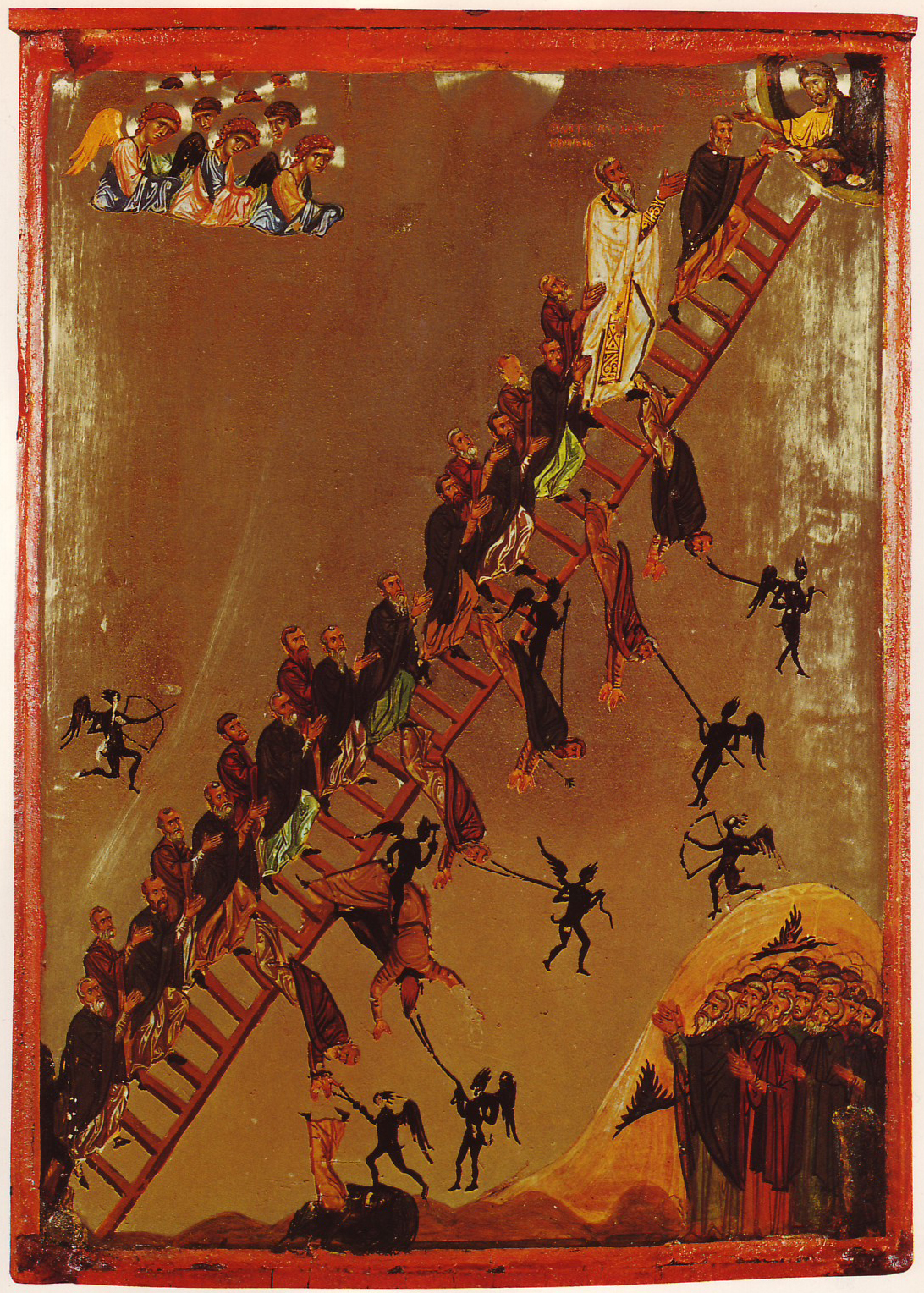
John Climacus (“John of the Ladder”) was a monk and abbot at Mount Sinai in the seventh century. His Ladder of Divine Ascent sets out the monastic life as thirty steps, from renouncing the world at the bottom to faith, hope and love at the top. It became one of the most read books of the Eastern Church.
Compare it with the Hellenic ladder.
- The Hellenic ladder begins with civic virtue. Climacus’s begins with renunciation of the world, family and city.
- Most of Climacus’s steps are battles against vices and passions: anger, lust, avarice, gluttony, despondency, vainglory, pride. The Hellenic ladder is a growth in virtue, each rung a fuller likeness to the gods.
- Climacus’s climber is beset by demons. The icon above, from Sinai, shows it plainly: monks climb toward Christ while dark winged figures pull some of them off the ladder. On the Hellenic ladder the beings above the soul are gods who lead it (section 8).
- The Hellenic ladder rests on forgetfulness and stain as the soul’s trouble. Climacus’s rests on sin and temptation.
The form, a graded ascent of the soul toward divine union, is the Platonic form. The content has been turned around. The gods have become enemies, the city has become a danger, and virtue has become a fight.
12.3 From aretē to demons and temptation
This turn did not happen by chance. The doctrine that the gods were demons was the theological ground on which the suppression of Hellenic worship was built, as The Roman Crimes Against the Hellenes shows in detail. Once the gods were demons, every rite in their honour was demon-worship, and every Hellenic help on the ladder became a snare. The inner path and the outer persecution rest on the same claim.
12.4 The closing of the schools and the temples
The Roman Crimes Against the Hellenes records the destruction of the temples, among them the Serapeum in 391, the murder of Hypatia in 415, and the laws that ended public worship. It is not repeated here. Three facts matter most for the path described in this paper.
Proclus’s Athena. Marinus records that the statue of Athena was removed from the Parthenon in Proclus’s lifetime, and that the goddess then told Proclus in a dream to prepare his house, because she wished to live with him (Life of Proclus 30, paraphrased). The head of the school that taught the ladder lived to see the city’s goddess taken from her temple.
529. The chronicler John Malalas reports that in 529 the emperor Justinian sent a decree to Athens forbidding anyone to teach philosophy there (Malalas, Chronicle 18.47, paraphrased). The Platonic school, whose last head was Damascius, ceased to operate in Athens.
Exile. The historian Agathias tells how seven philosophers, among them Damascius and Simplicius, went to the court of the Persian king Khosrow I. They later returned under a peace treaty that allowed them to live by their own beliefs (Agathias, Histories 2.30–31, paraphrased).
The timing tells the story. The writings that carried Proclus’s system into the Church under a false apostolic name appeared within a few decades of the decree that silenced Proclus’s school. The structure was kept. The teachers who had built it were removed.
12.5 The argument from these facts
Set side by side, the facts support the thesis.
- The Hellenic ladder existed first, fully formed, and was taught in the schools for centuries (sections 3–11).
- Christian writers adopted its structure, its order of stages and its key terms, in the case of Pseudo-Dionysius by close dependence on Proclus (12.1).
- In adopting it they reversed the role of the gods, from guides to demons, and moved the soul’s problem from forgetfulness to guilt (sections 6, 8, 12.2–12.3).
- Those changes placed access to the goal under the control of the Church: its sacraments, its clergy, its orthodoxy (sections 9, 11).
- The same Church, joined to imperial power, saw the temples and schools that kept the older path closed (12.4).
That is what this paper means by co-opted and perverted. The structure was taken, not invented. It was turned against those who built it. And the change served to move spiritual authority from the Pagans to the Church.
13. The two paths side by side
| Stage | Hellenic path | Christian adaptation |
|---|---|---|
| Source | The One, from which all flows (procession) | A creator God who makes from nothing |
| Middle levels | The gods, in ranks and chains | Angels; the gods recast as demons |
| Soul | Divine in origin, pre-existent, reborn | Created, one life only |
| The problem | Forgetfulness, error, impurity | Sin and inherited guilt |
| The remedy | Katharsis and lysis (cleansing and release) | Salvation through Christ and the Church |
| The ladder | Civic, purificatory, contemplative, paradigmatic, theurgic virtue | Renunciation and struggle against vices |
| Helpers | The gods, followed and imitated | Angels and saints; the gods as enemies |
| Means (ritual) | Theurgy: the gods’ rites and symbols | Sacraments, performed by clergy |
| Contemplation | Ladder of love, starting from beauty | Ascent into divine darkness, starting from renunciation |
| Goal | Henōsis: union with the One | Theōsis: deification by grace |
14. Conclusion
The Hellenes did not leave the soul’s ascent to guesswork. They mapped reality as a procession from the One and a return to it. They explained the soul’s fall as forgetfulness and stain, not guilt. They set out a ladder of virtues, from the good citizen to the sage, and named its rungs. They held that the gods help at every rung: as models to follow, as givers of the mysteries, as sources of light, and, at the summit, as the power at work in the rites. They named the means, theurgy, and they named the goal, henōsis. And they tested all of it, in schools that taught across many centuries.
The Christians inherited this structure. They kept its shape: procession and return, the graded ladder, purification, illumination and union, sacred rites working through material signs. They changed its heart. The gods became demons. The soul’s forgetting became guilt. The city’s virtues gave way to the monk’s war on temptation. The rites of the gods gave way to sacraments that only the Church could give. Then the Church, holding the power of the state, closed the temples and silenced the schools.
So the thesis stands. The ancients had a clear and tested theological structure of ascent that was co-opted and perverted by the Christians trying to wrest power from the Pagans. To recover the path is not to invent something new. It is to take back what was ours: the ladder, the gods who stand beside it, and the union at the top.
P.G.
Glossary of Greek terms
- Amelēs (Ἀμέλης)
- Unmindfulness; the river of forgetting in the Myth of Er.
- Anankē (Ἀνάγκη)
- Necessity; mother of the Fates.
- aretē (ἀρετή)
- Virtue, excellence.
- anamnēsis (ἀνάμνησις)
- Recollection; learning as remembering.
- daimōn (δαίμων)
- A guiding spirit or divine guardian; not an evil being.
- epistrophē (ἐπιστροφή)
- Return, reversion to the source.
- erōs (ἔρως)
- Love, desire; the force of ascent in the Symposium.
- euchē (εὐχή)
- Prayer.
- eusebeia (εὐσέβεια)
- Piety, right reverence.
- hamartia (ἁμαρτία)
- Missing the mark, error; later used for “sin.”
- henōsis (ἕνωσις)
- Union. The goal of the Hellenic path.
- hierarchia (ἱεραρχία)
- “Sacred order”; a word coined by Pseudo-Dionysius.
- homoiōsis theōi (ὁμοίωσις θεῷ)
- Likeness to god.
- hylē (ὕλη)
- Matter.
- hypostasis (ὑπόστασις)
- Underlying reality; one of the three principles.
- katharsis (κάθαρσις)
- Purification.
- lēthē (λήθη)
- Forgetfulness.
- lysis (λύσις)
- Release, loosing.
- metensōmatōsis (μετενσωμάτωσις)
- Re-embodiment, rebirth.
- Mnēmosynē (Μνημοσύνη)
- Memory; also the goddess Memory.
- Moirai (Μοῖραι)
- The Fates: Lachesis, Clotho, Atropos.
- miasma (μίασμα)
- Pollution, stain.
- nous (νοῦς)
- Intellect, divine mind.
- ochēma (ὄχημα)
- Vehicle; the soul’s subtle body.
- proodos (πρόοδος)
- Procession, outflow.
- psychē (ψυχή)
- Soul.
- seira (σειρά)
- Chain; the series under a god.
- sōtēria (σωτηρία)
- Salvation, safety.
- synthēmata / symbola (συνθήματα / σύμβολα)
- Divine tokens and symbols used in theurgy.
- theōria (θεωρία)
- Contemplation.
- theōsis (θέωσις)
- Deification. The Christian goal, analogue of henōsis.
- theourgia (θεουργία)
- Theurgy, divine work. A Hellenic means, analogue of the sacraments.
- tolma (τόλμα)
- Daring, self-will.
- to hen (τὸ ἕν)
- The One.
Notes on sources and translations
- Plato, Republic 10, 614b, 616c, 617d–e, 620c–d, 621a–c, tr. B. Jowett (Project Gutenberg). Quotations checked word for word.
- Macrobius, Commentary on the Dream of Scipio 1.12: paraphrased; no public-domain translation checked.
- Petelia gold tablet, tr. Gilbert Murray, in J. E. Harrison, Prolegomena to the Study of Greek Religion (1903), Critical Appendix on the Orphic Tablets, I (Project Gutenberg). Checked word for word.
- Anathemas against Origen (Constantinople, 553), anathema 1, tr. H. R. Percival, NPNF series 2, vol. 14 (New Advent). Checked.
- Plato, Phaedrus 245c, 246a–b, 246d–e, 246e–247a, 248c, 248e–249a, 252d; Symposium 211b–c; Theaetetus 176a–b; Phaedo 67c–d, 69b–d. Tr. Benjamin Jowett (Project Gutenberg editions). Quotations checked word for word. Symposium 202d–e is paraphrased.
- Plotinus, Enneads 4.8.8 and 6.9.11, tr. Kenneth Sylvan Guthrie, Plotinos: Complete Works (1918; Project Gutenberg). Quotations checked word for word. Enneads 1.2, 1.6 and 5.1.1 are paraphrased. The phrase “the flight of the alone to the alone” is from A. H. Armstrong’s Loeb translation.
- Iamblichus, On the Mysteries 2.11, tr. Thomas Taylor (1821; Project Gutenberg). Quotations checked word for word. Book 5 on prayer is paraphrased.
- Porphyry, Sententiae 32 and Life of Plotinus 23: paraphrased.
- Proclus, Elements of Theology prop. 35, and the doctrine of divine chains: paraphrased.
- Marinus, Life of Proclus 3 and 30: paraphrased.
- Athanasius, On the Incarnation 54.3, tr. A. Robertson, Nicene and Post-Nicene Fathers, series 2, vol. 4 (New Advent). Checked.
- Bible: Romans 5:12; 2 Peter 1:4 (King James Version). Psalm 96:5 (95:5 in the Septuagint): paraphrased.
- John Malalas, Chronicle 18.47, and Agathias, Histories 2.30–31: paraphrased.
- Pseudo-Dionysius, Divine Names, Celestial Hierarchy, Ecclesiastical Hierarchy, Mystical Theology: described, not quoted.
References and further reading
Primary sources
- Plato. The Republic. Tr. B. Jowett. 3rd ed. Oxford: Clarendon Press, 1888.
- Macrobius. Commentary on the Dream of Scipio. Tr. W. H. Stahl. New York: Columbia University Press, 1952.
- Percival, H. R., tr. The Seven Ecumenical Councils. NPNF series 2, vol. 14. New York, 1900.
- Plato. The Dialogues of Plato. Tr. B. Jowett. 3rd ed. Oxford: Clarendon Press, 1892.
- Plotinus. The Enneads. Tr. Stephen MacKenna. 2nd ed. rev. B. S. Page. London: Faber, 1956.
- Plotinus. Plotinos: Complete Works. Tr. K. S. Guthrie. 4 vols. Alpine, NJ: Platonist Press, 1918.
- Plotinus. Enneads. Tr. A. H. Armstrong. 7 vols. Loeb Classical Library. Cambridge, MA: Harvard University Press, 1966–1988.
- Porphyry. On the Life of Plotinus and the Order of his Books. In Armstrong’s Loeb Plotinus, vol. 1.
- Porphyry. Sentences. Ed. L. Brisson et al. 2 vols. Paris: Vrin, 2005.
- Iamblichus. On the Mysteries of the Egyptians, Chaldeans, and Assyrians. Tr. Thomas Taylor. Chiswick, 1821.
- Iamblichus. De Mysteriis. Tr. E. C. Clarke, J. M. Dillon and J. P. Hershbell. Atlanta: Society of Biblical Literature, 2003.
- Proclus. The Elements of Theology. Ed. and tr. E. R. Dodds. Oxford: Clarendon Press, 1933; 2nd ed. 1963.
- Marinus. Proclus, or On Happiness. In M. Edwards, Neoplatonic Saints: The Lives of Plotinus and Proclus by their Students. Liverpool: Liverpool University Press, 2000.
- Pseudo-Dionysius. The Complete Works. Tr. C. Luibheid. New York: Paulist Press, 1987.
- John Climacus. The Ladder of Divine Ascent. Tr. C. Luibheid and N. Russell. New York: Paulist Press, 1982.
- Athanasius. On the Incarnation. Tr. A. Robertson. NPNF series 2, vol. 4. 1892.
Studies
- Bernabé, Alberto, and Ana Isabel Jiménez San Cristóbal. Instructions for the Netherworld: The Orphic Gold Tablets. Leiden: Brill, 2008.
- Graf, Fritz, and Sarah Iles Johnston. Ritual Texts for the Afterlife: Orpheus and the Bacchic Gold Tablets. London: Routledge, 2007.
- Harrison, Jane Ellen. Prolegomena to the Study of Greek Religion. Cambridge: Cambridge University Press, 1903. With a critical appendix on the Orphic tablets by Gilbert Murray.
- Chuvin, Pierre. A Chronicle of the Last Pagans. Tr. B. A. Archer. Cambridge, MA: Harvard University Press, 1990.
- Dodds, E. R. The Greeks and the Irrational. Berkeley: University of California Press, 1951.
- Hadot, Pierre. Plotinus or the Simplicity of Vision. Tr. M. Chase. Chicago: University of Chicago Press, 1993.
- Hadot, Pierre. What is Ancient Philosophy? Tr. M. Chase. Cambridge, MA: Harvard University Press, 2002.
- Louth, Andrew. The Origins of the Christian Mystical Tradition: From Plato to Denys. Oxford: Clarendon Press, 1981.
- Louth, Andrew. Denys the Areopagite. London: Geoffrey Chapman, 1989.
- O’Meara, Dominic J. Plotinus: An Introduction to the Enneads. Oxford: Clarendon Press, 1993.
- O’Meara, Dominic J. Platonopolis: Platonic Political Philosophy in Late Antiquity. Oxford: Clarendon Press, 2003.
- Rorem, Paul. Pseudo-Dionysius: A Commentary on the Texts and an Introduction to Their Influence. New York: Oxford University Press, 1993.
- Shaw, Gregory. Theurgy and the Soul: The Neoplatonism of Iamblichus. University Park: Pennsylvania State University Press, 1995; 2nd ed. Kettering, OH: Angelico Press, 2014.
- Uždavinys, Algis. Philosophy and Theurgy in Late Antiquity. San Rafael, CA: Sophia Perennis, 2010.
- Wallis, R. T. Neoplatonism. London: Duckworth, 1972.
- Watts, Edward J. City and School in Late Antique Athens and Alexandria. Berkeley: University of California Press, 2006.