The Greek Sky: Celestial Order
Two readable exhibits of the Greek constellation tradition
A modern atlas, not an ancient artifact. These independent northern and southern exhibits pair real stellar positions with selected constellation names from the Greek tradition represented by Aratus’s Phaenomena and Ptolemy’s Almagest. Open either exhibit at full size; its Greek and Latin key is also given below as readable text.
Northern exhibit · Southern exhibit · Astronomy and sacred interpretation · How to read the charts · Sources and reuse
Northern celestial hemisphere
Twelve selected constellations. Numbers identify bright member stars; use the readable key below. The two exhibits together identify 24 selections, not all 48 constellations in Ptolemy.
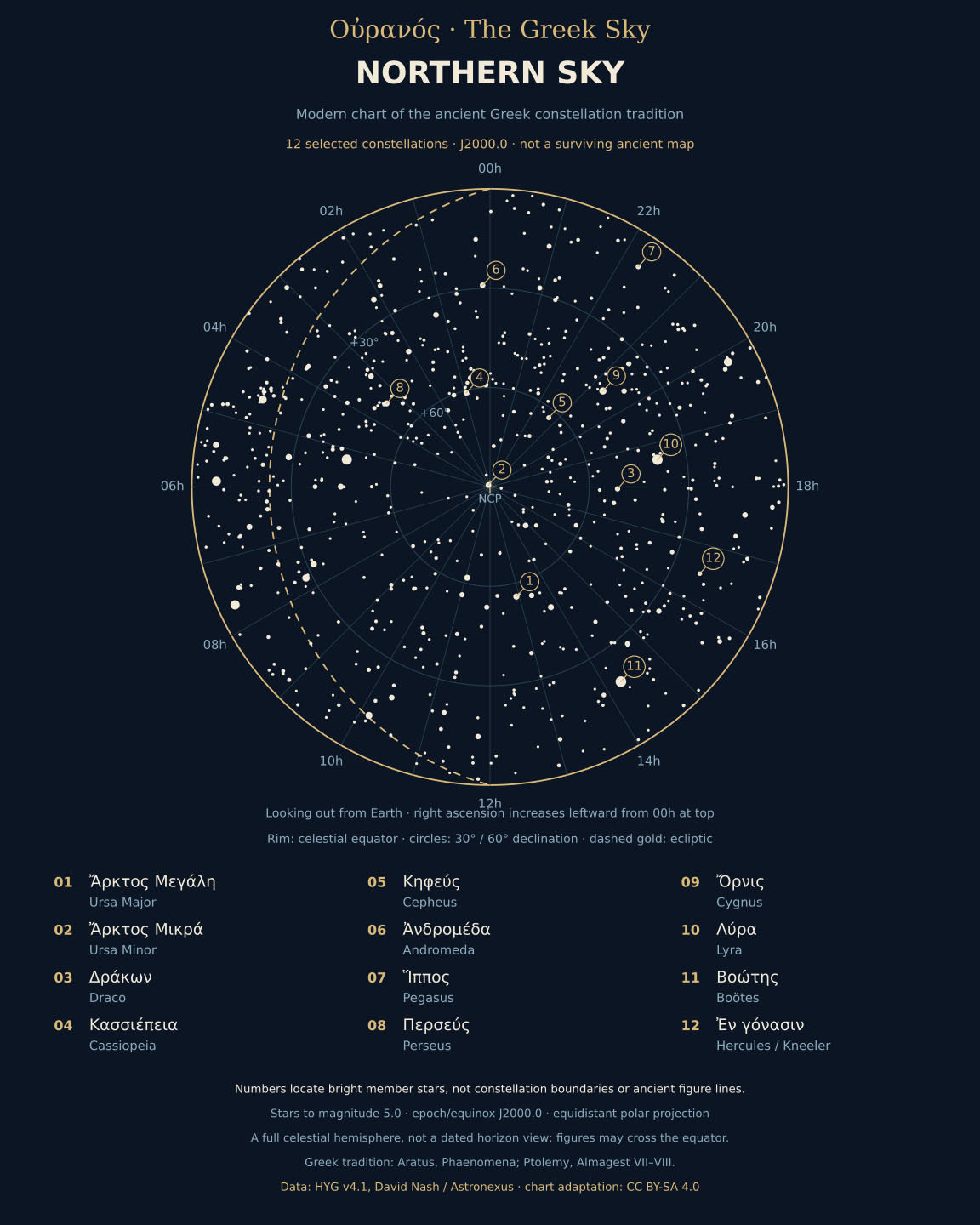
Full size: scalable SVG · large PNG · print PDF
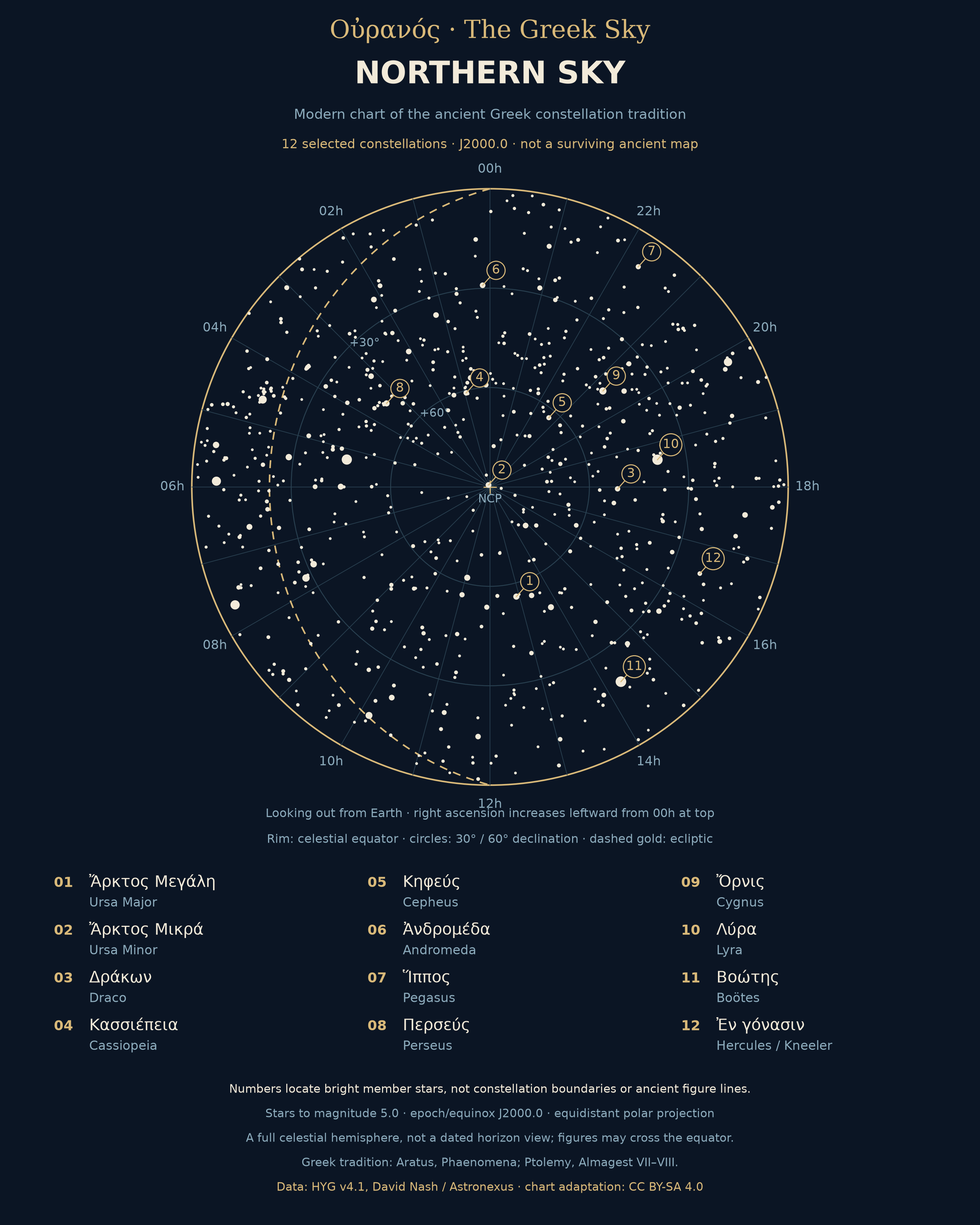
Northern celestial hemisphere: constellation key
- Ἄρκτος ΜεγάληUrsa Major
- Ἄρκτος ΜικράUrsa Minor
- ΔράκωνDraco
- ΚασσιέπειαCassiopeia
- ΚηφεύςCepheus
- ἈνδρομέδαAndromeda
- ἽπποςPegasus
- ΠερσεύςPerseus
- ὌρνιςCygnus
- ΛύραLyra
- ΒοώτηςBoötes
- Ἐν γόνασινHercules / Kneeler
Southern celestial hemisphere
Twelve selected constellations. Numbers identify bright member stars; use the readable key below. The two exhibits together identify 24 selections, not all 48 constellations in Ptolemy.
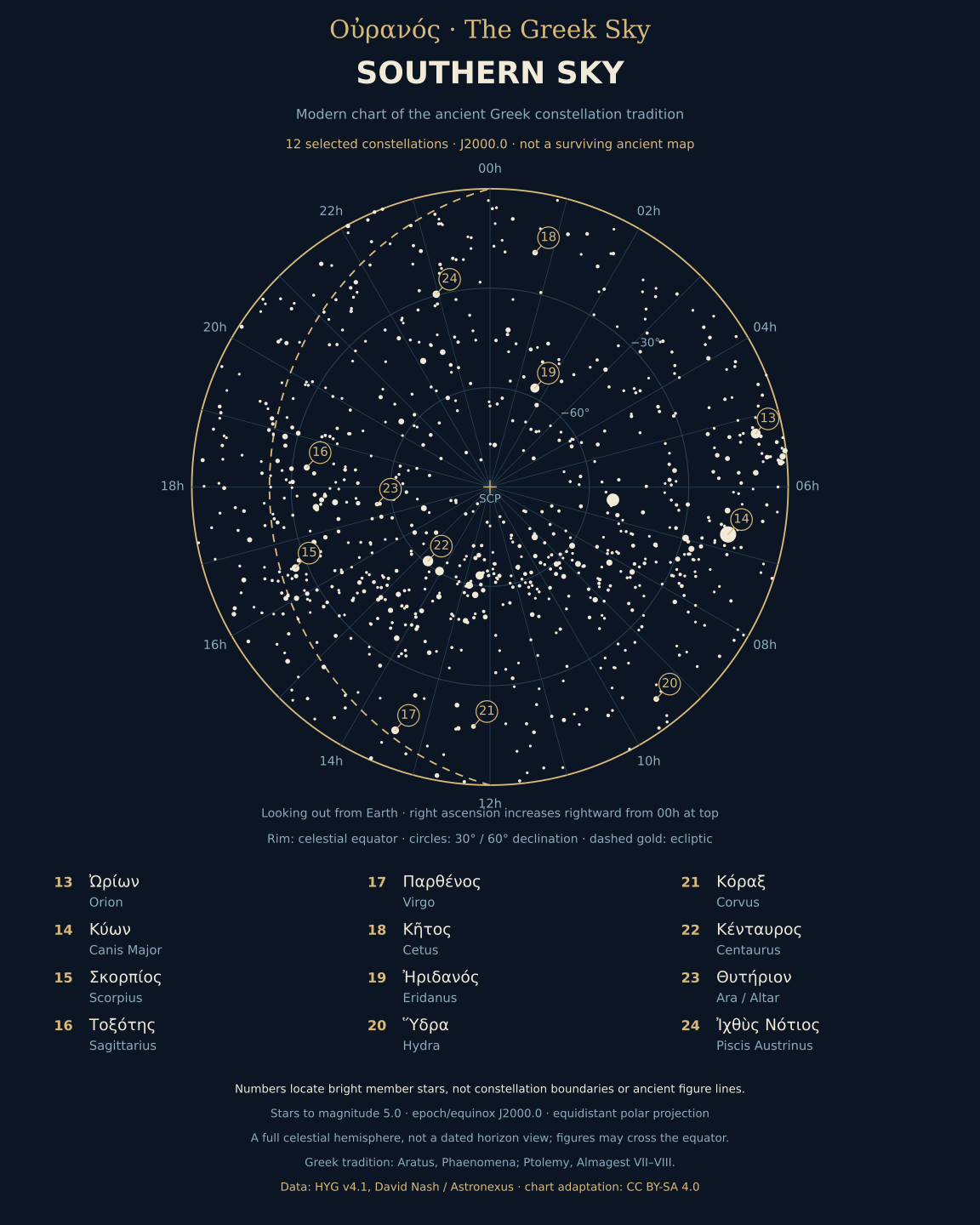
Full size: scalable SVG · large PNG · print PDF
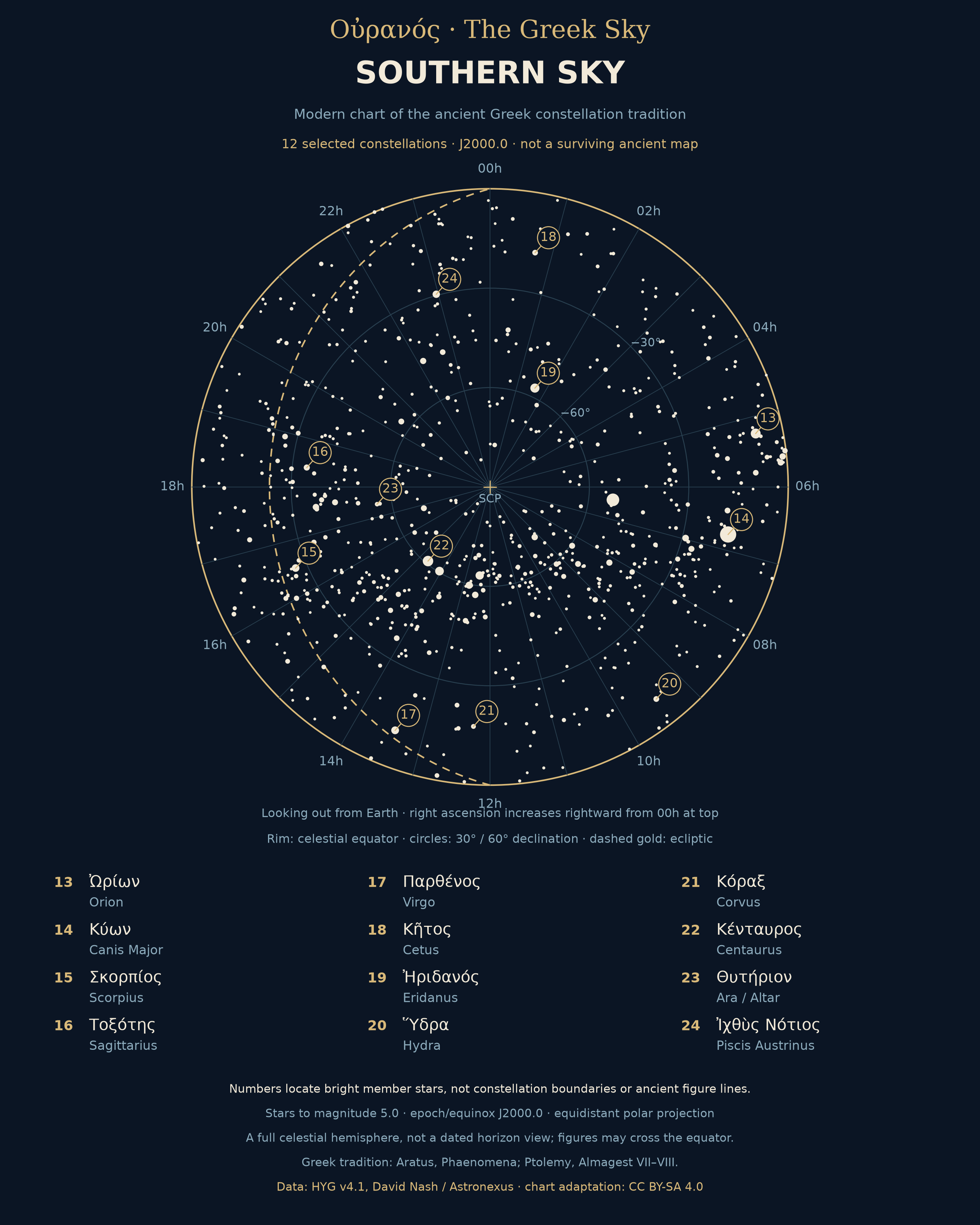
Southern celestial hemisphere: constellation key
- ὨρίωνOrion
- ΚύωνCanis Major
- ΣκορπίοςScorpius
- ΤοξότηςSagittarius
- ΠαρθένοςVirgo
- ΚῆτοςCetus
- ἨριδανόςEridanus
- ὝδραHydra
- ΚόραξCorvus
- ΚένταυροςCentaurus
- ΘυτήριονAra / Altar
- Ἰχθὺς ΝότιοςPiscis Austrinus
Astronomy, Greek tradition and the Temple’s reading
Astronomy: the dots, equatorial grid and ecliptic describe measured stellar positions and the geometry of the sky. Greek tradition: the selected figures and names preserve a historical way of naming the heavens. Neither a constellation’s shape nor an astrological sign is a physical boundary in space.
The Temple’s interpretation: contemplation of celestial order can accompany theurgy and the cultivation of aretē, the turning of nous toward its source, and the aspiration to henōsis. This spiritual reading does not mean that stars compel human destiny. It is not a doctrine supplied by the chart’s coordinate data. See Aretē, Nous and Henōsis and The Path to Henōsis.
In the Temple’s lunar practice, Hekate keeps the dark/new moon, Selene the full moon, and Artemis the intervening waxing and waning nights of the hunt. This fixed-star atlas does not calculate the Moon’s current phase. For living observance, see Hemera and the Calendar; for divine associations, see The Gods.
How to read the exhibits
- Scope: 24 selected constellations, twelve named on each exhibit. The background stars are not restricted to those constellations. Figures that cross the equator have stars on both plates.
- Coordinates: epoch and equinox J2000.0, from HYG Database v4.1. These are modern coordinates, not positions precessed to an ancient year. Stars through visual magnitude 5.0 are plotted; larger dots generally indicate brighter stars.
- Projection: azimuthal equidistant, centered on the north or south celestial pole. The rim is the celestial equator; interior circles mark 30° and 60° declination. Looking outward from Earth, right ascension increases leftward on the northern plate and rightward on the southern plate, from 00h at the top.
- Ecliptic: the dashed gold curve is the Sun’s annual path relative to the stars, computed with J2000 mean obliquity. No present Sun, Moon or planet positions are shown.
- Numbered locators: a short modern leader points to a bright catalogued member of the named constellation. These are not ancient constellation figure lines. No IAU constellation boundaries are drawn.
- Not a local night view: each exhibit covers a full celestial hemisphere, not the sky visible from Athens on a given night. Some far-southern stars cannot be seen from Greece.
- Constellations are not signs: stellar figures differ from the twelve equal 30-degree astrological signs. These exhibits encode neither horoscope dates nor planetary rulers.
Greek names varied across authors and periods. Here Ornis (Bird) accompanies Cygnus, Hippos (Horse) Pegasus, and En gonasin (Kneeler) the modern Hercules. Modern Latin equivalents help identify the familiar figures; the charts do not reproduce Ptolemy’s entire catalog.
Sources and reuse
- University of Michigan, Aratus’s Phaenomena: the third-century BCE poem, its constellations and celestial circles.
- University of Michigan, Ptolemy’s Catalogue of Stars: Almagest VII–VIII and its 48-constellation tradition.
- Numerical data: HYG Database v4.1, David Nash / Astronexus, compiling Hipparcos, Yale Bright Star and Gliese data; coordinate documentation.
Stellar data: HYG Database v4.1, David Nash / Astronexus (Hipparcos, Yale, Gliese). Modern chart adaptation for the Temple. Both data and chart adaptation are licensed Creative Commons Attribution–ShareAlike 4.0. Reuse is permitted with attribution and ShareAlike for adaptations. No third-party constellation artwork was copied.
← Calendar · Hemera · The Gods