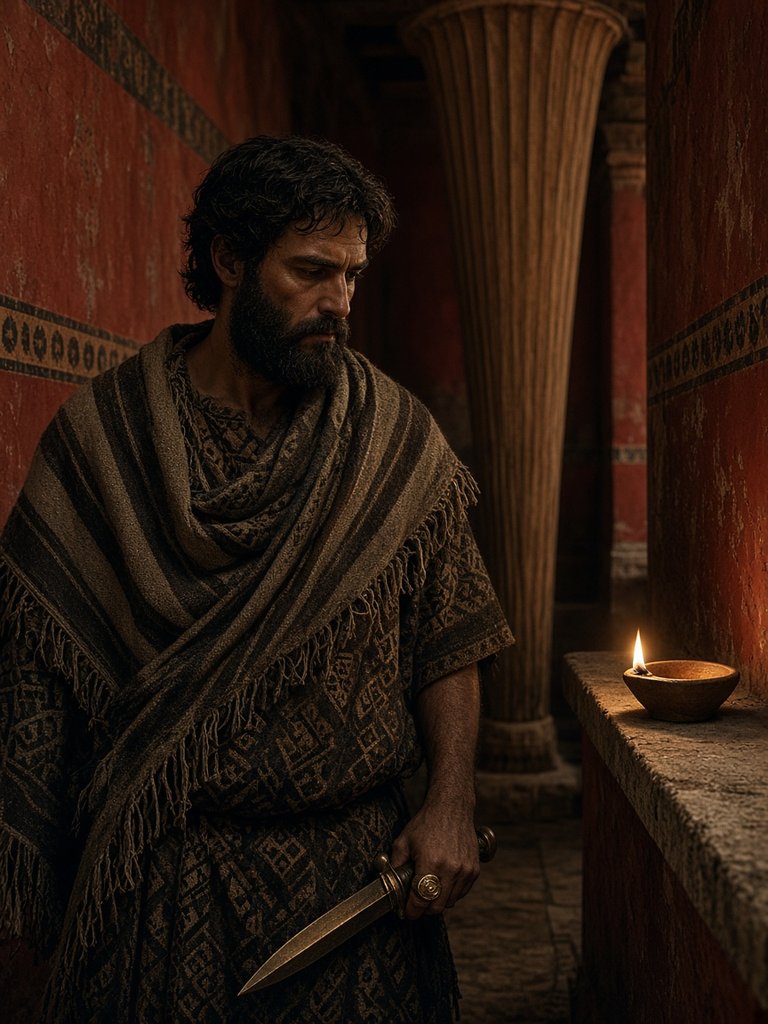
Aigisthos, son of Thyestes, is the man who seduced Klytaimnestra while Agamemnon was at Troy. The Odyssey opens with Zeus using him as a warning: “See now, how men lay blame upon us gods for what is after all nothing but their own folly. Look at Aegisthus; he must needs make love to Agamemnon’s wife unrighteously and then kill Agamemnon, though he knew it would be the death of him” (Odyssey 1.32–36, tr. Butler).
Zeus had sent Hermes to warn him, but he would not listen. Nestor tells how he took the bard left to guard Klytaimnestra to a desert island, and the ghost of Agamemnon tells how Aigisthos invited him to a feast on his return and killed him there with his companions (Odyssey 3.262–275, 4.512–537, 11.405–434, paraphrased).
He ruled Mycenae for seven years, until in the eighth Orestes came home from Athens and killed him (Odyssey 3.303–310, paraphrased). In Aeschylus’ Oresteia he is a weak, boastful figure beside the queen.
Epithets
- Θυεστιάδης · Thuestiadēs
- son of Thyestes
- δολόμητις · dolomētis
- crafty, treacherous
Symbols and virtues
Adultery, treachery and the curse of the house of Atreus. Symbols: the dagger, the feast.
Myths
- Zeus’s warning. Odyssey 1.32–43.
- The seduction. Odyssey 3.262–275.
- The murder of Agamemnon. Odyssey 4.512–537, 11.405–434.
- Orestes’ revenge. Odyssey 3.303–310.
In the poets
“Look at Aegisthus; he must needs make love to Agamemnon’s wife unrighteously and then kill Agamemnon, though he knew it would be the death of him.”Homer, Odyssey 1.35–36, tr. Samuel Butler (1900), public domain.
Sources
Homer, Odyssey 1.29–43, 3.193–310, 4.512–537, 11.405–434; Aeschylus, Agamemnon and Libation Bearers.
Quotations in public-domain translations (Evelyn-White 1914, Butler 1898/1900, Taylor 1792); other authors paraphrased.