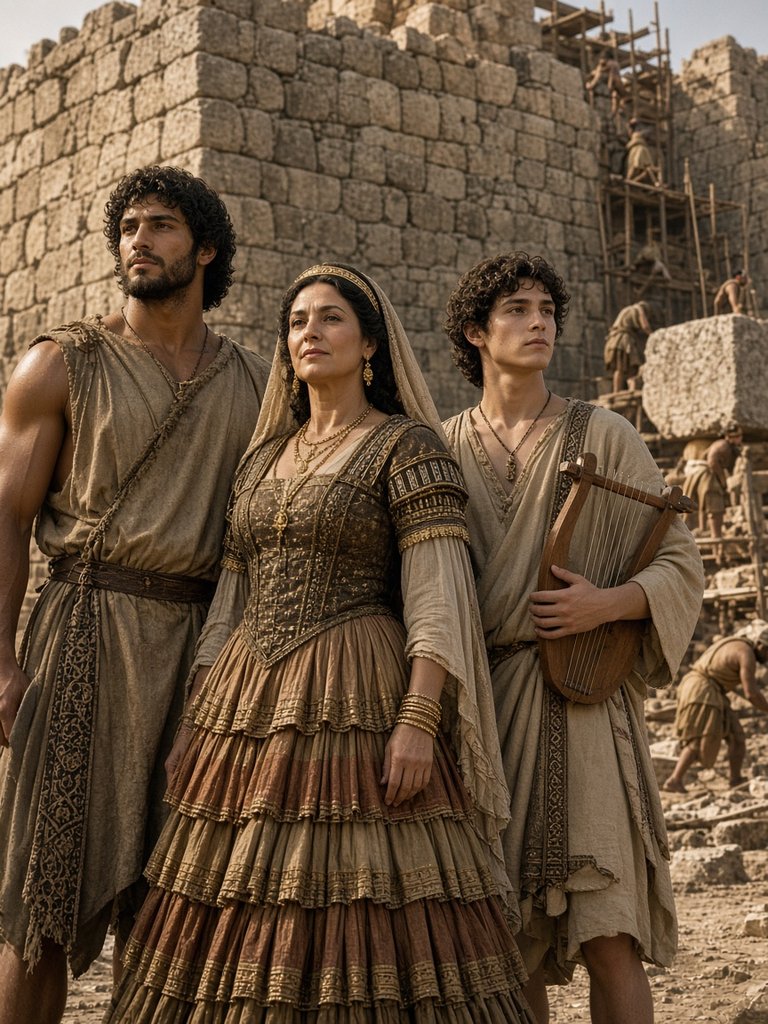
Antiope is daughter of the river Asopos in Homer, and mother of the twin founders of Thebes. Odysseus sees her among the heroines of the underworld: “Next to her I saw Antiope, daughter to Asopus, who could boast of having slept in the arms of even Jove himself, and who bore him two sons Amphion and Zethus” (Odyssey 11.260–262, tr. Butler).
Her sons “founded Thebes with its seven gates, and built a wall all round it; for strong though they were they could not hold Thebes till they had walled it” (Odyssey 11.263–265, tr. Butler). Later tradition said Amphion, given a lyre by Hermes, moved the stones into place by his music while Zethus carried them by strength.
In later versions she is daughter of Nykteus and is cruelly kept as a slave by her uncle Lykos and his wife Dirke. Her grown sons rescue her and kill Dirke by tying her to a bull (Apollodorus 3.5.5; Euripides’ lost Antiope, paraphrased). The scene is shown in the great marble group called the Farnese Bull.
Epithets
- Ἀσωποῖο θυγάτηρ · Asōpoio thugatēr
- daughter of Asopos (Odyssey 11.260)
Symbols and virtues
Suffering endured and set right by her sons. Symbols: the walls of Thebes, the lyre of Amphion.
Myths
- Loved by Zeus. Odyssey 11.260–262.
- The walls of Thebes. Odyssey 11.263–265.
- Dirke and the bull. Apollodorus 3.5.5.
Cult and places
- Thebes. Tomb of Amphion and Zethus shown to visitors (Pausanias 9.17.4).
In the poets
“Next to her I saw Antiope, daughter to Asopus, who could boast of having slept in the arms of even Jove himself, and who bore him two sons Amphion and Zethus.”Homer, Odyssey 11.260–262, tr. Samuel Butler (1900), public domain.
Sources
Homer, Odyssey 11.260–265; Apollodorus 3.5.5; Pausanias 9.5.6–9, 9.17.4–6; Euripides, Antiope (fragments).
Quotations in public-domain translations (Evelyn-White 1914, Butler 1898/1900, Taylor 1792); other authors paraphrased.