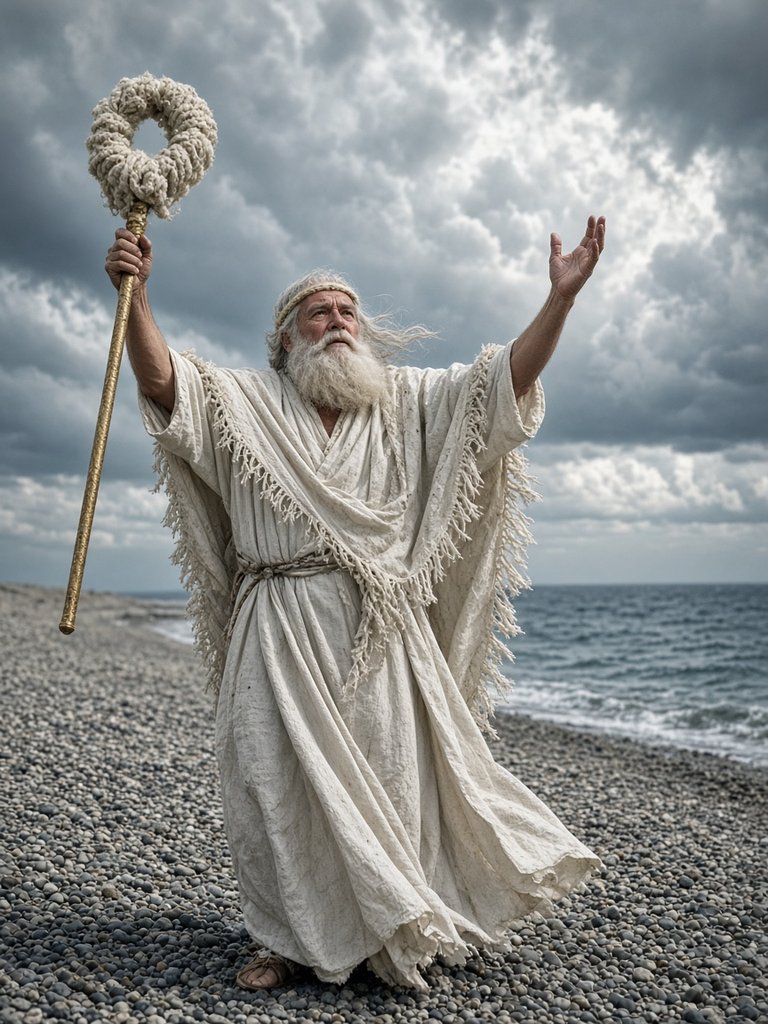
Chryses is priest of Apollo at Chryse near Troy. The Iliad begins with him: “Now Chryses had come to the ships of the Achaeans to free his daughter, and had brought with him a great ransom: moreover he bore in his hand the sceptre of Apollo wreathed with a suppliant’s wreath” (Iliad 1.12–15, tr. Butler).
Agamemnon drives him away with threats, keeping his daughter Chryseis. Walking alone by the shore of the sounding sea, the old man prays to Apollo Smintheus to avenge him, and the god comes down from Olympos and shoots plague into the Achaean camp for nine days (Iliad 1.22–52, paraphrased).
When Odysseus brings back Chryseis with a hecatomb, Chryses prays again, this time for the plague to end, and the god hears him (Iliad 1.430–474, paraphrased).
Epithets
- ἀρητήρ · arētēr
- the priest (Iliad 1.11)
- Ἀπόλλωνος ἱερεύς · Apollōnos hiereus
- priest of Apollo
Symbols and virtues
The power of a wronged suppliant’s prayer. Symbols: the golden staff with the suppliant’s wreath, the sea-shore.
Myths
- The ransom refused. Iliad 1.11–33.
- The prayer and the plague. Iliad 1.34–52.
- The prayer answered. Iliad 1.430–474.
Cult and places
- Chryse. Sanctuary of Apollo Smintheus (Iliad 1.37–39).
In the poets
“Now Chryses had come to the ships of the Achaeans to free his daughter, and had brought with him a great ransom: moreover he bore in his hand the sceptre of Apollo wreathed with a suppliant’s wreath.”Homer, Iliad 1.12–15, tr. Samuel Butler (1898), public domain.
Sources
Homer, Iliad 1.8–52, 1.366–385, 1.430–474.
Quotations in public-domain translations (Evelyn-White 1914, Butler 1898/1900, Taylor 1792); other authors paraphrased.