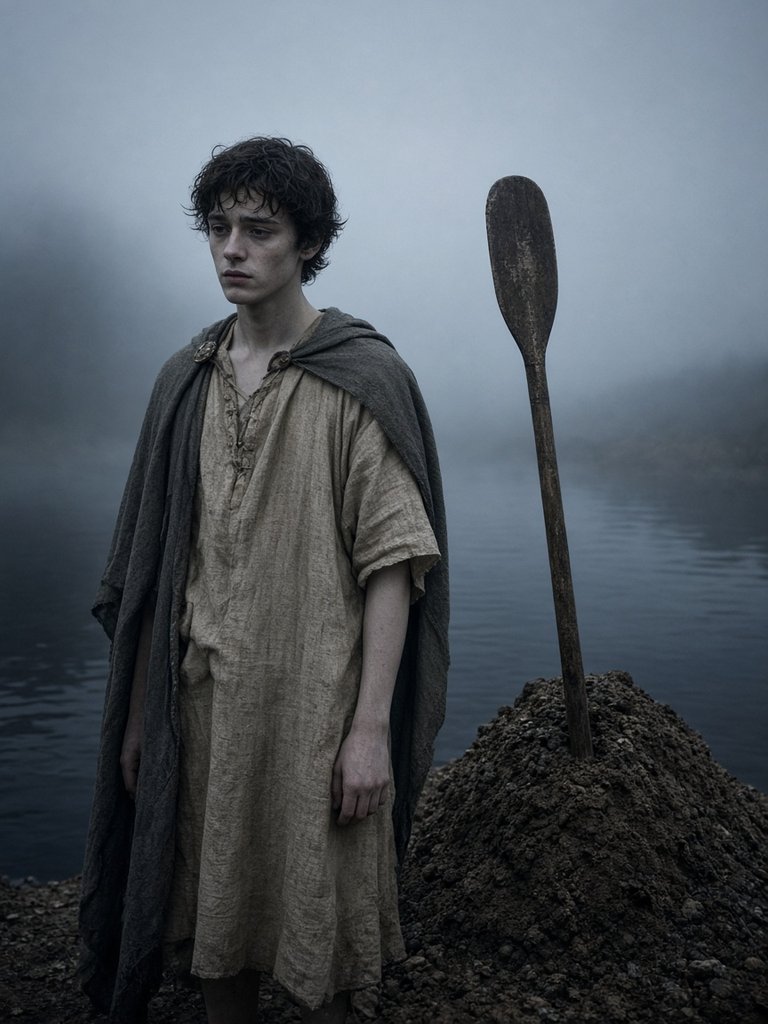
Elpenor is the youngest of the companions of Odysseus. As they leave Kirke’s island, “we had with us a certain youth named Elpenor, not very remarkable for sense or courage, who had got drunk and was lying on the house-top away from the rest of the men, to sleep off his liquor in the cool” (Odyssey 10.552–555, tr. Butler). Woken by the noise, he forgets the ladder, falls from the roof and breaks his neck.
His is the first ghost Odysseus meets at the edge of the underworld, because he has not yet been buried. He begs Odysseus to burn him with his armour, “build a barrow for me on the sea shore, that may tell people in days to come what a poor unlucky fellow I was, and plant over my grave the oar I used to row with when I was yet alive and with my messmates” (Odyssey 11.74–78, tr. Butler).
When they return to Aiaia, Odysseus keeps his promise: they burn the body, raise a mound with a stone, and plant his oar on top (Odyssey 12.8–15, paraphrased).
Epithets
- νεώτατος · neōtatos
- the youngest (Odyssey 10.552)
- ἑταῖρος · hetairos
- companion
Symbols and virtues
The humble dead and the duty of burial. Symbols: the oar on the grave mound.
Myths
- The fall from the roof. Odyssey 10.552–560.
- The ghost’s request. Odyssey 11.51–83.
- The burial. Odyssey 12.8–15.
In the poets
“Plant over my grave the oar I used to row with when I was yet alive and with my messmates.”Homer, Odyssey 11.77–78, tr. Samuel Butler (1900), public domain.
Sources
Homer, Odyssey 10.552–560, 11.51–83, 12.8–15.
Quotations in public-domain translations (Evelyn-White 1914, Butler 1898/1900, Taylor 1792); other authors paraphrased.