Ion was the ancestor of the Ionians. Most writers make him a son of Xouthos, son of Hellen, and of Kreousa, daughter of Erechtheus (Herodotus 7.94, 8.44; Pausanias 7.1.2–5, paraphrased). Herodotus says that the four old tribes of Athens were named after his sons (5.66).
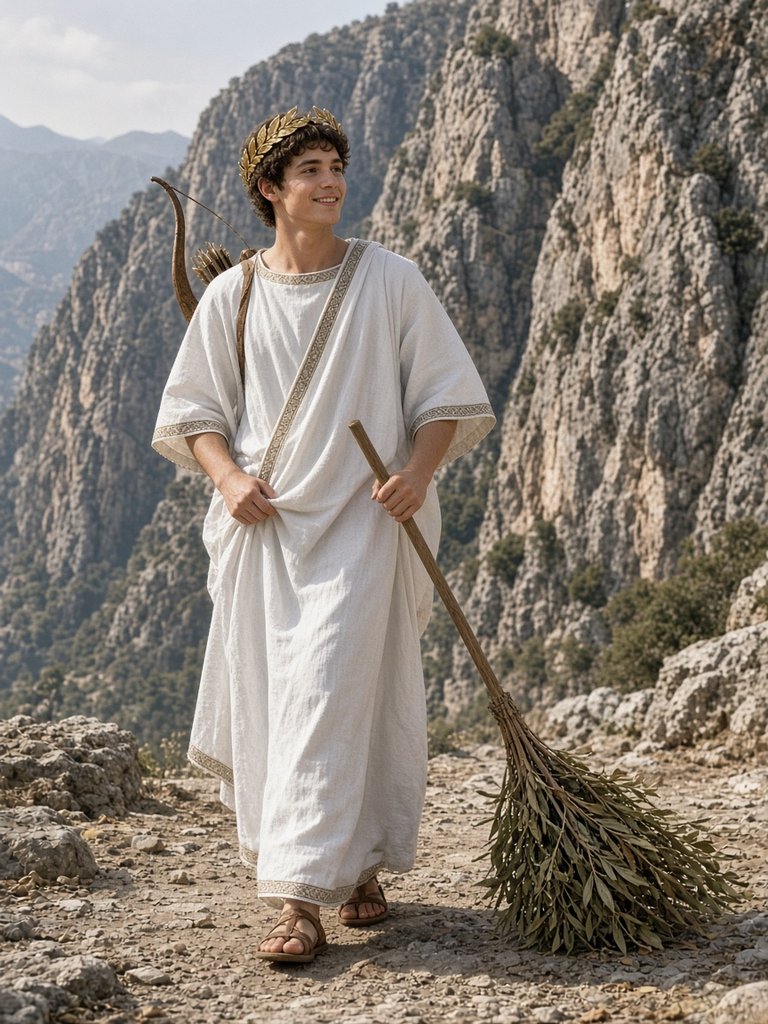
Euripides’ Ion makes him the son of Apollo, who had taken Kreousa in a cave under the Acropolis. She exposed the baby there, and Hermes carried him to Delphi, where he grew up as a servant of the god’s temple, sweeping the forecourt with laurel boughs and scaring off the birds with his bow (Ion 1–183, paraphrased).
When Kreousa and her husband Xouthos came to consult the oracle, Apollo gave the boy to Xouthos as his son. Kreousa, believing him a stranger, tried to poison him, and he would have killed her, until the priestess brought out the cradle with its tokens and mother and son recognized each other; Athena appeared to confirm his birth and his future (Ion 517–1622, paraphrased).
Epithets
- Ἴων · Iōn
- Ion
Symbols and virtues
Hidden birth and recognition, and the origin of a people. Symbols: the laurel broom, the bow, the cradle tokens.
Myths
- Ancestor of the Ionians. Herodotus 7.94, 8.44.
- The four tribes of Athens. Herodotus 5.66.
- Servant of Apollo at Delphi. Euripides, Ion 82–183.
- The recognition. Euripides, Ion 1261–1622.
Cult and places
- Attica. His tomb was shown at Potamoi (Pausanias 1.31.3).
Sources
Herodotus 5.66, 7.94, 8.44; Euripides, Ion; Strabo 8.7.1; Apollodorus 1.7.3; Pausanias 1.31.3, 7.1.2–5.
Quotations in public-domain translations (Evelyn-White 1914, Butler 1898/1900, Taylor 1792); other authors paraphrased.