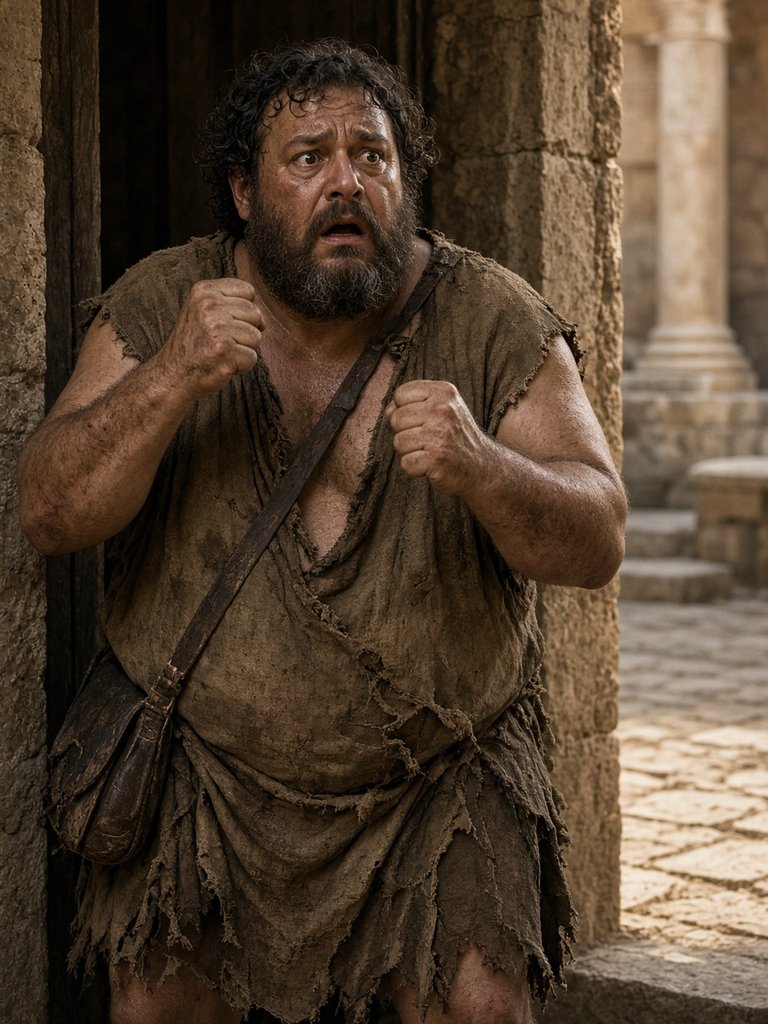
Iros is the public beggar of Ithaka. Book 18 of the Odyssey opens with him: “Now there came a certain common tramp who used to go begging all over the city of Ithaca, and was notorious as an incorrigible glutton and drunkard. This man had no strength nor stay in him, but he was a great hulking fellow to look at” (Odyssey 18.1–4, tr. Butler).
His real name was Arnaios, but the young men called him Iros, after Iris the messenger of the gods, because he ran their errands. He tries to drive the newly arrived beggar, the disguised Odysseus, from the door (Odyssey 18.5–31).
Antinoos sets them to box for a goat’s paunch stuffed with fat and blood. When Odysseus strips, Iros trembles; Odysseus strikes him just once under the ear, breaking his jaw, and drags him out to sit by the gate (Odyssey 18.32–107, paraphrased).
Epithets
- πτωχὸς πανδήμιος · ptōchos pandēmios
- the public beggar (Odyssey 18.1)
- Ἀρναῖος · Arnaios
- his real name
Symbols and virtues
Bluster and the proud brought low. Symbols: the beggar’s wallet, the boxing match at the door.
Myths
- At the door. Odyssey 18.1–31.
- The boxing match. Odyssey 18.32–107.
In the poets
“Now there came a certain common tramp who used to go begging all over the city of Ithaca, and was notorious as an incorrigible glutton and drunkard.”Homer, Odyssey 18.1–3, tr. Samuel Butler (1900), public domain.
Sources
Homer, Odyssey 18.1–116, 18.233–242.
Quotations in public-domain translations (Evelyn-White 1914, Butler 1898/1900, Taylor 1792); other authors paraphrased.