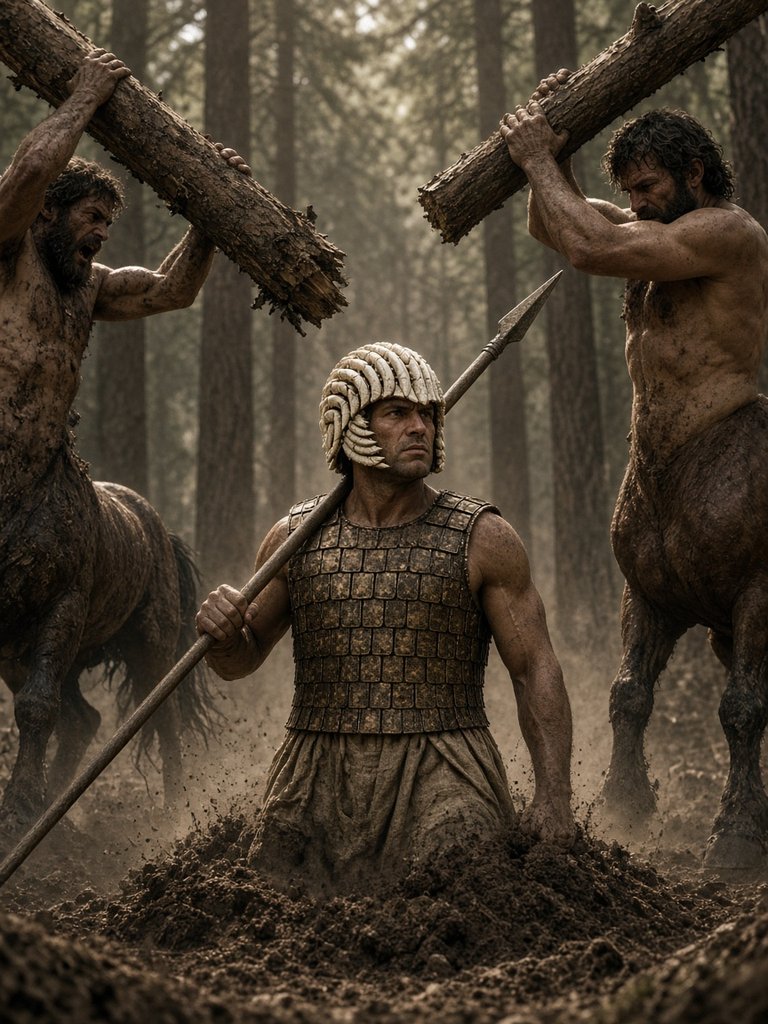
Kaineus was a chief of the Lapiths of Thessaly. Nestor names him among the mightiest of an earlier age: “such men as Pirithous and Dryas shepherd of his people, or as Caeneus, Exadius, godlike Polyphemus” (Iliad 1.263–264, tr. Butler). His grandson Leonteus led the Lapiths to Troy, “son of Coronus, the son of Caeneus” (Iliad 2.746, tr. Butler).
Later writers said that he had been born a girl, Kainis, and that Poseidon, who loved her, granted her wish to become a man who could not be wounded (Apollodorus, Epitome 1.22; Ovid, Metamorphoses 12.189–209, paraphrased).
At the wedding of Peirithoos, in the battle with the Centaurs, no weapon could pierce him, so the Centaurs beat him into the ground with trunks of pine and fir, and he went down beneath the earth unbowed (Apollonius, Argonautica 1.57–64; Apollodorus, Epitome 1.22, paraphrased). Ovid adds that a bird with golden wings rose from the pile (Metamorphoses 12.459–535, paraphrased).
Epithets
- Καινεύς · Kaineus
- Caeneus
Symbols and virtues
Invulnerability and its limits. Symbols: the unpierced body, the pine trunks of the Centaurs.
Myths
- Among the mightiest of men. Iliad 1.262–264.
- Grandfather of Leonteus. Iliad 2.746.
- Kainis changed by Poseidon. Apollodorus, Epitome 1.22; Ovid, Metamorphoses 12.189–209.
- Beaten into the earth. Apollonius, Argonautica 1.57–64.
In the poets
“Such men as Pirithous and Dryas shepherd of his people, or as Caeneus, Exadius, godlike Polyphemus.”Homer, Iliad 1.263–264, tr. Samuel Butler (1898), public domain.
Sources
Homer, Iliad 1.262–264, 2.746; Pindar fr. 167; Apollonius, Argonautica 1.57–64; Apollodorus, Epitome 1.22; Ovid, Metamorphoses 12.169–535.
Quotations in public-domain translations (Evelyn-White 1914, Butler 1898/1900, Taylor 1792); other authors paraphrased.