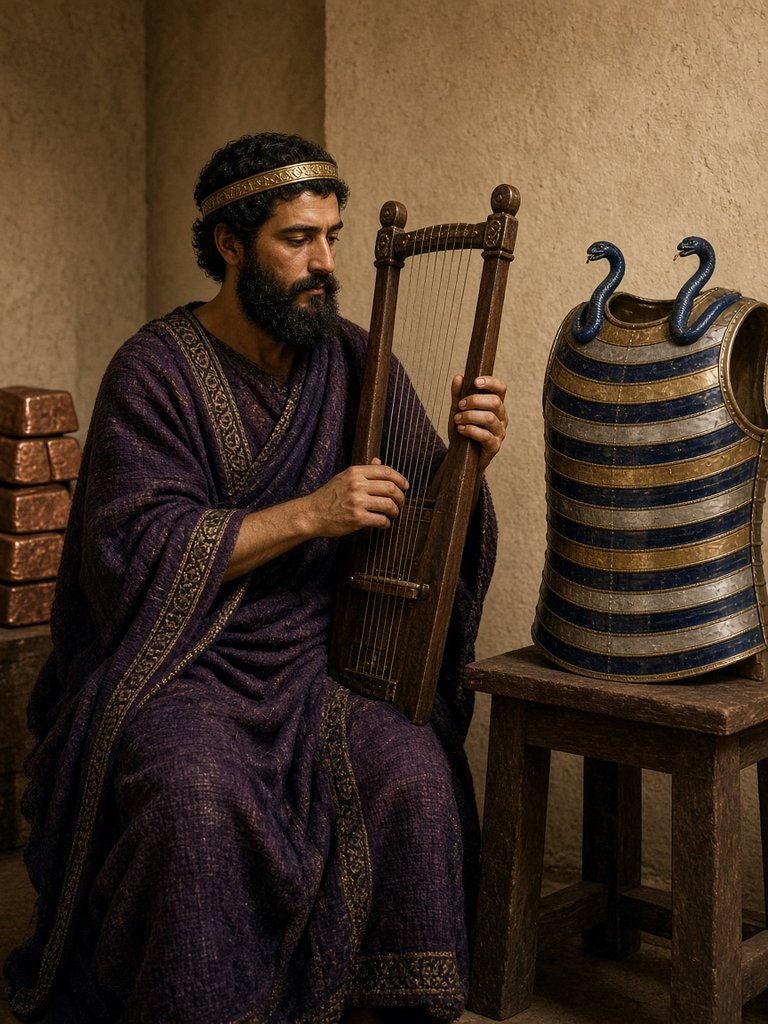
Kinyras was the legendary priest-king of Paphos on Cyprus, famous for his wealth. When Agamemnon arms in the Iliad, “about his chest he set the breastplate which Cinyras had once given him as a guest-gift” (Iliad 11.19–20, tr. Butler), sent when the news reached Cyprus that the Achaeans were sailing for Troy. It was banded with dark blue, gold and tin, with serpents rearing toward the neck (Iliad 11.21–28, paraphrased).
Pindar calls him beloved of Apollo and the favoured priest of Aphrodite (Pythian 2.15–17, paraphrased). Apollodorus says he married Metharme, daughter of Pygmalion, founded Paphos, and was father of Adonis (3.14.3, paraphrased). In Ovid he is the father of Myrrha (Metamorphoses 10.298–502).
A story in Apollodorus tells that he promised to send fifty ships to Troy but sent only one, with the rest made of clay and manned by clay figures (Epitome 3.9, paraphrased). His descendants, the Kinyradai, held the priesthood of Aphrodite at Paphos into Roman times (Tacitus, Histories 2.3, paraphrased).
Epithets
- Κινύρας · Kinyras
- Cinyras
Symbols and virtues
Wealth, music and the priesthood of Aphrodite. Symbols: the lyre, the inlaid breastplate, copper.
Myths
- The gift of the breastplate. Iliad 11.19–28.
- Priest of Aphrodite, beloved of Apollo. Pindar, Pythian 2.15–17.
- Founder of Paphos, father of Adonis. Apollodorus 3.14.3.
- The clay ships. Apollodorus, Epitome 3.9.
Cult and places
- Paphos. The Kinyradai, his descendants, served as priests of Aphrodite (Tacitus, Histories 2.3).
In the poets
“About his chest he set the breastplate which Cinyras had once given him as a guest-gift.”Homer, Iliad 11.19–20, tr. Samuel Butler (1898), public domain.
Sources
Homer, Iliad 11.19–28; Pindar, Pythian 2.15–17, Nemean 8.18; Apollodorus 3.14.3, Epitome 3.9; Ovid, Metamorphoses 10.298–502; Tacitus, Histories 2.3.
Quotations in public-domain translations (Evelyn-White 1914, Butler 1898/1900, Taylor 1792); other authors paraphrased.