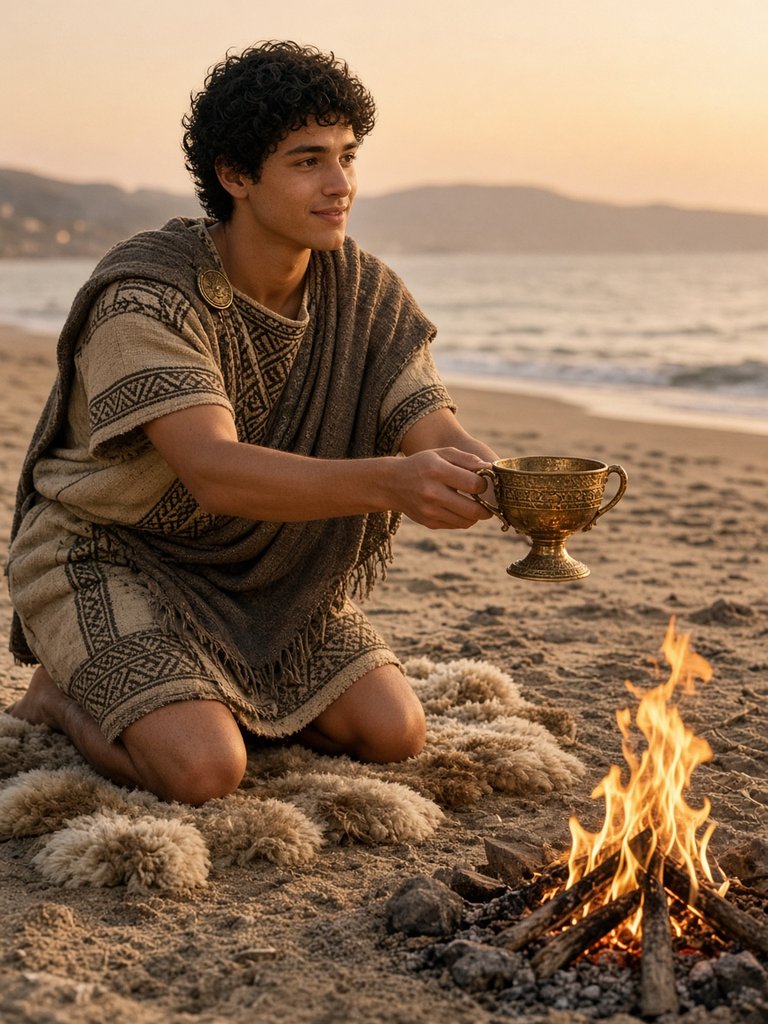
Peisistratos is the youngest son of Nestor. When Telemachos and the disguised Athena land at Pylos during a great sacrifice to Poseidon, he is the first to welcome them: “Nestor’s son Pisistratus at once offered his hand to each of them, and seated them on some soft sheepskins that were lying on the sands near his father and his brother Thrasymedes” (Odyssey 3.36–39, tr. Butler).
Being still unmarried and of an age with Telemachos, he goes with him overland to Sparta to see Menelaos (Odyssey 3.400–497, paraphrased). In Menelaos’ hall he weeps for his brother Antilochos, killed at Troy, whom he never saw (Odyssey 4.186–202).
On the way home he helps Telemachos slip past Nestor’s hospitality to reach his ship quickly (Odyssey 15.195–216, paraphrased). The Athenian tyrant Peisistratos and his family claimed descent from the house of Nestor and bore his name (Herodotus 5.65, paraphrased).
Epithets
- Νεστορίδης · Nestoridēs
- son of Nestor
- ὄρχαμος ἀνδρῶν · orchamos andrōn
- leader of men
Symbols and virtues
Hospitality and the friendship of the young. Symbols: the golden cup, the sheepskins on the sand.
Myths
- Welcome at Pylos. Odyssey 3.31–66.
- The road to Sparta. Odyssey 3.475–497.
- Tears for Antilochos. Odyssey 4.186–202.
- The return. Odyssey 15.1–216.
In the poets
“Nestor’s son Pisistratus at once offered his hand to each of them, and seated them on some soft sheepskins that were lying on the sands near his father.”Homer, Odyssey 3.36–38, tr. Samuel Butler (1900), public domain.
Sources
Homer, Odyssey 3.31–66, 3.400–497, 4.1–202, 15.1–216; Herodotus 5.65.
Quotations in public-domain translations (Evelyn-White 1914, Butler 1898/1900, Taylor 1792); other authors paraphrased.