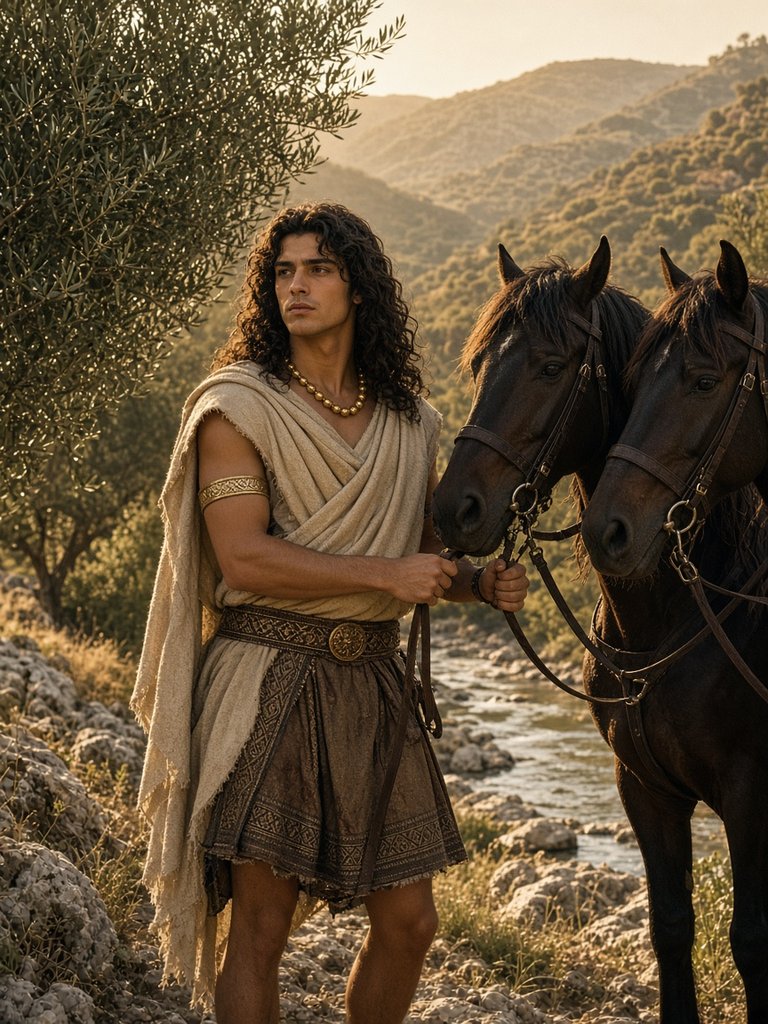
Pelops is the son of Tantalos. Pindar rejects the tale that the gods ate him at his father’s feast and says instead that Poseidon loved him and carried him off to Olympos (Olympian 1.25–51, paraphrased).
To win Hippodameia, daughter of Oinomaos king of Pisa, he had to beat her father in a chariot race; he prayed to Poseidon, who gave him a golden chariot and winged horses, and he won the bride and the kingdom (Pindar, Olympian 1.67–89, paraphrased). In the Iliad the sceptre of the Argive kings passed through his hands: “King Mercury gave it to Pelops, the mighty charioteer, and Pelops to Atreus, shepherd of his people” (Iliad 2.104–105, tr. Butler).
Thucydides says the Peloponnese took its name from him (1.9, paraphrased). At Olympia he had his own precinct, the Pelopion, where the magistrates sacrificed a black ram to him every year, and Pausanias says the Eleans honoured him above all heroes there as Zeus above the gods (5.13.1–2, paraphrased).
Epithets
- Τανταλίδης · Tantalidēs
- son of Tantalos
- πλήξιππος · plēxippos
- driver of horses (Iliad 2.104)
Symbols and virtues
Victory, kingship and the games. Symbols: the chariot, the winged horses, the sceptre.
Myths
- Beloved of Poseidon. Pindar, Olympian 1.25–51.
- The race with Oinomaos. Pindar, Olympian 1.67–89.
- The sceptre. Iliad 2.100–108.
Cult and places
- Olympia. The Pelopion and the yearly black ram (Pausanias 5.13.1–2).
In the poets
“King Mercury gave it to Pelops, the mighty charioteer, and Pelops to Atreus, shepherd of his people.”Homer, Iliad 2.104–105, tr. Samuel Butler (1898), public domain.
Sources
Homer, Iliad 2.100–108; Pindar, Olympian 1; Thucydides 1.9; Pausanias 5.13.1–7.
Quotations in public-domain translations (Evelyn-White 1914, Butler 1898/1900, Taylor 1792); other authors paraphrased.