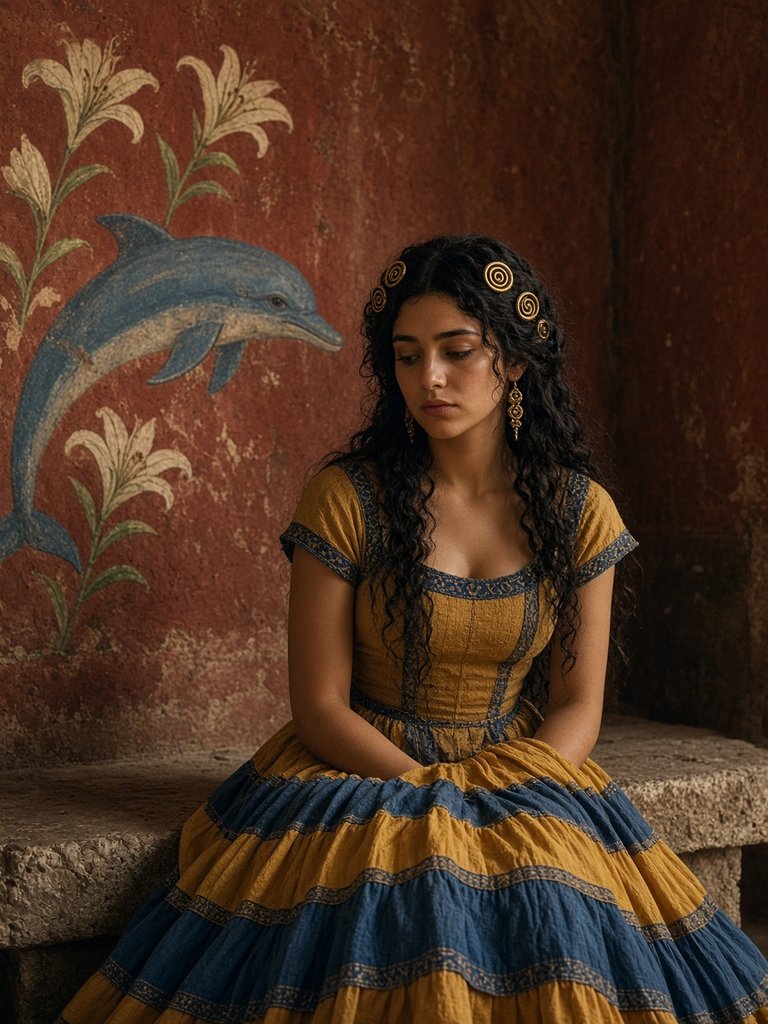
Phaidra is a daughter of Minos of Crete and Pasiphae, sister of Ariadne. Homer names her only once, among the heroines in the underworld: “Then I saw Phaedra, and Procris, and fair Ariadne daughter of the magician Minos, whom Theseus was carrying off from Crete to Athens” (Odyssey 11.321–323, tr. Butler).
She married Theseus. In Euripides’ Hippolytus, Aphrodite, angry with Theseus’ son Hippolytos for scorning her, makes Phaidra fall in love with him. Her nurse betrays the secret to the young man, who rejects it with horror (Euripides, Hippolytus 1–56, 565–668, paraphrased).
Shamed and afraid, Phaidra hangs herself, leaving a tablet that accuses Hippolytos of rape; Theseus believes it and curses his son (Hippolytus 776–890, paraphrased). At Troizen Pausanias was shown her tomb and a myrtle whose leaves she was said to have pierced with her hairpin in her longing (2.32.3, paraphrased).
Epithets
- Μίνωος θυγάτηρ · Minōos thugatēr
- daughter of Minos
Symbols and virtues
Desire sent by a god, and shame. Symbols: the tablet, the pierced myrtle.
Myths
- Among the heroines in Hades. Odyssey 11.321.
- Love for Hippolytos. Euripides, Hippolytus.
- The false tablet. Euripides, Hippolytus 856–890.
Cult and places
- Troizen. Tomb of Phaidra beside the myrtle (Pausanias 2.32.3).
In the poets
“Then I saw Phaedra, and Procris, and fair Ariadne daughter of the magician Minos.”Homer, Odyssey 11.321–322, tr. Samuel Butler (1900), public domain.
Sources
Homer, Odyssey 11.321–325; Euripides, Hippolytus; Apollodorus, Epitome 1.17–19; Pausanias 1.22.1–2, 2.32.3.
Quotations in public-domain translations (Evelyn-White 1914, Butler 1898/1900, Taylor 1792); other authors paraphrased.