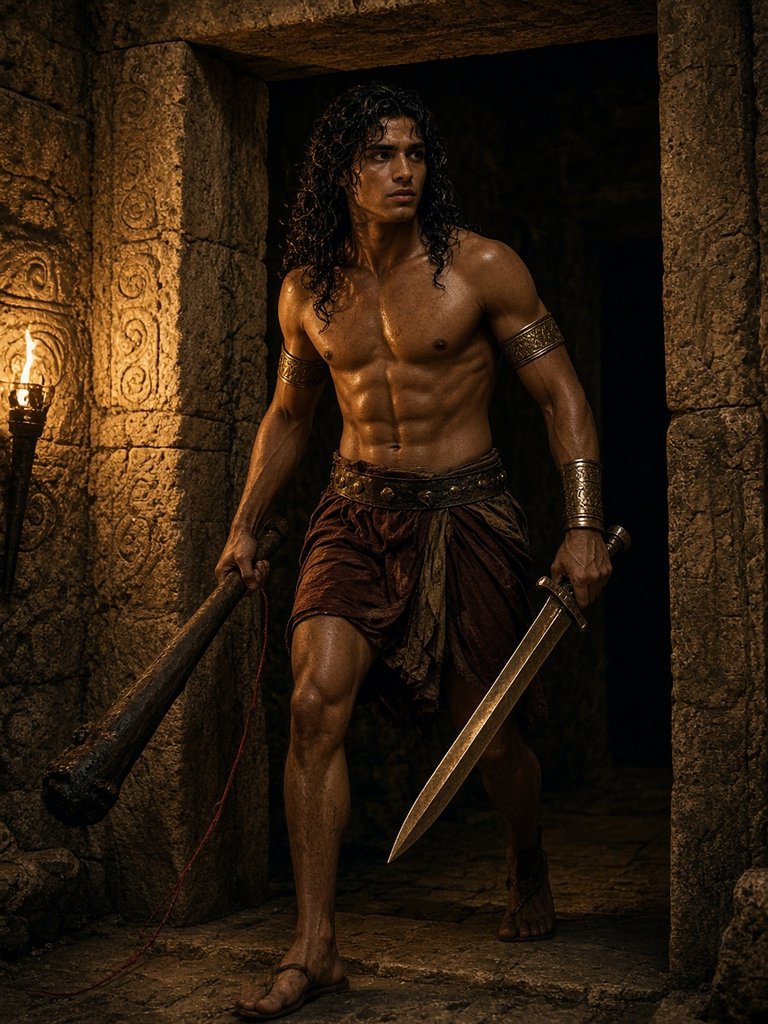
Theseus is the son of Aigeus king of Athens (or, some said, of Poseidon) and Aithra of Troizen. Nestor in the Iliad names him among the mightiest men ever born, “Theseus son of Aegeus, peer of the immortals” (Iliad 1.265, tr. Butler). Raised at Troizen, he lifted the rock under which his father had left a sword and sandals, and walked to Athens by the dangerous coast road, clearing it of the robbers Periphetes, Sinis, Skiron, Kerkyon and Prokroustes (Plutarch, Theseus 6–11, paraphrased).
At Athens he was sent, or went freely, as one of the youths owed each year to Minos of Crete, and with the help of Minos’ daughter Ariadne killed the Minotaur in the Labyrinth and found his way out (Plutarch, Theseus 15–19, paraphrased). Odysseus sees Ariadne among the dead, “whom Theseus was carrying off from Crete to Athens” (Odyssey 11.321–323, tr. Butler). On Delos he danced the crane dance with the rescued youths, and returning he forgot to change the black sail, so that Aigeus threw himself to his death (Plutarch, Theseus 21–22, paraphrased). Bacchylides tells how he dived to the hall of Amphitrite to prove himself Poseidon’s son (Ode 17, paraphrased).
As king he gathered the scattered villages of Attica into one city, the synoikismos that Athens remembered each year, and founded the Panathenaia (Plutarch, Theseus 24, paraphrased; Thucydides 2.15). With his friend Peirithoos he fought the Centaurs and went down to the house of Hades. After the Persian Wars Kimon brought his bones from Skyros to Athens and laid them in the Theseion, a sanctuary for runaways and the poor; the Athenians sacrificed to him on the eighth of the month Pyanepsion (Plutarch, Theseus 36, paraphrased; Pausanias 1.17.2–6).
Epithets
- Αἰγεΐδης · Aigeïdēs
- son of Aigeus (Iliad 1.265)
- ἐπιείκελος ἀθανάτοισιν · epieikelos athanatoisin
- peer of the immortals (Iliad 1.265)
Symbols and virtues
The hero of the city: strength put to the service of law and the weak. Symbols: the club, the sword and sandals under the rock, the thread, the black and white sails.
Myths
- The sword under the rock. Plutarch, Theseus 6.
- The coast road. Periphetes, Sinis, Skiron, Kerkyon, Prokroustes (Plutarch, Theseus 8–11).
- The Minotaur. Plutarch, Theseus 15–19.
- Ariadne. Odyssey 11.321–325.
- The dive to Amphitrite. Bacchylides 17.
- The synoikismos of Attica. Thucydides 2.15; Plutarch, Theseus 24.
Cult and places
- Athens. The Theseion, where Kimon laid his bones (Plutarch, Theseus 36; Pausanias 1.17.2–6).
- Festival. Sacrifice on 8 Pyanepsion (Plutarch, Theseus 36).
In the poets
“Theseus son of Aegeus, peer of the immortals. These were the mightiest men ever born upon this earth”Homer, Iliad 1.265–266, tr. Samuel Butler (1898), public domain.
Sources
Homer, Iliad 1.262–270; Odyssey 11.321–325, 11.631; Bacchylides, Ode 17; Thucydides 2.15; Plutarch, Theseus; Pausanias 1.17.2–6; Apollodorus, Epitome 1.
Quotations in public-domain translations (Evelyn-White 1914, Butler 1898/1900, Taylor 1792); other authors paraphrased.