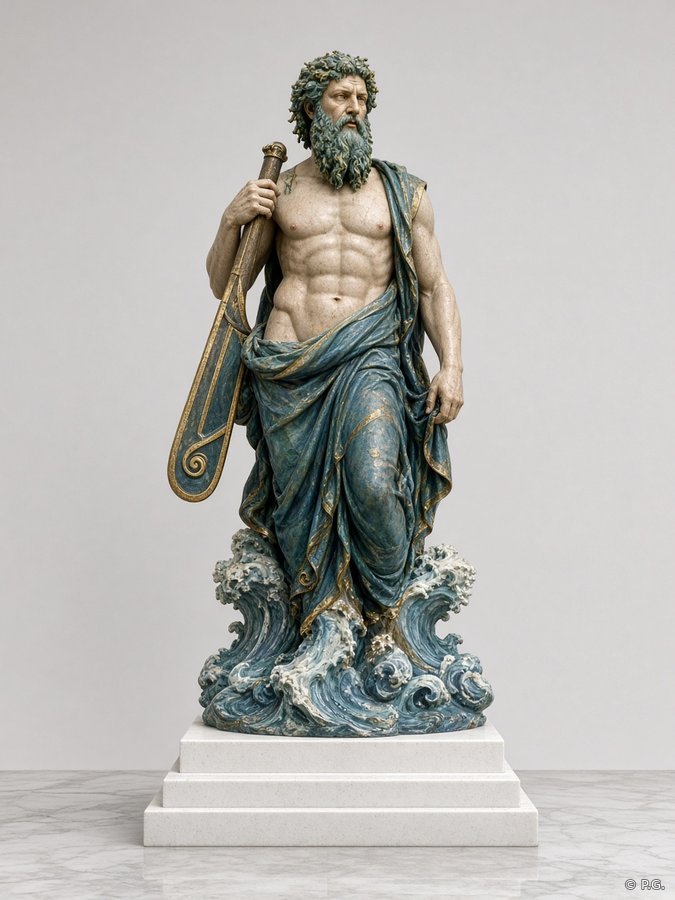
Pontos is the open sea, born before the Titans and before Poseidon. Gaia bore him alone, after Ouranos and the Hills: “She bare also the fruitless deep with his raging swell, Pontus, without sweet union of love” (Theogony 131–132).
Joined afterwards to Gaia, Pontos became father of the old gods of the sea: “Sea begat Nereus, the eldest of his children, who is true and lies not”, and then “great Thaumas and proud Phorcys, being mated with Earth, and fair-cheeked Ceto and Eurybia who has a heart of flint within her” (Theogony 233–239). Through them he is ancestor of the Nereids, of Iris and the Harpies, and of the Gorgons.
Epithets
- Ἀτρύγετος · Atrygetos
- fruitless, unharvested (Theogony 131, of the deep)
- Πόντος · Pontos
- the open sea
Domains and symbols
The open sea, its depth and swell. Admire: respect for powers greater than ourselves. Sacred symbols: the wave, salt water, the deep.
Myths
- Born of Gaia alone. Theogony 131–132.
- Father of Nereus. The eldest, true and gentle (Theogony 233–236).
- Father of Thaumas, Phorkys, Keto and Eurybia. By Gaia (Theogony 237–239).
- Ancestor of the Nereids. Through Nereus and Doris (Theogony 240–264).
Offerings
Pontos had no cult. Today: pour a little sea water back into the sea, or salt water on the ground, with respect.
Beneath the Divine Mind
Pontos is the Divine Mind as the deep: the boundless sea that Hesiod calls fruitless, from which come the truthful Nereus and all the gods of the waters. Like every god he stands beneath the One (The One and the Many).
Honouring Pontos today
- The sea. Stand before open water and keep silence.
- Truth. Honour Nereus, his eldest, by speaking truly.
- Reading. Read Theogony 131–132 and 233–239 aloud.
Hymn
And Sea begat Nereus, the eldest of his children, who is true and lies not: and men call him the Old Man because he is trusty and gentle.Hesiod, Theogony 233–235, tr. H. G. Evelyn-White (1914), public domain. There is no Homeric or Orphic hymn to Pontos.
Sources
Hesiod, Theogony 126–132, 233–264.
Quotations in public-domain translations (Evelyn-White 1914, Butler 1898/1900, Taylor 1792); other authors paraphrased.